
You have not yet added any article to your bookmarks!
Join 10k+ people to get notified about new posts, news and tips.
Do not worry we don't spam!
Post by : Anis Farhan
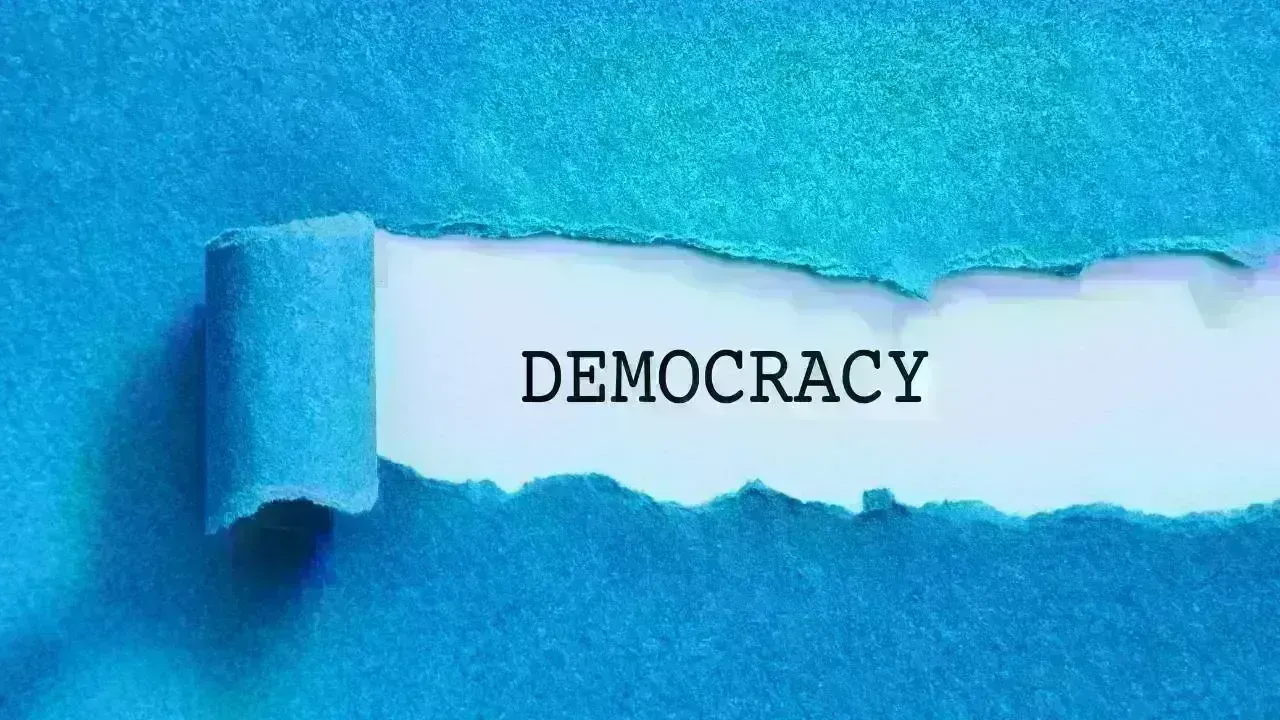
Democracy has always evolved under pressure, but 2025 feels different. It does not resemble the crises of the past where tanks rolled into capitals or dictators announced coups on radio broadcasts. This year’s threat is quieter, faster, and far more complicated. It arrives through screens, speeches, headlines, and hashtags.
Across the world, wars are dragging on, elections are approaching in politically fragile nations, and algorithms now decide what millions of people read every morning. The result is a political climate filled with distrust, fear, anger, and fatigue. Democracies are still standing — but they are shaking.
For the average citizen, it no longer feels like voting alone is enough. Public institutions appear weaker. Leaders feel more temporary. Truth feels negotiable. And digital platforms have become louder than parliaments.
2025 is not only about political decisions.
It is about whether democratic systems can survive uninterrupted crisis.
In times of war, fear becomes currency. Security outweighs liberty. Survival overrides civil debate. In 2025, wars in multiple regions have normalized emergency measures, tightened borders, and militarised politics.
During extended conflicts, governments often:
Limit public dissent in the name of security
Centralise authority for faster decision-making
Control or filter information
Reduce legislative oversight
Postpone electoral reforms
These changes are sold as temporary.
History shows they are rarely reversed fully.
When people accept limitations in the name of safety, democracy becomes conditional.
War simplifies narratives. It divides the world into “us” and “them.” It makes disagreement feel disloyal.
Public conversation shifts from policies to patriotism.
In 2025, many governments are winning support not through performance, but through fear:
Fear of invasion
Fear of instability
Fear of outsiders
Fear of economic collapse
This emotional positioning allows leaders to avoid accountability and still remain popular.
Nationalism thrives in uncertainty.
Democracy suffocates in it.
In previous decades, elections were about manifestos, debates, and governance plans. In 2025, elections are emotional battlefields.
Campaigns now:
Exploit fear narratives
Target anger
Spread exaggerated threats
Frame opponents as existential dangers
Blur reality with entertainment tactics
Voters are not engaged — they are triggered.
The modern campaign does not appeal to logic.
It aims for reaction.
Many elections worldwide are approaching under unusual conditions:
Fragile economies
Ongoing conflicts
Distrust in institutions
Social fragmentation
Online misinformation
When trust in electoral process weakens, even fair outcomes get questioned. Losing sides do not concede gracefully; they challenge legitimacy.
Results may be democratically valid yet socially rejected.
That is the deadliest form of electoral failure — not fraud, but disbelief.
Algorithms decide:
What news you see
Which opinions appear dominant
Which leaders look popular
Which issues matter most on a given day
The danger is not censorship.
The danger is curation without accountability.
Political awareness is no longer shaped by:
Journalists
News editors
Academic analysts
It is shaped by mathematics paired with profit.
Whoever masters algorithmic reach now outperforms traditional political machinery.
George Orwell imagined dictatorship with censorship.
2025 lives with distraction.
Truth requires:
Investigation
Evidence
Time
Misinformation requires:
Emotion
Speed
Sensation
In a digital system built on engagement, truth is slower and quieter. False information spreads faster because it is designed to shock.
Lies now travel worldwide before facts tie their shoes.
By the time truth arrives, opinions are hardened.
Elections are now decided during misinformation, not after clarification.
Military invasions used to be physical. Today, influence is digital.
Nations no longer destabilize each other only through force. They do it through:
Online disinformation campaigns
Political propaganda
Social media manipulation
Economic pressure narratives
Psychological operations
A country does not need to attack borders.
It only needs to influence voters.
2025 is filled with elections happening under digital siege.
People are tired.
They have endured:
Pandemic stress
Currency instability
Inflation pressure
Job insecurity
Rising living costs
Geopolitical chaos
Exhausted citizens do not verify facts.
They respond emotionally.
They swing politically.
When people feel unheard for long enough, they stop listening altogether.
A tired population is dangerous for democracy.
A hopeless population is fatal.
Politics today is not governed.
It is performed.
Leaders don’t argue — they go viral.
Statements are written for effect, not policy.
Cameras follow emotion, not legislation.
Decision-making has shifted from parliament floors to news feeds.
Popularity outruns competence.
Visibility defeats capability.
That is the entertainment trap of democracy.
A generation raised inside financial crises, climate disasters, and political instability struggles to trust authority.
Young voters see:
Leaders failing on climate
Housing becoming unattainable
Education becoming expensive
Jobs becoming uncertain
Systems favoring the wealthy
When promise fails repeatedly, belief disappears.
Many young people now vote with cynicism, not hope.
Democracy requires belief.
Cynicism kills participation.
Fear is the oldest political tool.
But in 2025, it is optimized.
Fear today is:
Delivered quickly
Amplified algorithmically
Reinforced socially
Spread across platforms
Fueled constantly
Fear keeps populations obedient.
Fear discourages scrutiny.
Fear produces loyalty.
But fear destroys freedom.
Journalism was once the backbone of democracy.
Now it fights:
Click-driven economics
Political pressure
Algorithmic invisibility
Trust decline
Legal threats
Sensationalism outperforms accuracy.
Truth loses to convenience.
Freedom of press remains in law — but not in impact.
When journalism weakens, democracy walks alone.
In 2025:
Leaders are defended, not evaluated
Parties are worshipped, not questioned
Loyalty matters more than ethics
Identity overrides evidence
People no longer ask:
“Is my leader right?”
They ask:
“Is my leader winning?”
This is not democracy.
It is fandom.
Perception is built months in advance:
Poll manipulation
Media framing
Narrative saturation
Emotional engineering
By the time citizens go to vote, their ideas have already been influenced.
The vote is real.
The choice was constructed.
Democracy is not dead.
It is bleeding.
Recovery requires:
Media reform
Digital accountability
Transparent funding
Civic education
Algorithm regulation
Institutional rebuilding
Democracy cannot survive if it is treated like tradition.
It must be defended like infrastructure.
Being a voter is not enough.
People must learn:
How propaganda works
How algorithms manipulate
How political language shapes perception
How opinion is engineered
How to verify facts
Educated voters are harder to control.
Ignorant voters are easy to mobilize.
Democracy erodes when:
Corruption is normalized
Accountability disappears
Inequality rises
Institutions weaken
Free speech shrinks
Courts lose independence
Governments cannot cry patriotism while selling democracy quietly.
“It doesn’t matter who wins.”
That sentence is the end of democracy.
When people believe their voice is worthless, they stop using it.
Silence becomes surrender.
It needs:
Free media
Honest courts
Independent institutions
Active citizens
Ethical leadership
Ballots without systems are decoration.
Democracy without integrity is performance.
Digital platforms have more power than:
Political parties
Governments
Media houses
Their role in shaping thought is unprecedented.
Regulating them is not censorship.
It is survival.
War tests nations.
Elections test trust.
Algorithms test truth.
2025 tests all three at once.
Democracy is no longer under attack from guns alone.
It is under pressure from screens.
The fight is no longer just political.
It is psychological.
And the battlefield is every device in every hand.
The future of democracy will not be decided by speeches.
It will be decided by citizens who choose:
To think.
To question.
To remain alert.
To refuse easy lies.
To defend nuance.
To vote consciously.
The system still exists.
But it is asking something now.
Not loyalty.
Courage.
Disclaimer:
This article is an analytical perspective based on global political trends and public information. It does not represent any political affiliation or recommendation. Readers should consult diverse sources and expert commentary to form their own opinions.



Beauden Barrett Opens Up About Mental Struggles During All Blacks Exile
Beauden Barrett discusses his confidence struggles after missing six tests, his return against Austr
IMF Says AI Investment Supports Global Growth Despite Energy Shock
IMF says AI investment is supporting global growth near 3%, with Asian economies benefiting from ris

Will O'Rourke Ruled Out of New Zealand's India Series
New Zealand fast bowler Will O'Rourke will miss the India series with hamstring and calf injuries as

AI Companies Expected to Drive Most US Earnings Growth in Q3
AI companies are expected to drive US third-quarter earnings growth as investors assess tech profits

Money Market Funds See Record Inflows as Global Bond Selloff Intensifies
Global money market funds attract $153.81 billion as bond yields rise, inflation fears persist and i

Meta Bans TikTok Ads on Facebook and Instagram in Seven Countries
Meta has banned TikTok ads in seven countries, escalating competition over social media users, adver

