
You have not yet added any article to your bookmarks!
Join 10k+ people to get notified about new posts, news and tips.
Do not worry we don't spam!
Post by : Anis Farhan
After nearly two decades of negotiations, India and the European Union (EU) have reached a historic milestone with the conclusion of a comprehensive Free Trade Agreement (FTA) at the 16th India-EU Summit on 27 January 2026. This landmark pact, widely described by officials as the “mother of all trade deals,” represents a significant breakthrough in bilateral relations, with far-reaching implications for commerce, investment, strategic cooperation and geopolitical alignment.
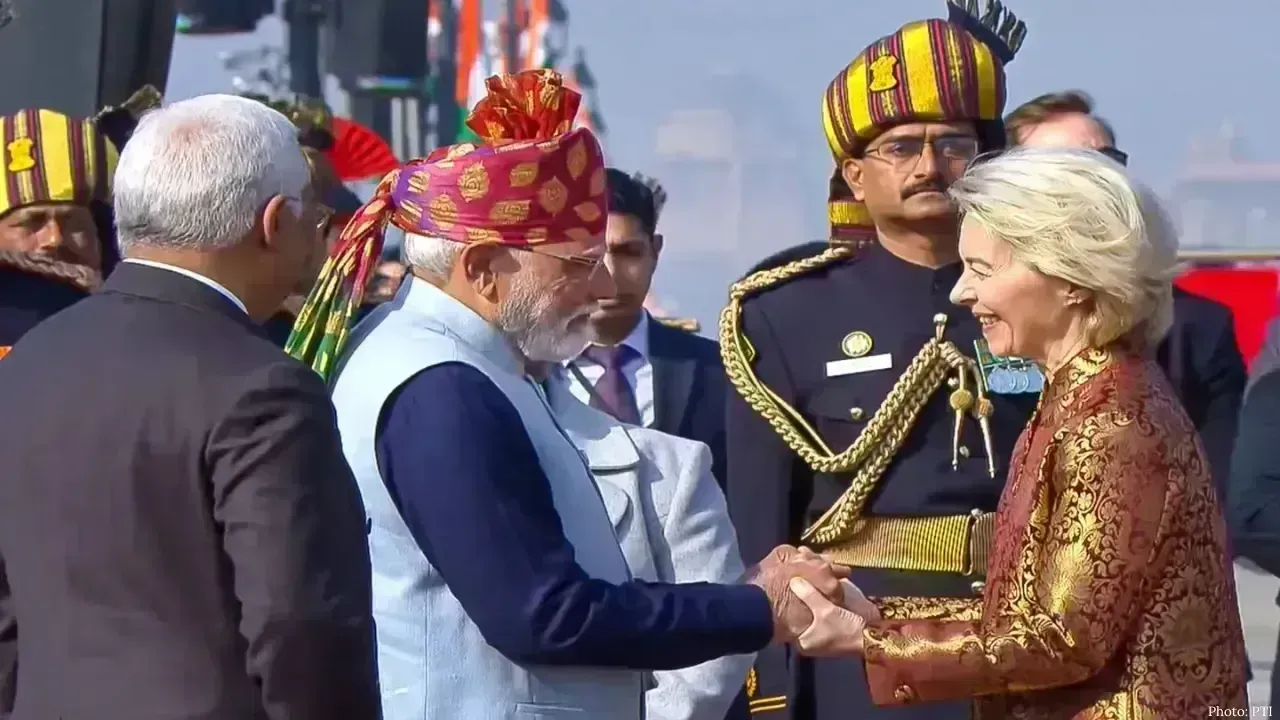
The summit, co-chaired by Prime Minister Narendra Modi, European Commission President Ursula von der Leyen, and European Council President Antonio Costa, took place in New Delhi against a backdrop of strengthened ties — highlighted by high-level participation in India’s 77th Republic Day celebrations just a day earlier.
Here is a detailed examination of what the summit accomplishes, the key provisions of the deal, how markets and industries reacted, and its broader strategic context.
India’s bilateral relationship with the European Union rests on decades of diplomatic and economic cooperation. While negotiations for a free trade agreement date back to 2007, progress was intermittent for many years, with renewed momentum only emerging in the early 2020s.
By 2024–25, total India-EU merchandise trade reached approximately $136.5 billion, making the EU India’s largest trading partner in goods. Exports from India — which include textiles, chemicals, machinery and services — have shown significant growth, while EU exports to India encompass machinery, transport equipment, chemicals and other industrial goods.
Beyond trade, both sides have expanded cooperation across multiple domains, including climate action, technology and innovation, and defence, culminating in a new Strategic EU-India Agenda aimed at fostering deeper ties.
Ratcheting up nearly 20 years of discussions, India and the EU finally concluded comprehensive FTA negotiations, with officials signalling a formal announcement at the India-EU Summit on 27 January 2026.
Described as “balanced and forward-looking,” the agreement is expected to cover trade in goods, services and investment, alongside commitments to reduce tariffs on a wide array of products and create preferential market access for exporters on both sides.
One of the most pivotal elements of the FTA is the substantial reduction of import duties. India has indicated it will significantly cut tariffs on many EU imports, while the EU is expected to offer duty-free or preferential access to Indian goods — particularly in labour-intensive sectors such as textiles, leather, footwear, gems and jewellery, and electrical machinery.
Current EU tariffs on Indian goods average around 3.8 per cent, but can reach about 10 per cent for certain labour-intensive categories. India’s weighted average tariff on EU imports is roughly 9.3 per cent, with much higher levies in sectors like automobiles and plastics. The FTA aims to reduce these barriers, unleashing export potential in both directions.
In a concrete example, tariffs on EU car imports — currently between 70–110 per cent — are likely to be cut under the agreement, with phased reductions that could ultimately reach single digits, benefiting European automakers while promising greater choice for Indian consumers.
The India-EU trade agreement is projected to deliver a tangible boost to economic activity on both sides. Early estimates from market analysts suggest Indian exports to the EU could rise by $3–5 billion in the near term, building on an existing export base of nearly $76 billion in 2024–25.
This potential expansion is especially significant for labour-intensive industries, which stand to gain from lower tariffs and streamlined regulatory barriers. Geographical diversification of export markets — particularly in the context of global protectionist pressures — could also help Indian companies mitigate risks associated with over-dependence on traditional destinations.
Investors responded positively to the trade news, with stocks of textile and seafood exporters posting sharp intraday gains as markets anticipated expanded access to European markets.
While trade dominated headlines, the India-EU Summit also emphasised strategic collaboration in security and defence, technology, clean energy transitions, mobility, connectivity and global governance. These expanded partnerships reflect mutual interests beyond commerce, positioning India and the EU as cooperative forces on the global stage.
Officials have indicated plans to elevate their strategic engagement, including the formation of a Security and Defence Partnership to explore deeper defence industry and interoperability cooperation — a significant step in geopolitical alignment.
Furthermore, the summit provided a platform for dialogues on multilateralism, climate leadership, regional stability in the Indo-Pacific and other pressing international issues that require comprehensive cooperation across continents.
The India-EU Free Trade Agreement arrives at a moment of global economic flux, marked by rising trade barriers in some major economies. European leaders have underscored that the deal sends a broader political message against tariffs and protectionism, championing open markets, rules-based trade and diversification of supply chains.
European Council President Antonio Costa highlighted that the agreement not only enhances economic ties but also demonstrates shared commitment to stability, reliability and cooperative global engagement — especially amidst surging unilateral tariff measures elsewhere.
This historic FTA also illustrates India’s broader strategy to diversify its trade relationships beyond traditional partners. In recent years, New Delhi has pursued agreements with other regions and blocs, while balancing geopolitical interests across major powers.
The India-EU pact — adding to deals with partners like the UK, Oman and New Zealand — underscores the country’s determination to integrate more deeply into global trade, reduce reliance on single markets, and secure robust access to European capital, technology and investment.
Although negotiations are concluded and the agreement has been announced, it will still undergo several procedural steps before taking effect:
In India, the deal requires approval from the Union Cabinet and relevant parliamentary processes.
Within the EU, the agreement must be ratified by the European Parliament, in line with European legislative protocols.
This means that the formal signing is expected to take place later in 2026, followed by implementation phases beginning in 2027, once legal and legislative requirements are fulfilled.
Market participants reacted swiftly to trade summit developments, particularly sectors set to benefit from tariff liberalisation. Export-oriented companies — notably in textiles, shrimp and other labour-intensive categories — saw their shares rise sharply, reflecting investor optimism about near-term business prospects.
Industry associations and trade bodies also welcomed the move, highlighting the potential for deeper integration into global value chains and stronger competitiveness in European markets. Analysts noted that the deal’s balanced structure — with protections for sensitive sectors — could foster sustainable long-term growth without overwhelming domestic industries.
The India-EU Free Trade Agreement changes the contours of one of the world’s most significant economic relationships. By reducing trade barriers, promoting investment flows and deepening strategic cooperation, the pact lays a foundation for sustained economic engagement with global ramifications.
The deal’s long-term success will hinge on effective implementation, ongoing diplomatic collaboration, and adaptability to changing global economic conditions.
India and the EU — collectively encompassing nearly 20 per cent of global trade and about a quarter of the world’s population — now possess a framework for mutual prosperity that could shape economic patterns for decades.
Disclaimer:
This article is for informational purposes only and does not constitute financial, legal or policy advice. The content reflects developments and expert analysis available at the time of writing and is subject to change as formal procedures progress.










PM Modi Pays Tribute to Mahatma Gandhi, Urges People to Support Khadi
PM Modi pays tribute to Mahatma Gandhi on Gandhi Jayanti and urges citizens to support Khadi and the

Amazon Seeks to Offload $8 Billion in Nvidia Chips to Investors
Amazon plans to move $8 billion in Nvidia chips to investors, using a new financing model to strengt

Samsung Raises Galaxy S26 Prices as Memory Chip Costs Rise
Samsung raises Galaxy S26 prices in South Korea as rising memory chip costs put pressure on smartpho

Lewis Hamilton Calls Singapore Grand Prix One of F1's Toughest Races
Lewis Hamilton discusses the demanding Singapore Grand Prix and brings Plus44 and Almave to Singapor

Denmark's Pandora Opens World's Largest Jewellery Factory in Vietnam
Pandora opens its largest jewellery factory in Vietnam, expanding global production, strengthening s

Gautam Gambhir Questions Batting-Friendly Pitches After India's Record ODI Chase
Gautam Gambhir questions batting-friendly ODI pitches after India’s record chase, calling for a bett

