
You have not yet added any article to your bookmarks!
Join 10k+ people to get notified about new posts, news and tips.
Do not worry we don't spam!
Post by : Anis Farhan
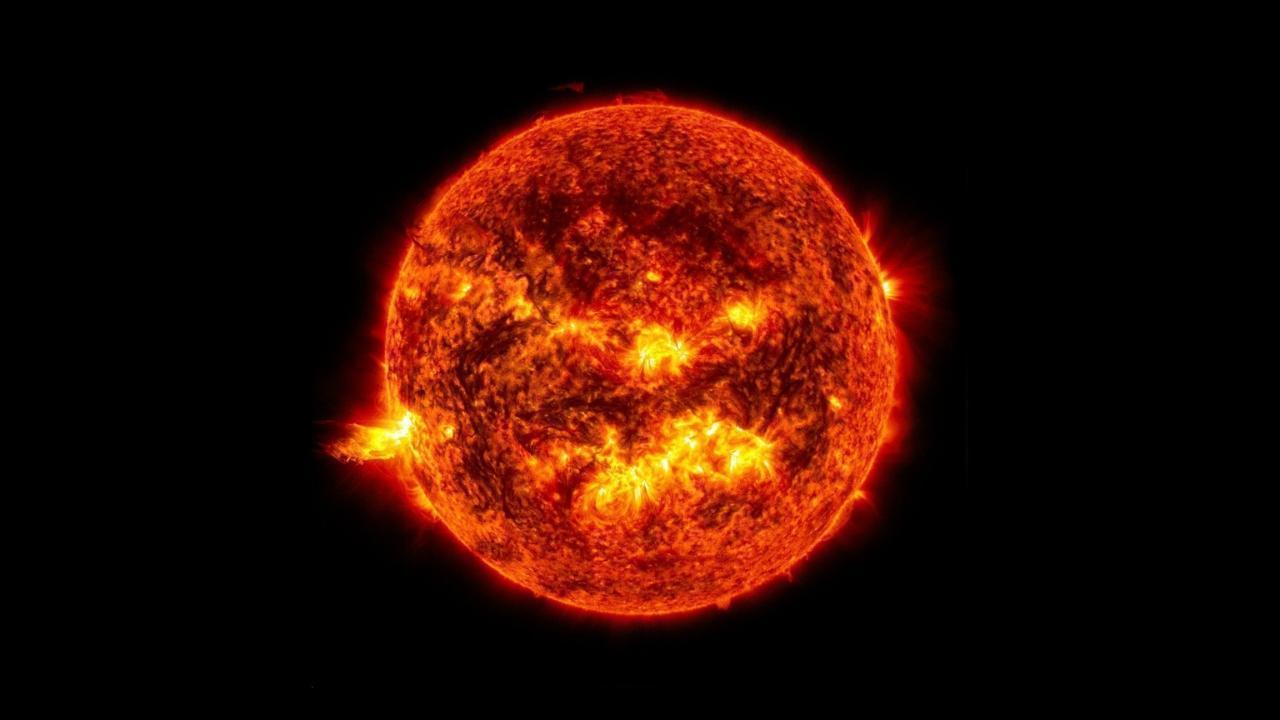
Since February 1, 2026, our star the Sun has entered a period of unusually intense activity, emitting a series of powerful solar flares — including multiple X-class events — that have captured the attention of space weather scientists and international space agencies. These flares are among the strongest observed so far this year and have led to heightened monitoring as their effects ripple through near-Earth space.
Solar flares are immense bursts of electromagnetic radiation from the Sun’s surface, caused by the sudden release of magnetic energy near sunspots — dark, volatile regions on the solar surface. They release energy across the spectrum, from X-rays to ultraviolet, and travel at the speed of light, reaching Earth’s atmosphere in roughly eight minutes. While this radiation is largely absorbed by the upper layers of the atmosphere, the effects of more powerful flares extend far beyond radiation alone, influencing space weather conditions and technological systems used by humans.
International space agencies — including ISRO (Indian Space Research Organisation), NASA, and other observatories — are closely tracking the situation as several potent flares have already been recorded. Continuous observation helps scientists forecast potential impacts, issue warnings, and mitigate risks associated with these solar eruptions.
Solar flares are sudden, intense releases of magnetic energy that occur when the magnetic fields near sunspots become twisted and unstable. The energy released can be equivalent to the detonation of millions or even billions of hydrogen bombs. They are classified by strength using a letter scale:
A, B, C-class: Minor flares
M-class: Moderate flares that can cause brief radio blackouts
X-class: Major flares capable of significant impacts on technology and space weather
The recent flare series includes multiple X-class events — among the most powerful categories — signalling a particularly active and energetic phase on the Sun’s surface.
Solar flares often occur with or near another major phenomenon: coronal mass ejections (CMEs) — vast clouds of charged particles and magnetic field structures ejected into space. While solar flare radiation reaches Earth within minutes, CMEs travel more slowly and can take one to three days to arrive at Earth’s orbit. If a CME is directed toward Earth, it can interact with the planet’s magnetic field and trigger geomagnetic storms, affecting satellites, communications systems and power grids.
In the first days of February 2026, the Sun unleashed multiple intense flares in rapid succession:
On Feb. 1, at least three strong flares were observed, including an X8.3-class flare — the strongest recorded so far this year.
A fourth flare followed on Feb. 2, reinforcing the pattern of elevated solar activity.
Additional powerful flares, including X4.2-class events, were recorded on Feb. 4, indicating that the Sun’s magnetic fields are unusually volatile.
These events originate from highly active sunspot regions on the Sun’s surface — areas of intense magnetic complexity that can trigger repeated flares. When such regions rotate into a position facing Earth, the likelihood of impactful space weather effects increases.
Space agencies worldwide have responded to this heightened activity:
India’s space agency recently warned of potential radio communication blackouts due to solar flare activity. These blackouts can affect high frequency (HF) radio signals, critical for aviation, maritime communication, and emergency systems. ISRO is also actively tracking the operational health of over 50 Indian satellites for any anomalies as a result of space weather fluctuations.
Organizations such as NOAA’s Space Weather Prediction Center (SWPC) and NASA continuously monitor the Sun using instruments like the Solar Dynamics Observatory (SDO). Their observations provide real-time data and forecasts that help scientists predict geomagnetic disturbances and issue warnings when necessary.
Space weather forecasting is a collaborative global effort involving multiple observatories and research institutions. These collaborations enable the sharing of solar observations and model predictions to better understand and respond to solar activity.
Although we are shielded from the direct radiation of solar flares by Earth’s atmosphere, the indirect effects of intense solar activity can be significant:
Powerful flares can cause HF radio blackouts, interfering with long-distance radio communication used by aviation, maritime navigation, and some emergency services. This can also affect GPS signal quality, posing challenges for precision navigation systems.
Satellite electronics and onboard systems are sensitive to energetic particles produced by solar flares and CMEs. Elevated radiation levels can lead to temporary malfunctions, sensor errors, or signal degradation. Space agencies often place satellites into protective modes during intense solar storms to limit damage.
Geomagnetic storms triggered by CMEs can induce geomagnetically induced currents (GICs) in power infrastructure, potentially stressing transformers and power grids. Modern grids incorporate safeguards, but extreme events can still pose challenges, particularly in higher-latitude regions.
When charged particles from CMEs interact with Earth’s magnetic field, they can produce spectacular visual phenomena — the aurora borealis (Northern Lights) and aurora australis (Southern Lights). Depending on the strength and direction of the CME, these light displays can sometimes be visible at lower latitudes than usual.
The Sun is currently in a phase known as solar maximum — the peak period in its roughly 11-year activity cycle, during which sunspots and solar eruptions become more frequent and intense. This phase leads to increased solar flare and CME events, raising the baseline level of space weather activity compared to quieter periods. The ongoing cycle suggests that heightened activity may continue through 2026.
Solar activity like this is not uncommon during solar maximum, but the intensity and frequency of recent flares have underscored the importance of robust space weather monitoring. Investments in predictive capabilities, satellite hardening, and international collaboration will be key to managing the risks posed by future solar events.
Advances in solar observation missions — from NASA’s existing fleet of solar monitors to planned missions such as ESA’s Vigil project which aims to forecast space weather more accurately — promise improved early warnings and better readiness for extreme solar conditions.
Disclaimer: This article is intended for informational purposes only and is based on current observations and scientific understanding. Space weather predictions evolve as new data becomes available; readers should consult official space weather agencies for updated alerts and forecasts.










PM Modi Pays Tribute to Mahatma Gandhi, Urges People to Support Khadi
PM Modi pays tribute to Mahatma Gandhi on Gandhi Jayanti and urges citizens to support Khadi and the

Amazon Seeks to Offload $8 Billion in Nvidia Chips to Investors
Amazon plans to move $8 billion in Nvidia chips to investors, using a new financing model to strengt

Samsung Raises Galaxy S26 Prices as Memory Chip Costs Rise
Samsung raises Galaxy S26 prices in South Korea as rising memory chip costs put pressure on smartpho

Lewis Hamilton Calls Singapore Grand Prix One of F1's Toughest Races
Lewis Hamilton discusses the demanding Singapore Grand Prix and brings Plus44 and Almave to Singapor

Denmark's Pandora Opens World's Largest Jewellery Factory in Vietnam
Pandora opens its largest jewellery factory in Vietnam, expanding global production, strengthening s

Gautam Gambhir Questions Batting-Friendly Pitches After India's Record ODI Chase
Gautam Gambhir questions batting-friendly ODI pitches after India’s record chase, calling for a bett

