You have not yet added any article to your bookmarks!
Join 10k+ people to get notified about new posts, news and tips.
Do not worry we don't spam!
Post by : Rameen Ariff
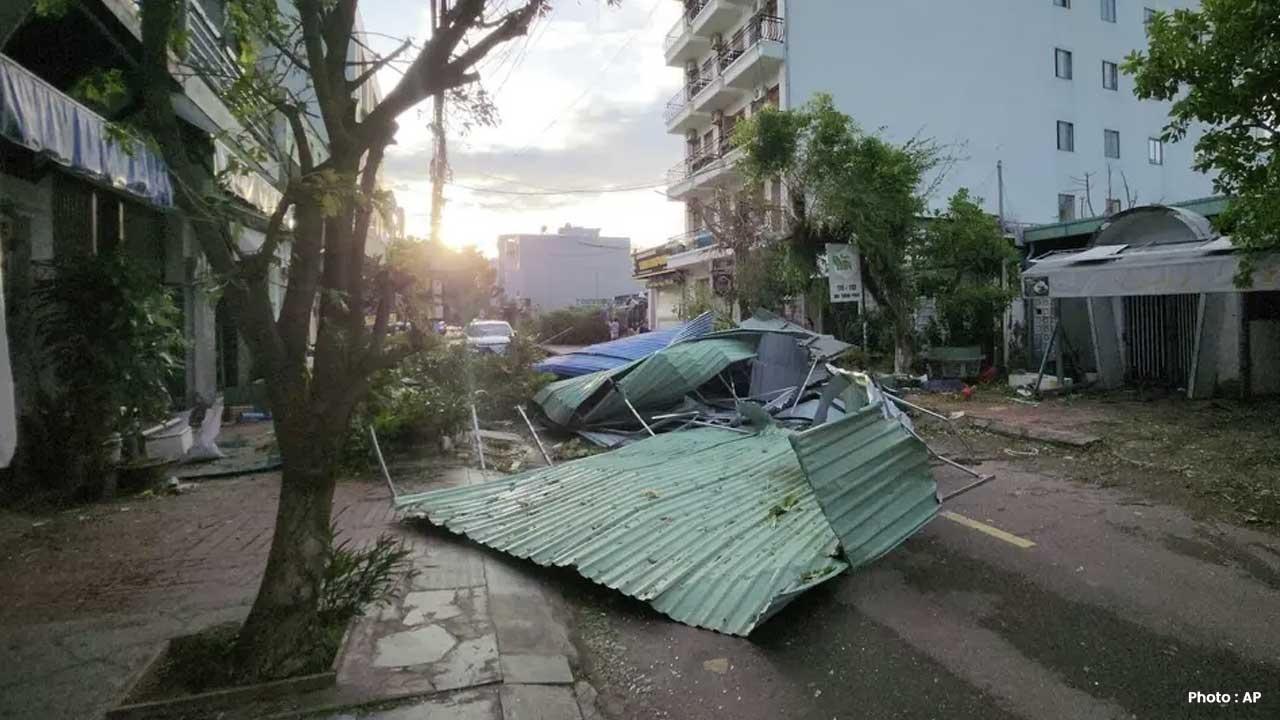
After wreaking havoc across the Philippines, Typhoon Kalmaegi unleashed its fury on central Vietnam, resulting in at least five fatalities, numerous missing, and widespread displacement. This storm, now recognized as one of the most intense in Vietnam's recorded history, significantly affected the provinces of Gia Lai and Dak Lak, where homes crumbled, trees were uprooted, and electrical lines fell.
Local authorities reported three fatalities in Dak Lak and two in Gia Lai, alongside three individuals unaccounted for in Quang Ngai province. The Ministry of Natural Resources and Environment indicated that 57 homes were destroyed, with nearly 2,600 suffering damage or losing roofs, primarily in Gia Lai.
Social media footage depicted chaotic scenes unfolding in storm-impacted areas—gale-force winds compelling residents to flee their vehicles, seawater inundating residences in Binh Dinh Province, and roofs being ripped from structures as Kalmaegi swept through. Witnesses recounted a “terrifying” ordeal with winds peaking at 149 km/h and torrents inundating neighborhoods.
As of Friday morning, teams were on the ground assessing the widespread damage. Emergency personnel were mobilized to assist trapped residents, while military units worked to clear debris and restore communication systems. Although the typhoon has dissipated into a tropical storm upon entering Cambodia, the destruction it caused remains staggering.
Earlier this week, Kalmaegi first made landfall in the Philippines, where it caused catastrophic damage—resulting in at least 188 deaths, 135 missing, and displacing over half a million individuals. The government has enacted a state of national emergency as ongoing rescue efforts contend with the looming threat of another storm, Typhoon Fung-wong, which is anticipated to make landfall soon.
Meteorologists caution that the escalating pattern of tropical cyclones in this region is associated with global climate change. Rising ocean temperatures are contributing to stronger storms and excessive rainfall, making typhoons like Kalmaegi increasingly destructive and frequent in Southeast Asia.
Experts advise nations in the region to enhance disaster preparedness systems, upgrade early warning mechanisms, and prioritize policies fostering climate resilience to safeguard vulnerable coastal populations.
While cleanup efforts continue in Vietnam and the Philippines, families grieve for their lost loved ones, reconstruct their devastated homes, and prepare for the forthcoming storms—a stark reminder of the transformation in Asia’s storm dynamics due to climate change.








Hyundai raises profit target, expands hybrid lineup in the US
Hyundai hybrid cars get a major boost as the automaker raises its profit margin target and plans new

Josh Kerr and Jakob Ingebrigtsen Set for 1,500m Rivalry Rematch
Josh Kerr and Jakob Ingebrigtsen will renew their 1,500m rivalry at the Ultimate Championship in Bud

PSG Coach Luis Enrique Urges Players to Step Outside Comfort Zone
PSG coach Luis Enrique says players must leave their comfort zone and keep improving as the club tar

China’s Tiangong Sets New 400m Record at Robot Olympics
China’s Tiangong robot sets a new 400m record at the Robot Olympics, beating a South African robot i

George Russell Wins Dutch GP Sprint, Boosts Mercedes Morale
George Russell wins the Dutch GP Sprint from pole as Mercedes teammate Kimi Antonelli extends his F1

Australia 50/3 After Bangladesh Bowled Out for 64 in Second Test
Australia reached 50/3 after Bangladesh were bowled out for 64 in the second Test, with Mitchell Sta