
You have not yet added any article to your bookmarks!
Join 10k+ people to get notified about new posts, news and tips.
Do not worry we don't spam!
Post by : Anis Farhan
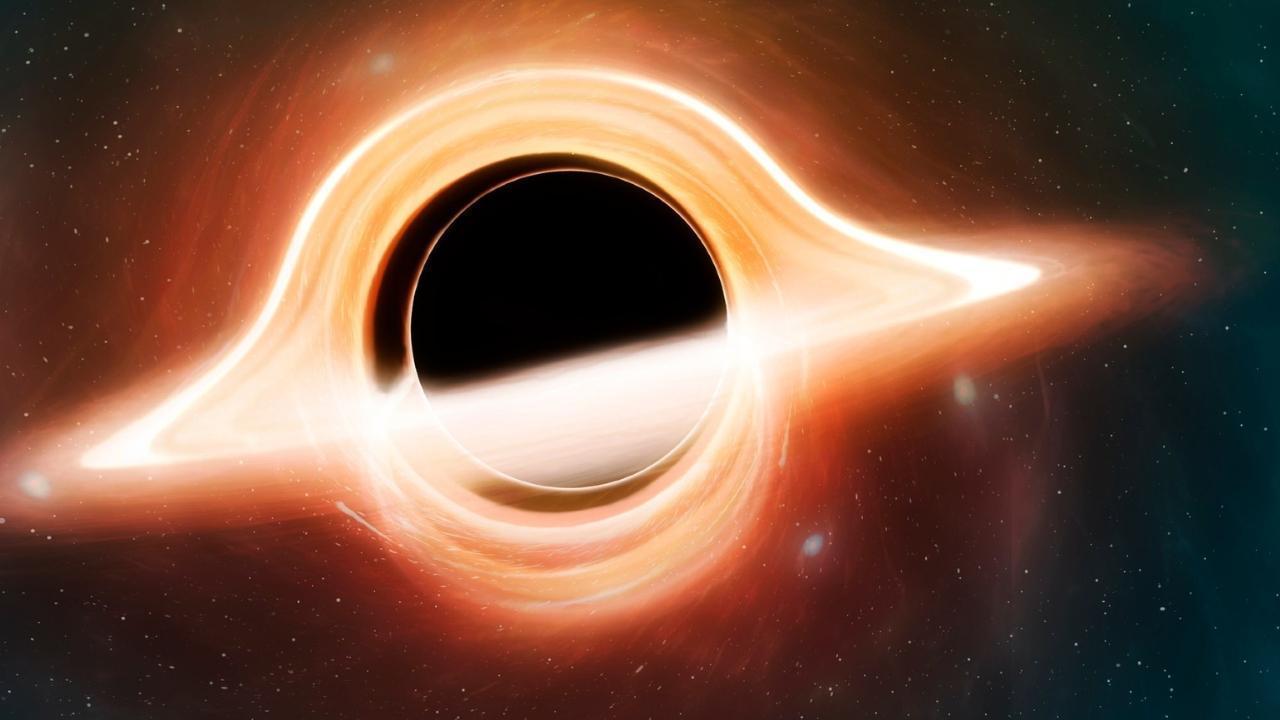
Black holes are among the most mysterious objects in the universe. They bend space and time, trap light, and challenge the very limits of human understanding. For decades, scientists believed black holes were cosmic dead ends—regions where the laws of physics simply broke down. But modern astrophysics and theoretical physics have transformed that view. Today, black holes are not just astronomical curiosities; they are laboratories for testing the deepest ideas about gravity, quantum mechanics, and the nature of reality itself.
So what really happens inside a black hole? While no human—or signal—can return from within, physics allows us to build a remarkably detailed picture of what occurs as matter crosses the point of no return and ventures into the most extreme environment known to science.
Most black holes form when a massive star reaches the end of its life. After exhausting its nuclear fuel, the star can no longer support itself against gravity. The core collapses in a fraction of a second, compressing matter to unimaginable densities. If the remaining mass is large enough, no known force can halt the collapse.
What remains is a black hole—a region of space where gravity is so strong that nothing, not even light, can escape.
Black holes are not all the same. They come in several varieties:
Stellar-mass black holes, formed from collapsing stars
Supermassive black holes, millions or billions of times heavier than the Sun, found at the centers of galaxies
Intermediate-mass black holes, still rare and under investigation
Primordial black holes, hypothetical remnants from the early universe
Despite differences in size, the internal physics of black holes follows the same fundamental rules.
The defining feature of a black hole is its event horizon. This is not a physical surface but a boundary in spacetime. Once something crosses it, escape becomes impossible—not because of a force pulling inward, but because spacetime itself curves so steeply that all possible paths lead deeper inside.
To a distant observer, an object falling toward the event horizon appears to slow down and fade, its light stretched to longer wavelengths. But for the falling object, something very different happens.
Contrary to popular belief, crossing the event horizon does not necessarily involve instant destruction. For a large black hole, tidal forces at the horizon may be weak enough that an astronaut would notice nothing unusual at the moment of crossing. No alarms, no visible barrier—just darkness ahead.
This disconnect between what an outside observer sees and what the falling observer experiences is one of the strangest consequences of Einstein’s theory of relativity.
As you fall deeper into the black hole, gravity becomes increasingly uneven. The pull on your feet becomes much stronger than the pull on your head. This difference stretches your body vertically and compresses it sideways, a process physicists call spaghettification.
In smaller black holes, this stretching would occur even before reaching the event horizon, tearing atoms apart. In supermassive black holes, spaghettification might only occur much later, closer to the center.
Eventually, the forces become so extreme that molecules, atoms, and even subatomic particles are pulled apart. At this stage, conventional concepts like solidity and structure lose meaning entirely.
At the heart of a black hole lies the singularity—a point (or possibly a region) where density becomes infinite and spacetime curvature diverges without limit. According to general relativity, all the mass of the black hole is crushed into this infinitely small location.
Here, our current understanding of physics stops working.
General relativity predicts the singularity, but it cannot describe what happens at the singularity. Quantum mechanics, on the other hand, governs the behavior of particles at extremely small scales—but it does not account for gravity in a complete way.
The singularity marks the place where these two foundational theories collide, highlighting the need for a unified theory of quantum gravity.
Inside a black hole, space and time behave in ways that defy intuition. Outside the black hole, you can choose to move forward, backward, or sideways in space. Inside, moving toward the singularity is as inevitable as moving forward in time.
In simple terms, reaching the singularity is not a choice—it is a future event.
Even light, which normally defines the ultimate speed limit of the universe, cannot avoid this fate. All possible trajectories lead inward. This is why escape is fundamentally impossible once the event horizon is crossed.
One of the biggest unresolved questions in physics is whether information that falls into a black hole is truly lost. According to quantum mechanics, information can never be destroyed. But classical black hole theory suggests that anything crossing the event horizon disappears forever.
This contradiction is known as the black hole information paradox.
Several ideas attempt to resolve this paradox:
Information may be encoded on the event horizon itself
It may slowly leak out through quantum processes
Spacetime may behave differently at the smallest scales
None of these ideas has been conclusively proven, but they are reshaping how physicists think about reality.
In the 1970s, physicists discovered that black holes are not completely black. Due to quantum effects near the event horizon, they emit a faint glow known as Hawking radiation.
Over immense timescales, this radiation causes black holes to lose mass and eventually evaporate.
For stellar or supermassive black holes, this process would take far longer than the current age of the universe. But if black holes do evaporate completely, the fate of the information they once contained becomes even more mysterious.
Some theories suggest that black holes could be gateways to other regions of spacetime—possibly even other universes. In these ideas, the singularity is replaced by a bridge or a bounce rather than a destructive endpoint.
While fascinating, such concepts remain speculative and untested.
The true nature of black hole interiors likely depends on a theory that unifies gravity with quantum mechanics. Approaches like loop quantum gravity and string theory offer glimpses of what might replace the singularity with a more complete description of spacetime.
Black holes are not just cosmic oddities. They influence galaxy formation, regulate star birth, and provide the most extreme testing grounds for the laws of physics. Understanding what happens inside them could unlock answers to questions about time, space, and the origin of the universe itself.
What really happens inside a black hole is one of the deepest questions science can ask. While we may never directly observe the interior, theory has taken us remarkably far—from the quiet crossing of the event horizon to the violent stretching of matter and the breakdown of known physics at the singularity.
Black holes remind us that the universe is stranger, more complex, and more profound than everyday experience suggests. And as science advances, these dark objects may yet illuminate the ultimate structure of reality.










PM Modi Pays Tribute to Mahatma Gandhi, Urges People to Support Khadi
PM Modi pays tribute to Mahatma Gandhi on Gandhi Jayanti and urges citizens to support Khadi and the

Amazon Seeks to Offload $8 Billion in Nvidia Chips to Investors
Amazon plans to move $8 billion in Nvidia chips to investors, using a new financing model to strengt

Samsung Raises Galaxy S26 Prices as Memory Chip Costs Rise
Samsung raises Galaxy S26 prices in South Korea as rising memory chip costs put pressure on smartpho

Lewis Hamilton Calls Singapore Grand Prix One of F1's Toughest Races
Lewis Hamilton discusses the demanding Singapore Grand Prix and brings Plus44 and Almave to Singapor

Denmark's Pandora Opens World's Largest Jewellery Factory in Vietnam
Pandora opens its largest jewellery factory in Vietnam, expanding global production, strengthening s

Gautam Gambhir Questions Batting-Friendly Pitches After India's Record ODI Chase
Gautam Gambhir questions batting-friendly ODI pitches after India’s record chase, calling for a bett

