
You have not yet added any article to your bookmarks!
Join 10k+ people to get notified about new posts, news and tips.
Do not worry we don't spam!
Post by : Anis Farhan
For most of human history, people did not think in terms of global time. Communities measured their days using the rising and setting of the sun. Noon was simply when the sun was at its highest point in the sky. This meant that every city, every town, and even every village could technically have its own “local time.” While this was sufficient for daily life in agricultural societies, it became increasingly impractical with the rise of faster travel, modern communication, and global trade.
The invention of time zones solved the chaos that resulted when local times conflicted with national schedules and international coordination. Today, time zones are so natural that we rarely question them, yet their creation reflects a fascinating blend of science, geography, politics, and compromise.
Before the concept of time zones, time was local and inconsistent. Sundials, water clocks, and later mechanical clocks marked the passage of hours, but each community relied on the sun’s position. If one town set its noon ten minutes earlier than the next, no one was troubled. Travel was slow, and communication was limited, so there was no urgency to standardize time.
The earliest move toward synchronization came with astronomy. Civilizations such as the Babylonians, Egyptians, and Greeks studied celestial patterns to create calendars and more precise divisions of the day. Yet even then, these divisions remained local and culturally specific, not global.
The need for standardized time became urgent during the Industrial Revolution. With the introduction of trains, factories, and telegraphs, local timekeeping caused confusion and even danger.
Imagine two towns only 30 kilometers apart. One town sets noon at 12:00 when the sun peaks, while the next town does the same 12 minutes later. For pedestrians and horse riders, this difference mattered little. But for trains running on strict timetables, these inconsistencies could cause missed connections, accidents, or scheduling chaos.
By the mid-19th century, railway companies in Britain and North America began imposing their own “railway times” to keep trains on schedule. This meant that large regions were forced to abandon their local solar times in favor of standardized clocks, laying the groundwork for formal time zones.
Railways were the true catalyst for time zones. In Britain, the Great Western Railway adopted “London Time” (based on Greenwich) in 1840, and other companies soon followed. By 1855, nearly all public clocks in Britain displayed Greenwich Mean Time (GMT).
In North America, the problem was even bigger. Dozens of local times clashed across vast distances. The railways initially adopted around 100 “railroad times,” but this was hardly practical. On November 18, 1883, known as the “Day of Two Noons,” American and Canadian railroads introduced a system of four standardized time zones across the continent. This shift was so successful that it set the stage for global reform.
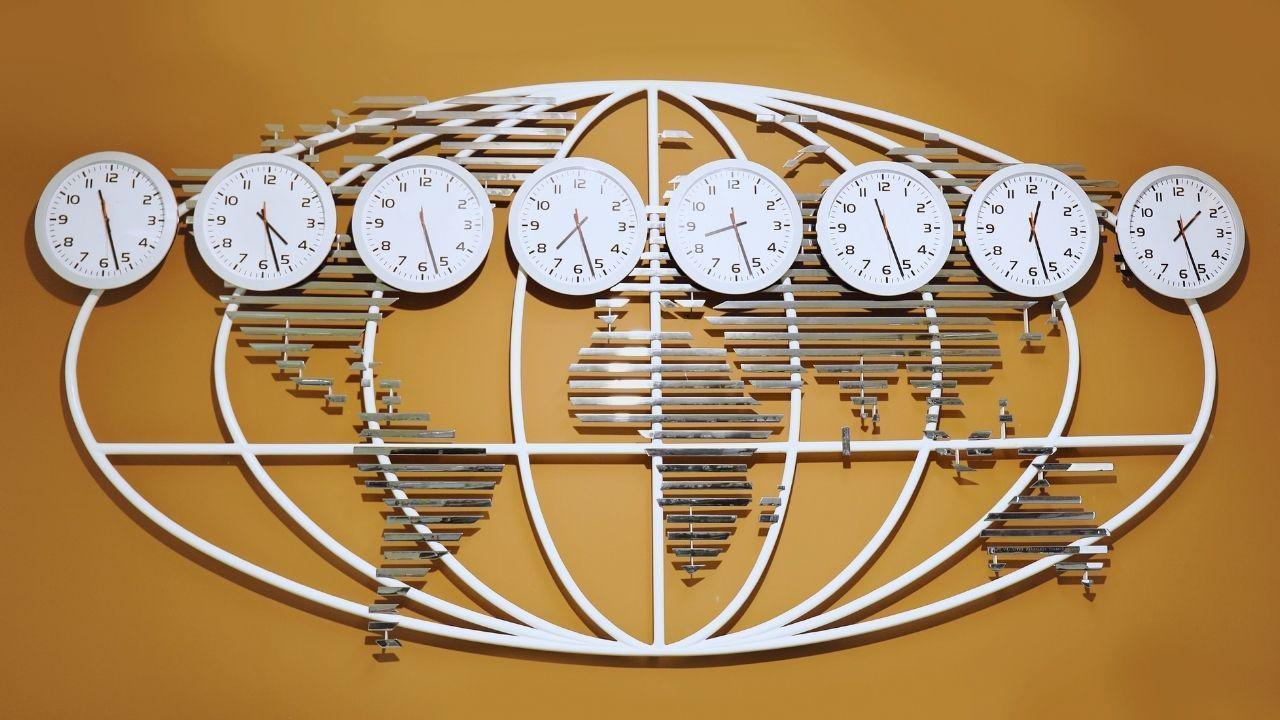
The turning point came with the International Meridian Conference held in Washington, D.C., in 1884. Representatives from 25 countries met to decide on a global standard. After much debate, they agreed to establish:
The Prime Meridian at Greenwich, England, as the zero-degree longitude line.
A system of 24 time zones, each roughly 15 degrees of longitude wide, covering the entire globe.
Universal Day Starting at Greenwich, setting midnight at Greenwich as the beginning of the day.
This agreement not only solved the issue of time coordination but also gave Britain, then a global naval power, symbolic control over the world’s clocks.
While the system was agreed upon in 1884, it took decades for time zones to be fully adopted worldwide. Some countries resisted, either out of pride, politics, or convenience. France, for example, initially refused to adopt Greenwich as the prime meridian, preferring Paris. Eventually, practicality outweighed nationalism, and Greenwich Mean Time became the global standard.
In other regions, local adaptations were made. India, for example, adopted a single standard time despite its vast size, while China famously uses just one official time zone (Beijing Time) across its enormous territory. These decisions illustrate how politics and geography influence the clock as much as science.
Once time zones were established, further adjustments followed. The concept of Daylight Saving Time (DST) emerged in the early 20th century, first proposed by Benjamin Franklin and later implemented during World War I to conserve energy. DST added another layer of complexity, shifting clocks forward or backward seasonally.
Over the years, countries have shifted their time zones for economic, political, or practical reasons. Some islands align their clocks with trade partners rather than geography. Others, like Samoa in 2011, skipped an entire day by jumping the International Date Line to improve ties with Australia and New Zealand.
Today, time zones affect everything from work hours to sports broadcasts. They determine when financial markets open and close, when planes depart and land, and even when students take online classes across borders. In a digital age, the inconvenience of multiple time zones remains evident, especially in international business.
Yet time zones also reflect cultural identity. Nations choose zones that reinforce national unity or align with political allies. In this sense, time zones are not just practical tools but also symbols of sovereignty.
One of the most striking examples of political influence over time is China. Despite spanning five geographical time zones, the entire nation officially follows Beijing Time. This creates unusual situations: in western China, the sun may rise at 10:00 AM, and people adjust their daily lives accordingly. This choice emphasizes national unity but also highlights the tension between geography and governance.
With globalization and instant communication, some argue that time zones are increasingly outdated. The internet allows us to interact across the world in real-time, raising the question of whether humanity should adopt a single universal time system. Scientists have even proposed using Coordinated Universal Time (UTC) globally, leaving local communities to adapt socially without changing the clocks.
However, the deep cultural and practical roots of time zones make such a shift unlikely. For now, people will continue navigating the complexities of different time zones, adjusting schedules for virtual meetings and international events.
Looking ahead, time zones may continue to evolve. Climate change, energy concerns, and technological innovation could lead to new debates about whether to adjust clocks or even abolish daylight saving. Advances in global positioning and atomic clocks ensure our measurement of time is more precise than ever, but the challenge remains how best to divide that time across billions of lives.
Time zones are a reminder that humanity, despite its diversity, shares a common planet and must agree on certain standards to coexist. The system of dividing the world’s clocks was born from the practical needs of trains and trade but has grown into a universal structure that underpins modern life.
Whether we are scheduling flights, trading stocks, or simply chatting with friends abroad, we rely on the invisible framework of time zones. They represent both a scientific achievement and a social contract — proof that the world can, at times, come together to solve complex problems.
This article is intended for informational purposes only and reflects the history, development, and impact of time zones. It does not provide technical or policy recommendations.










Starc Compares Australia's Tough Year to McIlroy's Major Sweep
Mitchell Starc says Australia winning three away Test series and the World Cup would match Rory McIl

France’s Sesterce Plans $11 Billion AI Data Centre in Finland
Sesterce plans a $11 billion AI data centre in Finland, with major expansion, green energy plans and

Danaher to Launch AI-Powered Autonomous Research Lab in 2027
Danaher plans an AI research lab for 2027, combining robotics and automation to speed up drug discov

Musk Welcomes German Support for Tesla Driver Assistance Tech as EU Approval Push Continues
Elon Musk welcomes Germany's backing for Tesla FSD as the company seeks EU approval amid speed, safe

Microsoft and Nvidia CEOs to Unveil AI Laptop at San Francisco Event
Microsoft and Nvidia showcase a new AI laptop with RTX Spark chips as they push powerful local AI co

Man to face charges over perfume thefts at Changi Airport
A 47-year-old man faces charges over perfume theft at Changi Airport after six items worth nearly S$

