
You have not yet added any article to your bookmarks!
Join 10k+ people to get notified about new posts, news and tips.
Do not worry we don't spam!
Post by : Rameen Ariff
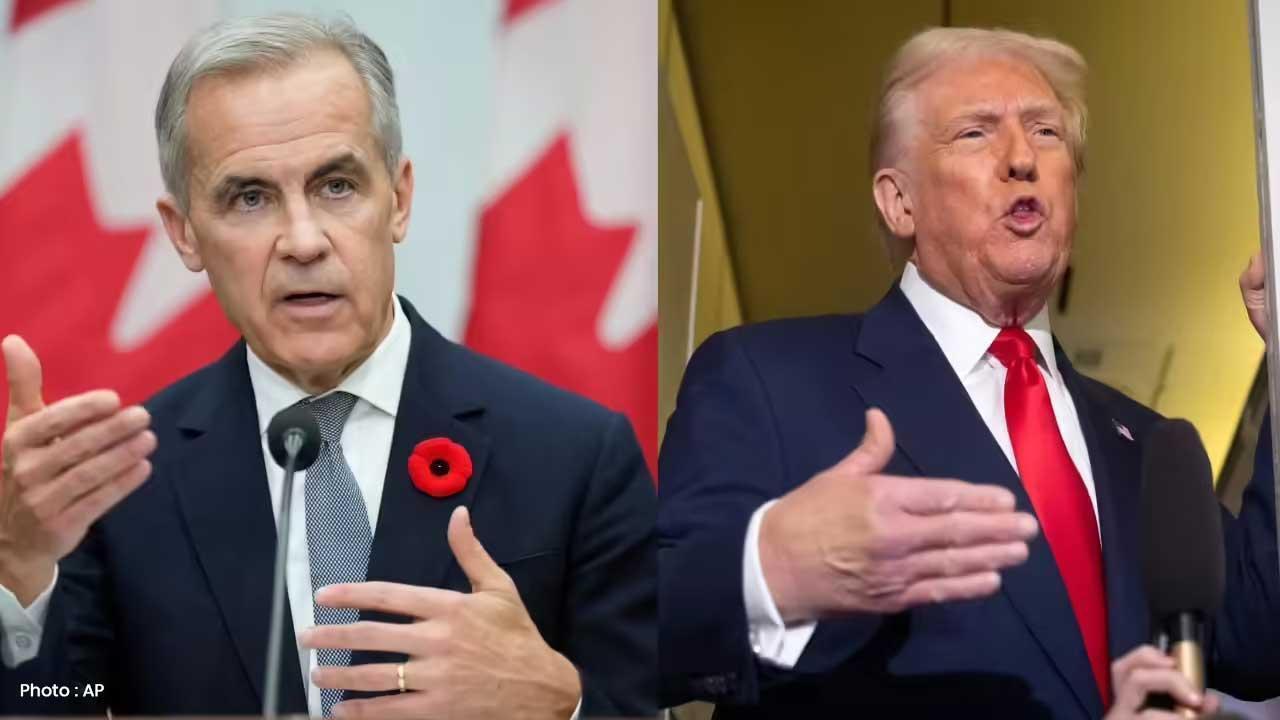
In a surprising turn in North American trade relations, Canadian Prime Minister Mark Carney publicly apologized to U.S. President Donald Trump over a controversial anti-tariff advertisement featuring former President Ronald Reagan. The apology came after the ad, launched by Ontario Premier Doug Ford, caused significant diplomatic friction and intensified trade tensions between the two countries.
The one-minute commercial used clips from Reagan’s 1987 speech, where he warned against tariffs, stating they led to trade wars, economic disasters, and widespread job losses. The ad aimed to criticize protectionist policies by highlighting Reagan’s caution against tariffs. However, Mark Carney revealed that after reviewing the commercial with Ford, he expressed reservations and did not want the ad to be aired.
"I told Ford I did not want to go forward with the ad," Carney told reporters during a press conference in Gyeongju. “I did apologize to the president. The President was offended.” Carney also hinted that trade talks between the U.S. and Canada would resume only when the U.S. was “ready.”
President Trump responded to the controversy while aboard Air Force One, calling the ad "false" and a misrepresentation of Reagan’s views. “Ronald Reagan loved tariffs,” Trump asserted, dismissing the commercial as “crooked.” The U.S. president expressed disappointment but noted his positive personal relationship with Carney, stating, “He was very nice. He apologized for what they did with the commercial.”
Trump further escalated the situation by suspending ongoing trade negotiations with Canada and imposing an additional 10 percent tariff on Canadian goods. “Because of their serious misrepresentation of the facts, and hostile act, I am increasing the Tariff on Canada by 10 percent over and above what they are paying now,” Trump declared.
The ad aired during the World Series baseball games, despite Ford’s eventual agreement to pull the campaign. Trump criticized this move, tweeting on Truth Social that he wanted the ad “taken down immediately” and condemned its airing during the popular sports event as a “fraud.”
The Reagan speech featured in the ad included powerful warnings about tariffs: “High tariffs inevitably lead to retaliation by foreign countries, and the triggering of fierce trade wars. Then the worst happens, markets shrink and collapse, businesses and industries shut down, and millions of people lose their jobs.” Reagan’s message underscored the importance of “rejecting protectionist legislation and promoting fair and free competition” to achieve prosperity.
This episode adds a complex layer to the U.S.-Canada trade relationship, highlighting how political messaging can influence international diplomacy and economic policy. The incident remains a reminder of the sensitive nature of trade discussions and the impact of media campaigns on global partnerships.







Rabada Misses First Australia Test as South Africa Pick Two Spinners
Kagiso Rabada misses the opener as South Africa vs Australia begins, with Anrich Nortje returning an

Starc Compares Australia's Tough Year to McIlroy's Major Sweep
Mitchell Starc says Australia winning three away Test series and the World Cup would match Rory McIl

France’s Sesterce Plans $11 Billion AI Data Centre in Finland
Sesterce plans a $11 billion AI data centre in Finland, with major expansion, green energy plans and

Danaher to Launch AI-Powered Autonomous Research Lab in 2027
Danaher plans an AI research lab for 2027, combining robotics and automation to speed up drug discov

Musk Welcomes German Support for Tesla Driver Assistance Tech as EU Approval Push Continues
Elon Musk welcomes Germany's backing for Tesla FSD as the company seeks EU approval amid speed, safe

Microsoft and Nvidia CEOs to Unveil AI Laptop at San Francisco Event
Microsoft and Nvidia showcase a new AI laptop with RTX Spark chips as they push powerful local AI co

