You have not yet added any article to your bookmarks!
Join 10k+ people to get notified about new posts, news and tips.
Do not worry we don't spam!
Post by : Anis Farhan
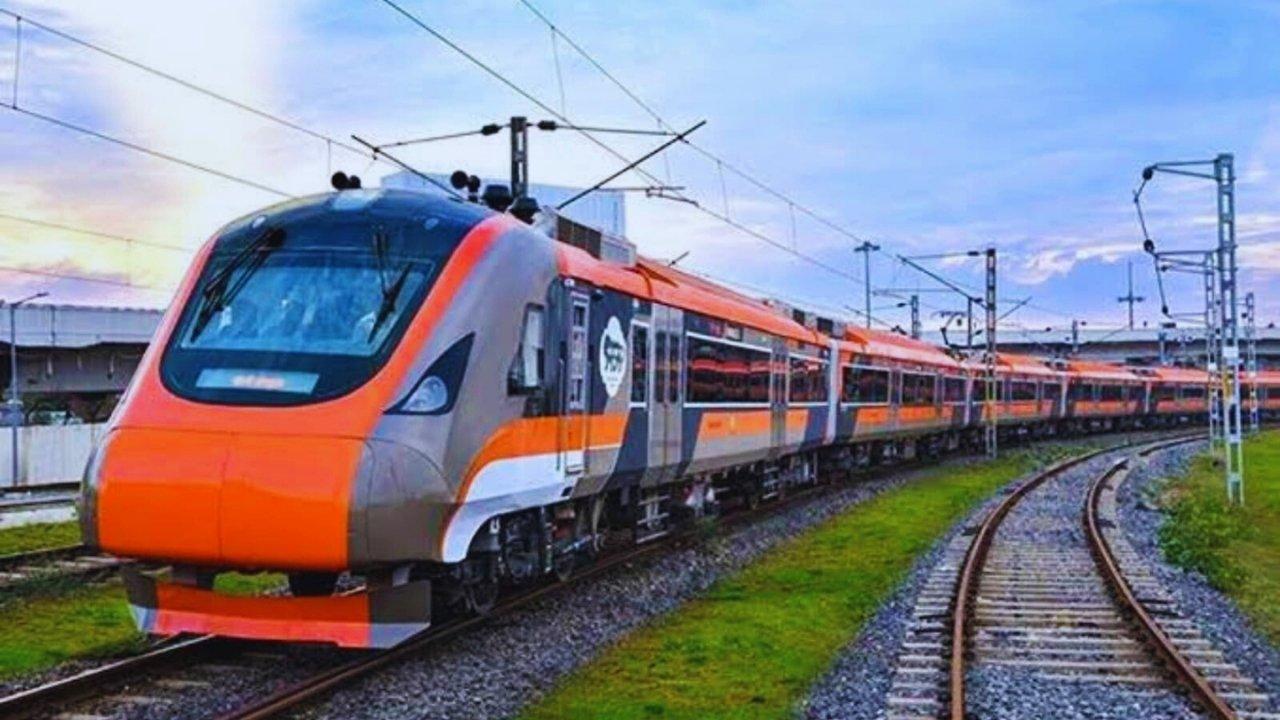
India’s journey in modernizing its railway system has reached an exciting milestone with the introduction of Namo Bharat, the country’s fastest regional train. Designed to drastically reduce travel time while enhancing passenger comfort, this semi-high-speed train symbolizes India’s determination to provide futuristic, sustainable, and efficient travel for millions of citizens. It is not just a train; it is an emblem of progress, convenience, and national ambition.
The launch of Namo Bharat marks a historic step forward, especially for regional travel, where connectivity and speed are essential. By combining cutting-edge technology with passenger-focused amenities, the train is setting new standards that rival global benchmarks.
Unlike conventional trains that often prioritize capacity over comfort, Namo Bharat has been engineered with a vision of providing a superior passenger experience. With sleek aerodynamics, luxurious seating, and advanced safety features, the train is tailor-made for modern-day travelers who value both time and quality.
The design borrows from global high-speed rail models but is adapted to India’s regional requirements, making it unique. Faster acceleration, reduced vibration, and a noise-minimized interior ensure passengers can enjoy a smooth ride, whether traveling for work, education, or leisure.
The defining feature of Namo Bharat is its unmatched speed. Built to operate at 180 km/h with potential to increase in the future, it significantly cuts down travel time between regional hubs. What once took hours can now be accomplished in less than half the time, making it a powerful tool for both daily commuters and occasional travelers.
This speed does not come at the cost of safety. The train is equipped with modern signaling systems, automatic brakes, and advanced driver assistance technology. Together, these systems ensure passenger security even at high speeds, thereby building trust in this new mode of transport.
Step inside Namo Bharat, and passengers are welcomed with interiors that resemble an airplane cabin more than a conventional train. Spacious seating with extra legroom, charging ports for every traveler, Wi-Fi connectivity, large windows, and ambient lighting create an atmosphere of comfort.
Accessibility has also been prioritized. Specially designed spaces for differently abled passengers, digital information displays, and easy-to-access doors make the train inclusive and user-friendly. Travelers can work on the go, relax, or simply enjoy the journey while watching the changing landscapes outside.
The vision behind Namo Bharat is not just to speed up travel but to redefine connectivity between smaller towns, cities, and metropolitan hubs. For India, where millions rely on trains every day, such a project can change the dynamics of regional movement.
By connecting people to opportunities faster, the train acts as a bridge between rural and urban centers. Students can reach universities with ease, professionals can commute comfortably to business hubs, and families can travel with convenience. It ensures regional development doesn’t lag behind urban progress.
Infrastructure projects like Namo Bharat are often measured not only by engineering feats but also by their economic contributions. Reduced travel time can boost business productivity, increase tourism, and make smaller cities more attractive to industries.
For businesses, faster connectivity means quicker access to clients, suppliers, and talent. For workers, it means more job opportunities across a wider geography without the need to relocate. The spillover effect could also boost local markets around stations, leading to new employment and better local economies.
Namo Bharat isn’t just about speed—it also addresses environmental concerns. Powered by electricity and designed for energy efficiency, it reduces dependence on fossil fuels. Compared to cars and buses, the carbon footprint per passenger is drastically lower.
Sustainability is also embedded in its operation model. Advanced braking systems regenerate energy, while the aerodynamic build reduces drag, minimizing energy consumption. In a time when climate change is a pressing concern, Namo Bharat presents a cleaner alternative for mass travel.
Globally, countries like Japan, France, and China have long dominated the high-speed rail sector. While Namo Bharat may not yet match bullet trains in terms of speed, it offers a unique blend of affordability, regional suitability, and comfort.
For India, the project is not about competing with the world’s fastest trains but about creating a system that suits its population density, geography, and economic realities. By doing so, India is carving out a space in the global rail narrative while prioritizing its citizens’ needs.
For a daily commuter, the biggest gift of Namo Bharat is time. Hours saved can be invested in work, family, or personal growth. Parents can spend more time with their children, students can dedicate more hours to studies, and professionals can achieve better work-life balance.
Such seemingly small improvements can have ripple effects across society. Reduced road traffic due to fewer cars and buses, fewer accidents, and a more relaxed travel experience could significantly improve the quality of life for many.
While Namo Bharat has started its journey on select routes, plans are already underway to expand this network across multiple states. The idea is to eventually create a web of semi-high-speed connectivity that integrates with metros, buses, and flights, creating a seamless travel ecosystem.
Future corridors will focus on high-density routes where millions travel daily. Expansion will also focus on affordability so that the train remains accessible to a wide section of the population, not just the privileged few.
Despite the excitement, the project is not without challenges. Building high-speed rail infrastructure in a country as vast and diverse as India involves land acquisition, funding, and technical hurdles. Ensuring affordability while maintaining world-class standards is another balancing act.
Yet, the government’s commitment and public enthusiasm suggest that the future of Namo Bharat is promising. Lessons learned from initial operations will help refine and perfect the system, making it a reliable backbone of regional travel.
Beyond transportation, Namo Bharat holds symbolic value. It reflects India’s determination to embrace modernity while balancing tradition and inclusivity. It shows the world that India is not just keeping pace with technological progress but is also setting benchmarks in infrastructure development.
For young Indians especially, Namo Bharat is more than just a train—it is a vision of a future where mobility is faster, greener, and better. It is a reminder that the nation is moving forward, and its people are at the center of this journey.
Namo Bharat is more than a transport project; it is a transformative experience for millions of Indians. By reducing travel time, enhancing passenger comfort, promoting sustainability, and boosting regional economies, it has the potential to reshape how India travels and connects.
As it expands, the train will not just carry passengers but also aspirations, dreams, and possibilities. With every journey, it will bring India closer together—both physically and emotionally—marking a new dawn in the story of Indian railways.
This article is a journalistic piece created for informational purposes. It reflects available details about the Namo Bharat project and its broader implications. Readers are encouraged to follow official updates for the latest information.








Starc Compares Australia's Tough Year to McIlroy's Major Sweep
Mitchell Starc says Australia winning three away Test series and the World Cup would match Rory McIl

France’s Sesterce Plans $11 Billion AI Data Centre in Finland
Sesterce plans a $11 billion AI data centre in Finland, with major expansion, green energy plans and

Danaher to Launch AI-Powered Autonomous Research Lab in 2027
Danaher plans an AI research lab for 2027, combining robotics and automation to speed up drug discov

Musk Welcomes German Support for Tesla Driver Assistance Tech as EU Approval Push Continues
Elon Musk welcomes Germany's backing for Tesla FSD as the company seeks EU approval amid speed, safe

Microsoft and Nvidia CEOs to Unveil AI Laptop at San Francisco Event
Microsoft and Nvidia showcase a new AI laptop with RTX Spark chips as they push powerful local AI co
Man to face charges over perfume thefts at Changi Airport
A 47-year-old man faces charges over perfume theft at Changi Airport after six items worth nearly S$