
You have not yet added any article to your bookmarks!
Join 10k+ people to get notified about new posts, news and tips.
Do not worry we don't spam!
Post by : Badri Ariffin
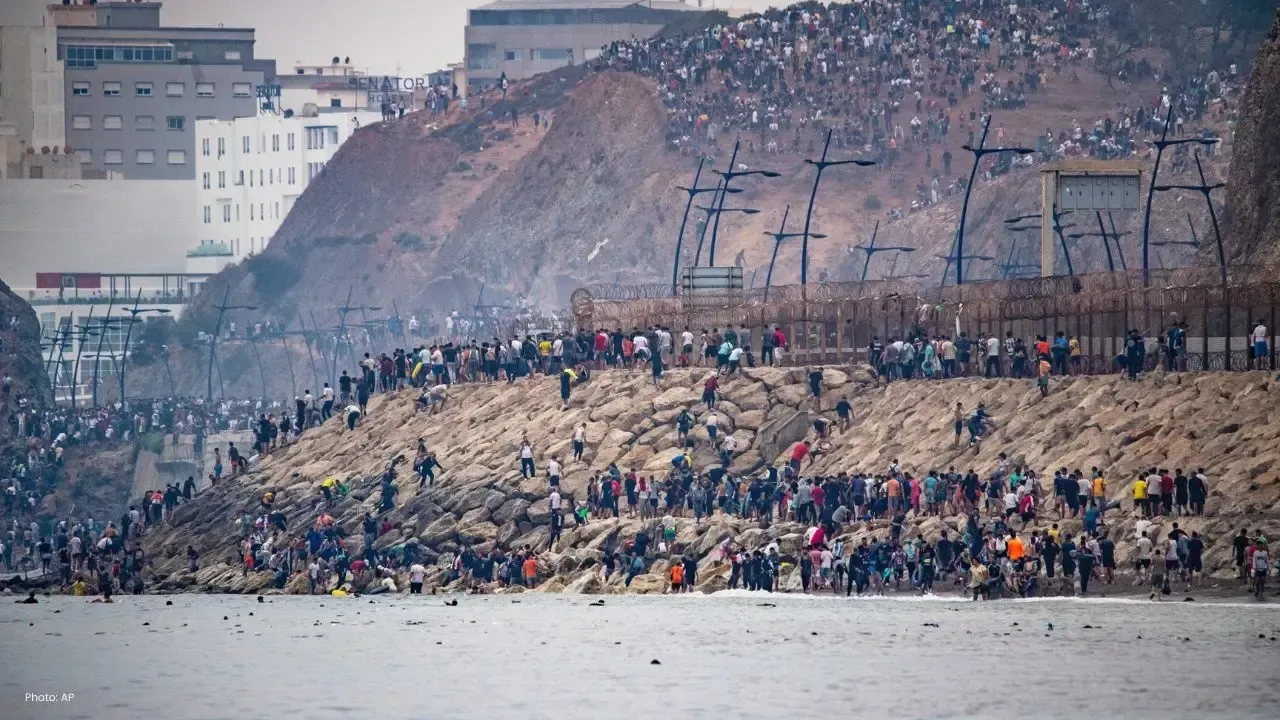
A major migrant crisis erupted in Spain’s Ceuta territory after tens of thousands of people crossed from Morocco, creating chaos in the small Spanish enclave located in North Africa. At least 57 migrants died during the dangerous journey, with many losing their lives while attempting to enter Spanish territory by sea.
According to Spanish authorities, around 50,000 migrants crossed into Ceuta from Morocco since Thursday. Ceuta’s regional president Juan Jesús Vivas estimated the number of arrivals at nearly 60,000 people, which is equivalent to around 70% of the territory’s population.
However, most migrants later returned voluntarily to Morocco after the situation became chaotic. Spain’s Interior Ministry said that more than 48,000 migrants had already returned by Friday evening, with hundreds more leaving every hour.
Many migrants attempted to reach Ceuta by swimming several kilometres through the Mediterranean waters from the Moroccan town of Fnideq. Some crossed through the sea route near Tarajal Beach, while others attempted to enter by land.
Spanish and Moroccan security forces tried to control the situation using crowd-control measures. Authorities used water cannons, tear gas and warning shots to prevent illegal crossings.
Several migrants drowned during the journey, while others died during a stampede near a border barrier at the Tarajal crossing point. Abandoned shoes, bags and other belongings were found floating in the sea after the mass crossing.
Following the sudden arrival of thousands of migrants, Spain deployed additional police and armed forces to restore order in Ceuta.
The Spanish government described the situation as a serious humanitarian and security challenge. Ceuta President Juan Jesús Vivas said the situation was “unsustainable” and called it a major crisis for the territory.
Ceuta is a small Spanish-controlled city located on the northern coast of Africa near the Strait of Gibraltar. It has remained under Spanish administration since the 16th century and shares a border with Morocco.
Spanish Prime Minister Pedro Sánchez visited Ceuta and called the border crossing a violation of Spain’s territorial integrity.
Sánchez blamed human trafficking and migrant smuggling networks, saying many young people were being misled by false promises of jobs and better opportunities in Europe.
The Spanish government also linked the sudden migrant movement to a recent Supreme Court decision related to deportation rules for migrants arriving by sea. Authorities said smugglers spread misleading information about the ruling, encouraging thousands to attempt the crossing.
Many migrants who entered Ceuta said they were hoping to find employment opportunities in Spain but decided to return after witnessing the chaos.
A 21-year-old migrant from Morocco told The Associated Press that life in his hometown offered limited opportunities and low wages, which pushed him to attempt the journey to Spain.
However, after failing to find immediate opportunities in Ceuta, he chose to return to Morocco.
The Ceuta migrant crisis has increased pressure on European countries over immigration policies.
European Commission President Ursula von der Leyen described the situation as unacceptable and called for stronger action against migrant smuggling networks.
Italy temporarily restored border checks with Spain under the Schengen agreement, while France announced plans to increase border monitoring with Spain.
The crisis has also reignited political debate over Spain’s immigration policies.
Prime Minister Pedro Sánchez’s government recently introduced measures to provide residency and work permits to hundreds of thousands of migrants already living in Spain without legal status.
Supporters argue that the policy could help Spain’s economy and address labour shortages caused by an ageing population. Critics, however, claim such measures encourage more irregular migration.
The Spanish government rejected claims that the Ceuta crisis was linked to its migration reforms.
According to Spain’s Interior Ministry, approximately 50,000 people crossed into Spain’s Ceuta territory from Morocco since Thursday (July 30) through sea and land routes. By Friday (July 31), around 30,000 migrants had already returned to Morocco, with authorities continuing the process of voluntary returns. Footage released by the ministry showed migrants crossing back into Morocco through the Tarajal border crossing. Following the massive influx, Spain and Morocco strengthened security measures and reinforced the border fence around Ceuta to control the situation.
A similar situation developed in Melilla, Spain’s other territory in North Africa, where migrants from Morocco also attempted to cross the border.
Authorities reported clashes between migrants and police near the Moroccan town of Bni Nsar, with incidents of stone throwing, damaged vehicles and arrests.
Both Ceuta and Melilla remain highly sensitive border points between Africa and Europe, as migrants often attempt to use these routes to enter the European Union.










PM Modi Pays Tribute to Mahatma Gandhi, Urges People to Support Khadi
PM Modi pays tribute to Mahatma Gandhi on Gandhi Jayanti and urges citizens to support Khadi and the

Amazon Seeks to Offload $8 Billion in Nvidia Chips to Investors
Amazon plans to move $8 billion in Nvidia chips to investors, using a new financing model to strengt

Samsung Raises Galaxy S26 Prices as Memory Chip Costs Rise
Samsung raises Galaxy S26 prices in South Korea as rising memory chip costs put pressure on smartpho

Lewis Hamilton Calls Singapore Grand Prix One of F1's Toughest Races
Lewis Hamilton discusses the demanding Singapore Grand Prix and brings Plus44 and Almave to Singapor

Denmark's Pandora Opens World's Largest Jewellery Factory in Vietnam
Pandora opens its largest jewellery factory in Vietnam, expanding global production, strengthening s

Gautam Gambhir Questions Batting-Friendly Pitches After India's Record ODI Chase
Gautam Gambhir questions batting-friendly ODI pitches after India’s record chase, calling for a bett

