You have not yet added any article to your bookmarks!
Join 10k+ people to get notified about new posts, news and tips.
Do not worry we don't spam!
Post by : Saif Rahman
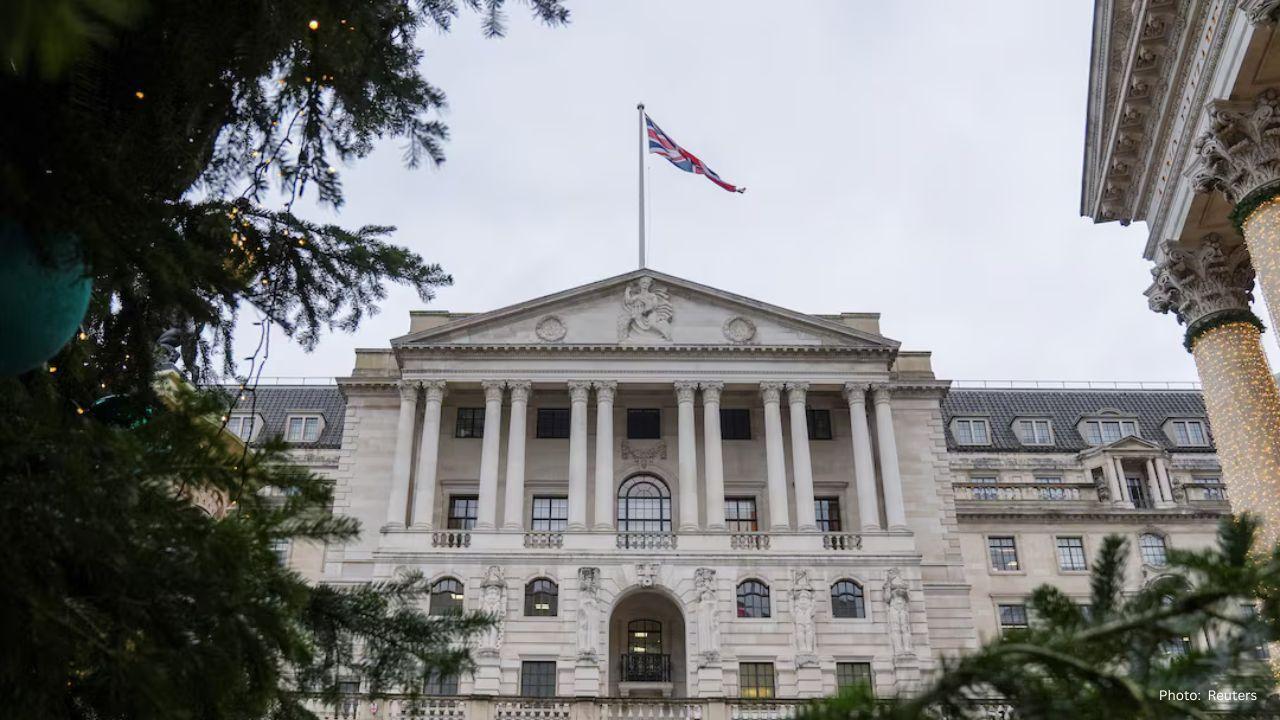
The Bank of England has issued a critical alert regarding the escalating risks to Britain's financial system, noting that 2025 has ushered in greater uncertainty than previously anticipated. In its latest Financial Stability Report, the central bank pointed out that various sectors of the financial market are becoming increasingly precarious, despite the resilience of banks and the low debt levels of households.
A major point of concern cited by the Bank is the rapid growth of companies associated with artificial intelligence. Globally, investors are showing heightened enthusiasm for AI, resulting in soaring share prices for numerous firms. The Bank of England remarked that these valuations are now among the most inflated since the dot-com craze in the U.S. and the peak of the financial crisis in the UK. Should the AI hype diminish abruptly, the consequences could reverberate across markets, heightening lending losses.
Moreover, the Bank has spotlighted the accumulating risks in private credit markets. A growing number of large firms are opting to borrow from private lenders rather than traditional banks, often incurring heightened risks. Recent collapses of U.S. companies like First Brands and Tricolor suggest potential vulnerabilities ahead. The Bank of England intends to conduct a stress test imminently to gauge how robust the private credit market is under financial duress.
The central bank also raised alarms regarding the government bond market, particularly the gilt repo sector. Hedge funds have secured almost £100 billion through leveraged transactions in this area, which hinge on stable borrowing arrangements. The Bank warned that any unforeseen market shock could trigger rapid unwinding of these positions, reminiscent of the bond market turmoil of 2022 following Liz Truss's budget announcement.
On a positive note, some segments have shown improvement. For instance, liability-driven investment funds are now better equipped after enhancements following the 2022 crisis. However, several non-bank financial institutions are still vulnerable to significant shocks, posing the risk of recurring crises. The Bank underscored that during past emergencies, public resources were deployed to stabilize the system, an outcome that policymakers aim to prevent in the future.
Adding to this challenging landscape is global uncertainty, with ongoing conflicts, trade tensions, and growing concerns over government debt affecting financial markets. Combined with inflated company valuations and risky lending tendencies, the Bank of England has come to the conclusion that the overall stability of the financial system has deteriorated this year.
Despite these cautions, the Bank noted that the UK banking sector remains well-capitalized and is poised to back the economy. The report emphasizes a critical message: the financial landscape is becoming increasingly intricate, necessitating heightened vigilance. With attention directed both towards the global economy and the rapidly evolving realms of AI and high-risk financial environments, the Bank of England is bracing for a year where financial disruptions are a distinct possibility.









Hyundai raises profit target, expands hybrid lineup in the US
Hyundai hybrid cars get a major boost as the automaker raises its profit margin target and plans new

Josh Kerr and Jakob Ingebrigtsen Set for 1,500m Rivalry Rematch
Josh Kerr and Jakob Ingebrigtsen will renew their 1,500m rivalry at the Ultimate Championship in Bud

PSG Coach Luis Enrique Urges Players to Step Outside Comfort Zone
PSG coach Luis Enrique says players must leave their comfort zone and keep improving as the club tar

China’s Tiangong Sets New 400m Record at Robot Olympics
China’s Tiangong robot sets a new 400m record at the Robot Olympics, beating a South African robot i

George Russell Wins Dutch GP Sprint, Boosts Mercedes Morale
George Russell wins the Dutch GP Sprint from pole as Mercedes teammate Kimi Antonelli extends his F1
Australia 50/3 After Bangladesh Bowled Out for 64 in Second Test
Australia reached 50/3 after Bangladesh were bowled out for 64 in the second Test, with Mitchell Sta