
You have not yet added any article to your bookmarks!
Join 10k+ people to get notified about new posts, news and tips.
Do not worry we don't spam!
Post by : Saif Rahman
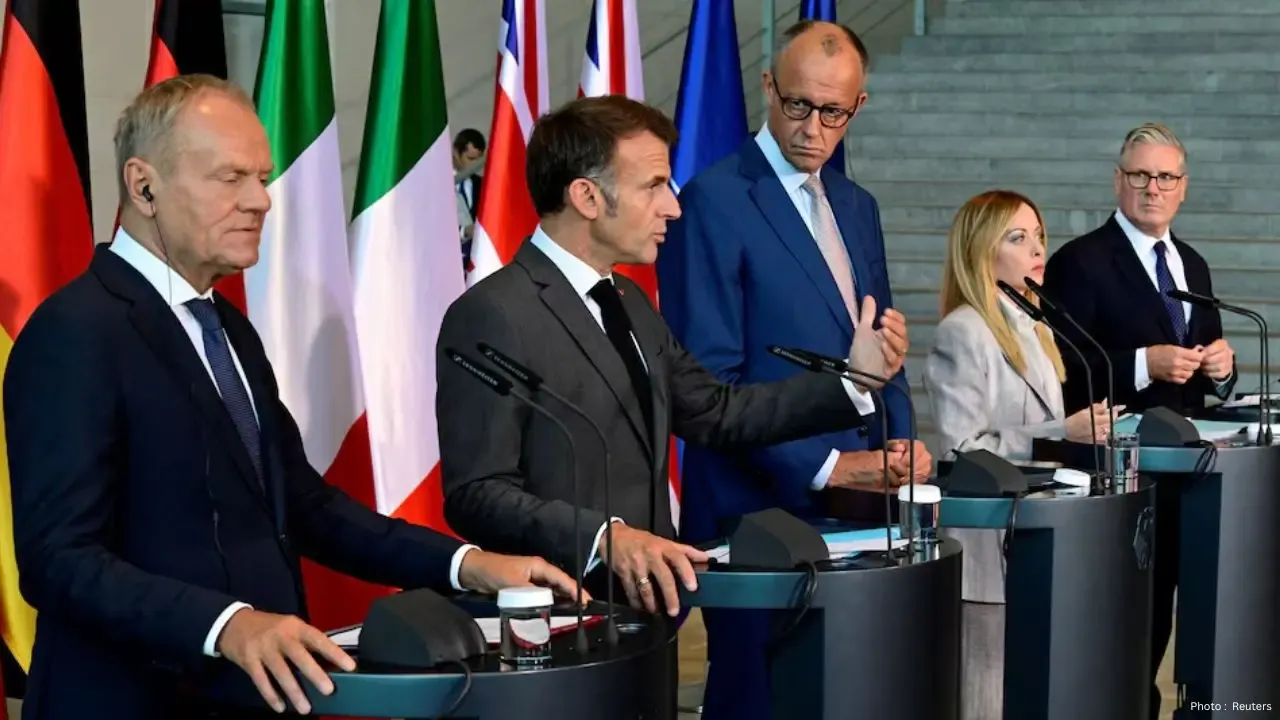
In a bid to project unity, European leaders convened in Berlin ahead of next month's NATO summit, working to alleviate recent strains with U.S. President Donald Trump. The message was clear: Europe aims to collaborate on defense initiatives, fortify its NATO involvement, and maintain a stable partnership with the United States during turbulent times.
German Chancellor Friedrich Merz welcomed leaders from the UK, France, Italy, and Poland for discussions centered on security, military collaboration, and Europe's future defense strategy. This meeting was significant given the upcoming NATO summit in Ankara on July 7-8, during which divisions among Europe’s major powers had already surfaced. Issues ranged from defense collaborations to relations with Washington to concerns that key military decisions were being made by a limited circle of nations.
Significance of the Berlin Summit
The Berlin dialogues transcended mere diplomatic engagements. They highlighted Europe's awareness of the challenges ahead, as the continent grapples with multiple pressures. Commitment to support Ukraine, uncertainty regarding America’s military future, and pressure from Trump over defense spending all cast shadows on Europe's security landscape.
Thus, the Berlin gathering was pivotal. It afforded Europe's key players an opportunity to present a united front before the NATO summit, demonstrating that internal disagreements would not undermine the alliance at this crucial juncture. Merz underscored that the Ankara summit should underline Europe's resolve to take a more assertive role in defense matters. A consensus among leaders reaffirmed their dedication to Euro-Atlantic security and transatlantic ties, indicating Europe's ongoing reliance on NATO for safety while also pursuing a larger role.
Underlying Tensions Amidst Unity
Despite the outward show of unity in Berlin, this assembly followed a series of disputes that have raised questions on Europe’s coordinated stance on security. A significant indicator of discord was the breakdown of the Franco-German Future Combat Air System project, known as FCAS. This failure highlighted the challenges European nations face in collaborating on major defense initiatives, even amid a public consensus on the necessity for enhanced military capability.
Broader political divergences over Europe's responses to conflicts beyond Ukraine have been noted. Reports indicate that tensions have also surfaced regarding Europe’s stance on the U.S.-Israeli situation with Iran, alongside U.S. frustrations with NATO allies who showed hesitance in supporting American actions in the Middle East. This dynamic adds layers of strain on an alliance already contending with adversities from Russia, budget constraints, and questions surrounding U.S. troop deployments in Europe.
Furthermore, nations feeling sidelined, such as Italy and Poland, have voiced concerns that key discussions have been dominated by Germany, France, and Britain — the so-called E3 group, particularly regarding Ukraine. This is critical since establishing a unified security framework becomes more cumbersome when some nations perceive major decisions are being dictated by a select few while others are expected to comply.
Influence of Trump on NATO Dynamics
The resurgence of Donald Trump has significantly underscored Europe's need to present a united front. With Trump’s return to the political scene, questions regarding America’s commitment to NATO have resurfaced, coupled with his persistent calls for increased defense spending by European allies and critiques of NATO's reactions in the Middle East.
This predicament has placed Europe at a crossroads—balancing reliance on U.S. military might, which has been paramount for deterrence and logistics, against acknowledging a potentially diminished American willingness to shoulder the NATO burden. Consequently, there is heightened dialogue about bolstering NATO’s European facet. Essentially, Europe seeks to enhance its defense capabilities while preserving the longstanding alliance that has safeguarded its security.
NATO Secretary General Mark Rutte has also engaged in efforts to relieve tensions ahead of the summit, emphasizing the seriousness of the current political landscape. The organization is not only responding to external military threats but also striving to uphold internal trust amid a president who openly critiques others and their financial contributions.
Europe’s Ambition for Greater Defense Autonomy
The gathering in Berlin signified Europe’s aspirations for a more prominent role in its defense strategy. The urgency stems from evolving security dynamics—Russia's aggression towards Ukraine has reshaped European thinking, resulting in increased military budgets and focus on arms production, with governments pressed to prepare for a future where stability is no longer guaranteed.
However, the gap between aspiration and implementation remains vast. Europe grapples with substantial challenges in fortifying defense collaboration, characterized by fragmented military industries, sluggish procurement practices, and national governments prioritizing domestic defense interests. These obstacles hinder the realization of collaborative defense projects and resource-sharing.
Leadership dynamics further complicate matters. Germany, France, the UK, Italy, and Poland each seek to influence Europe’s defense trajectory but are often at odds regarding priorities. Some emphasize the Eastern European front, while others focus on Mediterranean issues, the Middle East, or defense industrial strategies. These disagreements have substantial implications for budgets and overall security planning.
NATO Summit’s Implications for European Unity
The upcoming NATO summit in Ankara is poised to serve as a critical evaluation for Europe, providing an opportunity to articulate concrete plans for increased defense budgets, enhanced military cooperation, and a delineated responsibility structure within the alliance. It will also test their capacity to navigate relations with Trump, striving to prevent the summit from devolving into disputes over defense obligations.
For Europe, the stakes are undeniably high. A divisive arrival at the summit would cement perceptions of over-reliance on the United States while struggling to establish effective self-organization. Conversely, a collective, robust message could enable them to shape the summit positively, preserving NATO's integrity and granting Europe greater influence over its strategic future.
Moreover, this summit is pivotal for Ukraine. European nations aim to convey unwavering support for Kyiv and demonstrate NATO’s political resolve to counter Russia long-term. Any indication of discord within the alliance would not go unnoticed in Moscow.
Moving Beyond Symbolic Unity
The Berlin meeting, while significant, should not mark the conclusion of the discussion. European leaders are proficient in articulating unity as summits approach, yet the true challenge lies in transforming rhetoric into a lasting defense strategy that persists beyond public declarations.
This entails resolving the disputes that hinder joint defense initiatives, ensuring inclusivity for nations like Italy and Poland in strategic conversations, and elevating military expenditures to build genuine capability rather than mere numbers for political optics. Crucially, it entails acknowledging that Europe’s security landscape cannot depend solely on the assumption that the United States will address every gap.
Trump’s resurgence has compelled Europe to confront this reality more directly. While it may create discomfort, it is a necessary step forward. By leveraging this moment to fortify coordination, preparation, and earnest defense cooperation, the alliance stands to emerge more robust. Conversely, if they simply proclaim unity while neglecting deeper issues, they risk experiencing similar discord with the next crisis.
Assessing Actions at the NATO Summit
European leaders have unified under the awareness that the NATO alliance is navigating a complex phase. Tensions with Donald Trump, rifts within Europe, and the ongoing conflict in Ukraine present critical challenges for the continent’s security framework. The Berlin discussions aimed to convey that Europe stands united, enhances NATO’s European foundation, and sustains the transatlantic connection.
While this message holds significance, it will count for little unless it translates into real action. Europe faces a clear challenge: to grow stronger, more organized, and self-sufficient without undermining the alliance that has been central to its security for generations. The summit in Ankara will reveal whether progress is genuinely underway or if Europe is still striving to mask profound divisions with carefully crafted language.










PM Modi Pays Tribute to Mahatma Gandhi, Urges People to Support Khadi
PM Modi pays tribute to Mahatma Gandhi on Gandhi Jayanti and urges citizens to support Khadi and the

Amazon Seeks to Offload $8 Billion in Nvidia Chips to Investors
Amazon plans to move $8 billion in Nvidia chips to investors, using a new financing model to strengt

Samsung Raises Galaxy S26 Prices as Memory Chip Costs Rise
Samsung raises Galaxy S26 prices in South Korea as rising memory chip costs put pressure on smartpho

Lewis Hamilton Calls Singapore Grand Prix One of F1's Toughest Races
Lewis Hamilton discusses the demanding Singapore Grand Prix and brings Plus44 and Almave to Singapor

Denmark's Pandora Opens World's Largest Jewellery Factory in Vietnam
Pandora opens its largest jewellery factory in Vietnam, expanding global production, strengthening s

Gautam Gambhir Questions Batting-Friendly Pitches After India's Record ODI Chase
Gautam Gambhir questions batting-friendly ODI pitches after India’s record chase, calling for a bett

