You have not yet added any article to your bookmarks!
Join 10k+ people to get notified about new posts, news and tips.
Do not worry we don't spam!
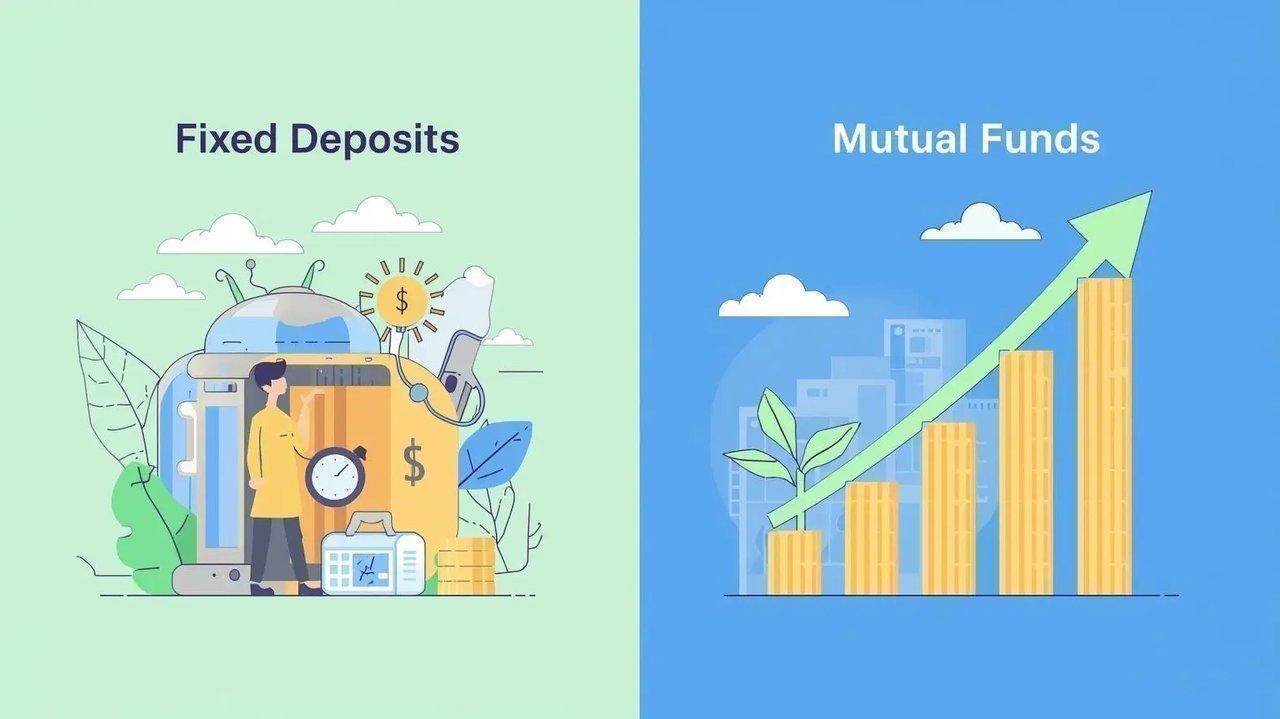
Post by : Samjeet Ariff
In times of market volatility and financial unpredictability, investors often ponder: where can my money be secure? Particularly for salaried workers, entrepreneurs, and novice investors, the choice is frequently between Fixed Deposits (FDs) and Mutual Funds. Both are well-known, widely adopted, and generally regarded as dependable, yet they fulfill distinct roles. This guide delves into the actual safety, risks, yields, and appropriateness of fixed deposits versus mutual funds in turbulent market times, enabling you to make an informed decision grounded in understanding rather than fear.
Before making a comparison, it's essential to clarify what safety represents. For various investors, safety encompasses:
No erosion of principal
Reliable returns
Immediate access to funds
For others, safety signifies:
Protection from inflation
Long-term wealth enhancement
Withstanding market fluctuations over time
Though both viewpoints hold merit, they lead to significantly different investment choices.
A Fixed Deposit is a conventional investment vehicle where you place a lump sum with a financial institution for a fixed duration at a set interest rate.
Principal protection: Your investment remains shielded from market changes.
Guaranteed yields: Interest rates are established at the outset.
Stable income: You have a clear understanding of your earnings.
Easily comprehensible: No intricate financial expertise required.
Insurance coverage: Bank deposits typically come with a safety net up to a certain limit.
These factors often lead to fixed deposits being deemed a secure option during economic uncertainty.
Despite their seemingly secure facade, fixed deposits harbor quiet risks that investors may overlook.
If inflation surpasses your FD interest rate, your funds lose effective purchasing power despite nominal growth.
Interest accrued on FDs is entirely taxable according to your income tax bracket, diminishing actual returns.
Fixed deposits seldom enable investors to accumulate substantial wealth over extended timeframes.
Upon maturity, if interest rates are lower, reinvesting your funds could yield diminished returns.
FDs safeguard capital, yet they may not consistently align with financial aspirations.
Mutual Funds gather capital from multiple investors and allocate it into stocks, bonds, or a combination of assets. Their value can change based on market dynamics, which is why they are commonly viewed as risky.
Returns linked to market performance
Daily fluctuations in NAV
Possible short-term losses during downturns
Complexity in fund selection
Yet, fear often stems from misunderstanding rather than real peril.
Not every mutual fund reacts the same way during fluctuations.
These funds invest in governmental securities and corporate bonds, typically exhibiting less volatility and often used as alternatives to FDs.
A blend of equity and debt, offering balanced risk and reward.
Though unstable in the short term, they tend to outshine inflation and fixed deposits over extended periods.
Mutual funds offer risk-adjusted safety rather than assured safety.
Fixed deposits promise almost complete capital security with regulated banks. The value of mutual funds may fluctuate, yet diversified options mitigate permanent loss risks over time.
Returns on FDs are stable. In contrast, mutual fund returns might dip temporarily but generally rebound and outperform over time.
Equity-focused mutual funds provide superior inflation-protection potential compared to FDs.
Generally, mutual funds facilitate quicker withdrawals compared to FDs, which might entail penalties for early closures.
Some mutual funds yield higher post-tax returns than FDs, particularly beneficial for long-term stakeholders.
The notion of safety is contingent on investment time frame and financial objectives.
Funds are needed within 1–3 years
Fluctuations are intolerable
Protecting emergency reserves
Prioritizing capital security over growth
Investing for 5 years or longer
Seeking inflation protection
Obtaining comfort with temporary fluctuations
Aiming for wealth accumulation over time
The primary risk is selecting the incorrect product for your intention.
Time plays a crucial role in reducing investment risk.
Equity investments in the short-term may entail risks
Long-term equity investments minimize volatility repercussions
Fixed deposits diminish in actual value over time
Especially in uncertain markets, consistent investing outweighs market-timing efforts.
Shifting funds from mutual funds to FDs during downturns locks in losses.
Concentrating all assets in FDs risks long-term wealth depreciation.
Failing to balance equity with debt increases financial strain.
Markets often react quicker than news cycles. Decisions dictated by panic can adversely affect returns.
Instead of choosing one at the expense of the other, savvy investors often integrate both.
Emergency reserves stored in fixed deposits
Short-term financial goals in debt mutual funds or shorter-term FDs
Long-term objectives directed towards equity or hybrid mutual funds
This strategy assures stability, growth, and tranquility amid uncertainty.
A higher percentage in mutual funds is sensible, given the longer timeframe.
A balanced distribution ensures growth while managing responsibilities.
Increased focus on fixed deposits to ensure capital preservation.
Safety is fluid, not fixed.
Rather than inquiring, “Which is safer?” contemplate:
What is my financial goal?
When will I require the funds?
Am I prepared for temporary fluctuations?
The correct response resides in finding harmony, not in directly comparing options.
During unpredictable market conditions, fear frequently nudges individuals back to familiarity. Fixed deposits seem secure due to their predictability, whereas mutual funds may appear risky because of their variability. True financial security derives from diversification, clarity, and patience, rather than an aversion to risk.
Making prudent choices today safeguards not only your finances but also your future lifestyle.
This article serves informational purposes only and should not be interpreted as financial or investment advice. Returns and risks fluctuate based on market circumstances, selection of funds, and individual financial situations. Readers are encouraged to consult with a qualified financial advisor before finalizing any investment decisions.










Beauden Barrett Opens Up About Mental Struggles During All Blacks Exile
Beauden Barrett discusses his confidence struggles after missing six tests, his return against Austr

IMF Says AI Investment Supports Global Growth Despite Energy Shock
IMF says AI investment is supporting global growth near 3%, with Asian economies benefiting from ris

Will O'Rourke Ruled Out of New Zealand's India Series
New Zealand fast bowler Will O'Rourke will miss the India series with hamstring and calf injuries as

AI Companies Expected to Drive Most US Earnings Growth in Q3
AI companies are expected to drive US third-quarter earnings growth as investors assess tech profits

Money Market Funds See Record Inflows as Global Bond Selloff Intensifies
Global money market funds attract $153.81 billion as bond yields rise, inflation fears persist and i

Meta Bans TikTok Ads on Facebook and Instagram in Seven Countries
Meta has banned TikTok ads in seven countries, escalating competition over social media users, adver