
You have not yet added any article to your bookmarks!
Join 10k+ people to get notified about new posts, news and tips.
Do not worry we don't spam!
Post by : Anis Farhan
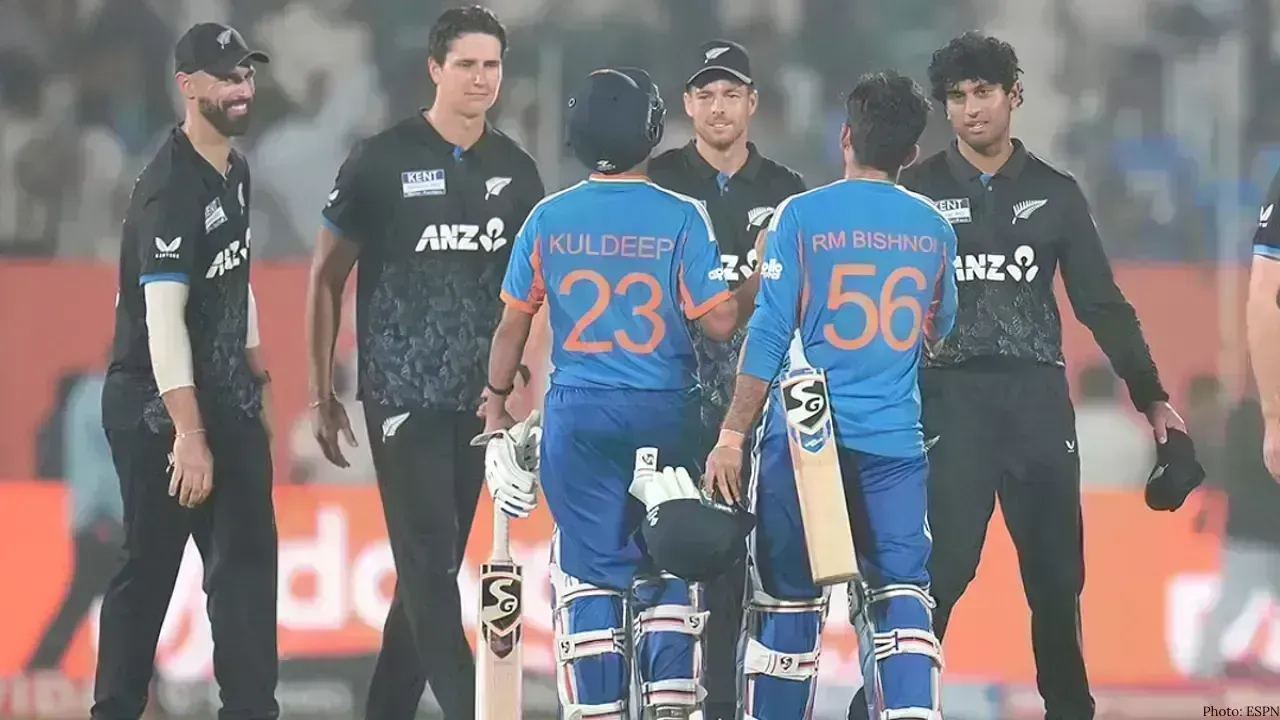
In a thrilling fourth Twenty20 International (T20I) of the New Zealand tour of India in 2026, the Black Caps delivered a resounding performance to beat India by 50 runs at the ACA-VDCA Cricket Stadium in Visakhapatnam. This defeat marked a significant moment in the five-match series, demonstrating New Zealand’s resilience despite India leading the series. Throughout the game, both teams exhibited moments of brilliance, tactical battles, and individual heroics that shaped the trajectory of the match and offered insights into the evolving dynamics of T20 international cricket.
Before the 4th T20I began, anticipation was high among fans and analysts. India, leading the series 3-0, entered the match with confidence and the possibility of securing the series early. However, New Zealand, known for their disciplined approach and strategic acumen, aimed to salvage pride and gain momentum ahead of the final match.
At the toss, India’s captain Suryakumar Yadav opted to field first, choosing to chase a target rather than set one. The decision reflected confidence in India’s batting depth and their ability to chase under pressure. However, a notable development ahead of the game was the absence of Ishan Kishan from India’s playing XI, a choice that surprised many and sparked pre-match debate.
Both teams announced their squads, with India featuring a mix of seasoned performers and explosive talent including Abhishek Sharma, Sanju Samson, Shivam Dube, Hardik Pandya, and captain Suryakumar Yadav. New Zealand, on the other hand, boasted a balanced lineup led by Mitchell Santner and featuring explosive batters like Tim Seifert and Devon Conway.
New Zealand won the toss and seized the opportunity to bat first, unleashing a powerful batting display that would set the tone for the remainder of the match. Their innings was a blend of controlled aggression and calculated risk, engineered to challenge the Indian bowling attack from the outset.
New Zealand’s innings began with Devon Conway, whose measured approach helped stabilize the opening overs and lay the foundation for a big total. Within a short span, he provided crucial runs before Tim Seifert took the mantle, launching an aggressive assault on the Indian bowlers. Seifert’s fifty-plus contribution came at an impressive strike rate, and he was ably supported by the lower order, which added valuable runs in the death overs.
By the midway point, New Zealand had built solid momentum, positioning themselves as favorites to post an intimidating total. The Kiwis’ strategy revolved around exploiting gaps in the Indian field and rotating strike while maintaining pressure on the bowlers.
In particular, Seifert’s 62 off 36 balls punctuated New Zealand’s innings with flair and authority, reflecting his ability to balance calculated risks with aggressive execution. Together with Conway’s steady contribution of 44 off 23, they formed a stable partnership that proved central to New Zealand’s dominance.
India’s bowling attack, led by Jasprit Bumrah, Kuldeep Yadav, and Arshdeep Singh, endured mixed fortunes. While the bowlers managed to secure some wickets and restrict scoring at phases, they were unable to consistently halt the momentum of New Zealand’s scoring. New Zealand capitalized during key powerplay and middle segments, rotating strike efficiently and punishing loose deliveries.
Bumrah, known for his mastery of pace and accuracy, conceded crucial runs in the death overs, while Kuldeep Yadav offered control with his wrist spin, extracting crucial breakthroughs. Despite these efforts, India found themselves unable to significantly slow New Zealand’s run-rate.
By the end of their 20 overs, New Zealand had posted a commanding total of 215 for the loss of 7 wickets — a target that would require a record chase by India to secure victory. This total was a clear testament to New Zealand’s batting depth, strategic intent, and composure under pressure.
Chasing 216, India faced a daunting task from the very first delivery. The required run-rate was steep, and the pressure of scoring at such a high pace intensified as early wickets fell.
India’s batting order went into immediate turbulence when opener Abhishek Sharma was dismissed on the very first ball of the chase, setting an ominous tone for India’s innings. The early loss applied psychological pressure, forcing India to rethink its chase strategy.
Soon after, India’s captain Suryakumar Yadav was dismissed cheaply, adding to India’s early woes. The loss of these key batters in quick succession created an uphill battle for India’s middle order, which now had to rebuild while keeping pace with the scoring demands.
Rinku Singh offered resistance and displayed aggressive intent, finding boundaries and striking at a healthy pace. His fight bolstered India’s chase, providing temporary hope. However, as the required rate continued to climb, the pressure intensified. Hardik Pandya’s contribution was short-lived as he attempted big hits but fell early, leaving India further back in the chase.
Amid mounting pressure, Shivam Dube delivered a dazzling performance that would become one of the defining narratives of the match. Dube unleashed a blistering 65 off just 23 balls, showcasing an aggressive approach that lit up the stadium and gave India fans a moment of exhilaration.
• Dube’s innings included a flurry of boundaries and towering sixes, demonstrating his power-hitting prowess. His explosive 15-ball fifty was one of the fastest seen in the series and temporarily brought India back into contention.
• His attacking approach, characterized by calculated risk and powerful execution, exemplified the aggressive spirit often required in high-pressure chases, even though it ultimately proved insufficient to bridge the large gap.
Despite Dube’s remarkable effort, India’s chase stalled as wickets continued to fall, and they were eventually bundled out for 165 in 18.4 overs — 50 runs short of the target.
Fielding and bowling performances from both sides were pivotal in shaping the match narrative:
• Mitchell Santner: The New Zealand all-rounder bowled with precision, finishing with figures of 3 for 26, and played a crucial role in applying pressure on India’s batting lineup.
• Jacob Duffy: He added to India’s challenges by dismissing key batters at crucial junctures, maintaining control and momentum in New Zealand’s favor.
• Hardik Pandya’s Fielding: India’s all-rounder stood out in the field with a memorable throw that energized the side and showcased athletic brilliance.
These moments, spread across India’s innings, reinforced how small margins and key interventions can significantly influence the outcome of high-stakes T20 encounters.
The Visakhapatnam clash revealed several strategic insights about both teams:
New Zealand displayed remarkable composure in batting and bowling. Their ability to adapt to match situations and sustain pressure throughout the match was a major reason behind their convincing win. They executed set plays effectively, rotated strike wisely, and capitalized on India’s early jitters.
India’s aggressive lineup was designed to chase even large targets, but early dismissals exposed structural vulnerabilities. While the team’s firepower remains impressive, the match underscored the importance of stability in the chase — particularly when facing high targets. Balancing aggression with strike rotation and high-pressure resilience remains a key tactical focus for India’s leadership moving forward.
The ACA-VDCA Cricket Stadium in Visakhapatnam has hosted some electrifying cricket over the years, and this match was no exception. The pitch offered good batting conditions, enabling high scoring, but also posed challenges for bowlers seeking breakthroughs.
• The batting-friendly surface rewarded aggressive stroke play while offering subtle variations that bowlers could exploit.
• Factors such as light, humidity, and pitch pace influenced tactical decisions, especially during the middle overs when bowlers looked to exert control through variations and tactical field placements.
The crowd attendance and engagement added an extra layer of intensity, with fans witnessing a dramatic contest of power hitting, disciplined bowling, and critical moments that typify modern T20 cricket.
Despite India already leading the series 3-0, this victory allowed New Zealand to assert competitiveness and close the series gap to 3-1. The win will boost Kiwi confidence heading into the final match in Thiruvananthapuram on January 31, 2026.
For India, the loss serves as a moment to evaluate bowling strategies and batting order depth when chasing mammoth targets. It offers an opportunity for reflection ahead of future contests, particularly as T20 cricket continues to evolve with dynamic game scenarios.
The 4th T20I at Visakhapatnam was a high-octane encounter that showcased the unpredictability, athleticism, and strategic depth of modern Twenty20 cricket. New Zealand’s comprehensive performance, marked by strong batting, disciplined bowling, and intelligent fielding, enabled them to overcome a formidable Indian side and secure a convincing win. Meanwhile, India’s chase — though bolstered by Dube’s explosive innings — highlighted the thin line between success and setbacks in T20 battles.
As the series progresses, the teams will look to refine tactics, harness momentum, and leverage individual brilliance to gain the edge in the ultimate contest for pride and supremacy.
Disclaimer: This article is for informational purposes only and does not constitute professional advice. Content reflects match events and analysis based on available reporting and is subject to interpretation.










PM Modi Pays Tribute to Mahatma Gandhi, Urges People to Support Khadi
PM Modi pays tribute to Mahatma Gandhi on Gandhi Jayanti and urges citizens to support Khadi and the

Amazon Seeks to Offload $8 Billion in Nvidia Chips to Investors
Amazon plans to move $8 billion in Nvidia chips to investors, using a new financing model to strengt

Samsung Raises Galaxy S26 Prices as Memory Chip Costs Rise
Samsung raises Galaxy S26 prices in South Korea as rising memory chip costs put pressure on smartpho

Lewis Hamilton Calls Singapore Grand Prix One of F1's Toughest Races
Lewis Hamilton discusses the demanding Singapore Grand Prix and brings Plus44 and Almave to Singapor

Denmark's Pandora Opens World's Largest Jewellery Factory in Vietnam
Pandora opens its largest jewellery factory in Vietnam, expanding global production, strengthening s

Gautam Gambhir Questions Batting-Friendly Pitches After India's Record ODI Chase
Gautam Gambhir questions batting-friendly ODI pitches after India’s record chase, calling for a bett

