
You have not yet added any article to your bookmarks!
Join 10k+ people to get notified about new posts, news and tips.
Do not worry we don't spam!
Post by : Saif Rahman
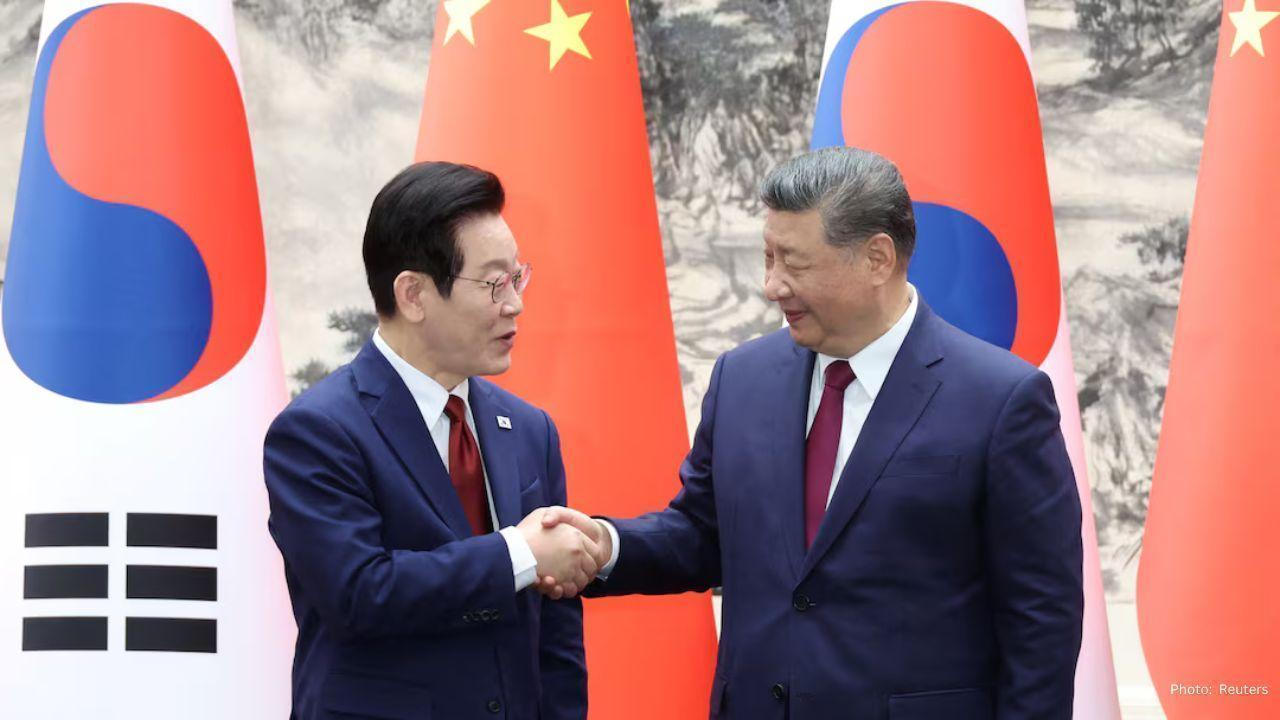
During his inaugural trip to Beijing since taking office, South Korean President Lee Jae Myung expressed his ambition to initiate a new era in relations with China, with hopes that 2026 will signify a complete rejuvenation of the partnership between the two nations.
Lee held discussions with Chinese President Xi Jinping at the Great Hall of the People, marking their second meeting in two months—a move indicative of both parties' strong commitment to enhancing collaboration, particularly in trade, tourism, and regional stability.
The summit served as a pivotal opportunity to rebuild mutual trust and foster future cooperation. President Lee emphasized the necessity for South Korea and China to establish a robust and enduring strategic partnership, which could yield benefits for both countries while contributing to peace in the region.
Xi reiterated the importance of close collaboration, underscoring the roles both countries play in safeguarding regional peace. He urged South Korea to make “correct strategic choices,” interpreted by analysts as a nudge for Seoul to consider Beijing's stance on delicate matters like Taiwan and recent U.S. actions concerning Venezuela.
The visit coincided with heightened regional tensions, as North Korea conducted its first ballistic missile launch in two months just hours prior to Lee's arrival in Beijing, with Kim Jong Un declaring the tests aimed at bolstering the nation's nuclear deterrent. Nevertheless, discussions between China and South Korea centered on cooperation and stability rather than conflict.
Economic relations formed a significant part of the agenda, resulting in the signing of 15 agreements across domains such as trade, technology, and investment. Notably, nine of these were agreements forged between companies of both nations, featuring major players like Alibaba International, Lenovo, and South Korea's Shinsegae.
Over 200 South Korean business leaders joined President Lee on this four-day journey, including top executives from Samsung Electronics, SK Group, and Hyundai Motor Group, reflecting a strong commercial interest in deepened ties with China, South Korea's primary trading ally.
President Lee pointed out the need for expanded collaboration in rapidly evolving sectors like artificial intelligence and the digital economy, also highlighting prospects in consumer goods, beauty, food, and cultural domains such as films, music, games, and sports.
Despite the optimistic outlook, challenges linger. South Korean officials noted the persistence of China's unofficial restrictions on Korean cultural content, affecting the dissemination of Korean music, dramas, and entertainment within China over recent years.
Yet, both nations exhibited a keen interest in propelling ahead. In a context of rising geopolitical tensions and unpredictable global economic conditions, President Lee's trip to Beijing signified a mutual aspiration to fortify and uplift one of Asia's key partnerships.
If the initiatives discussed during this visit come to fruition, 2026 could indeed emerge as a watershed moment for China-South Korea relations, heralding renewed cooperation and strengthened connections after a protracted period of strain.










PM Modi Pays Tribute to Mahatma Gandhi, Urges People to Support Khadi
PM Modi pays tribute to Mahatma Gandhi on Gandhi Jayanti and urges citizens to support Khadi and the

Amazon Seeks to Offload $8 Billion in Nvidia Chips to Investors
Amazon plans to move $8 billion in Nvidia chips to investors, using a new financing model to strengt

Samsung Raises Galaxy S26 Prices as Memory Chip Costs Rise
Samsung raises Galaxy S26 prices in South Korea as rising memory chip costs put pressure on smartpho

Lewis Hamilton Calls Singapore Grand Prix One of F1's Toughest Races
Lewis Hamilton discusses the demanding Singapore Grand Prix and brings Plus44 and Almave to Singapor

Denmark's Pandora Opens World's Largest Jewellery Factory in Vietnam
Pandora opens its largest jewellery factory in Vietnam, expanding global production, strengthening s

Gautam Gambhir Questions Batting-Friendly Pitches After India's Record ODI Chase
Gautam Gambhir questions batting-friendly ODI pitches after India’s record chase, calling for a bett

