You have not yet added any article to your bookmarks!
Join 10k+ people to get notified about new posts, news and tips.
Do not worry we don't spam!
Post by : Anis Farhan
Magh Bihu, also known as Bhogali Bihu, stands as one of the most deeply rooted and emotionally significant festivals of Assam. Celebrated in the heart of winter, this festival is a tribute to abundance, collective gratitude, and the timeless bond between people and the land they cultivate. More than a ritualistic observance, Magh Bihu is a lived experience—one that unfolds through food, fire, fellowship, and memory, binding generations in a shared rhythm of celebration.
Observed every year in mid-January, Magh Bihu marks the end of the harvest season. It is a moment when hard work in the fields gives way to rest, indulgence, and togetherness. Unlike festivals centered on fasting or restraint, Magh Bihu celebrates fulfillment—of granaries, of homes, and of hearts.
Magh Bihu derives its name from the Assamese month of “Magh,” which falls in January–February, while “Bhogali” comes from “bhog,” meaning enjoyment or feasting. True to its name, the festival revolves around food, prosperity, and sharing.
At its core, Magh Bihu is a thanksgiving festival. It acknowledges the generosity of nature after months of agricultural labor. Farmers, families, and communities come together to celebrate not only what has been harvested, but also the collective effort that made the harvest possible.
Assam’s fertile plains and riverine landscapes have long supported agrarian life. Rice cultivation, the backbone of the region’s economy and cuisine, shapes the cultural calendar. Magh Bihu emerged as a natural response to the completion of the harvest cycle, when barns are full and food security is assured.
Historically, this period allowed communities to pause agricultural activity and focus on social bonds. The festival grew organically from village life, unstructured by rigid rituals and instead guided by shared customs passed down orally.
What makes Magh Bihu unique is its continuity. Despite changes in lifestyle, urbanisation, and modern work patterns, the festival has retained its agrarian soul. Even today, many rituals mirror practices followed centuries ago, reflecting a rare cultural resilience.
The celebrations begin on the eve of Magh Bihu, known as Uruka. This night is the emotional centre of the festival. Villagers gather near fields, riverbanks, or open spaces to cook and eat together. Temporary huts called “Bhelaghar” are built using bamboo, hay, and leaves, symbolising simplicity and closeness to nature.
Food is prepared collectively, often outdoors, reinforcing the idea that Magh Bihu belongs to everyone, regardless of social standing.
Uruka is not just about eating. It is about conversation, laughter, folk songs, and storytelling. Elders recount memories, children run freely, and the boundaries of daily routine dissolve. The night stretches long, filled with warmth that counters the winter chill.
The morning of Magh Bihu begins with the lighting of the Meji bonfire. Built from bamboo, straw, and wood, the Meji stands tall as a symbol of purification and renewal. As flames rise, offerings are made, and prayers are whispered for prosperity, health, and harmony.
Fire holds deep symbolic meaning—it consumes the old and welcomes the new, marking the transition from one agricultural cycle to the next.
The Meji is never lit alone. It is a collective act, reinforcing unity. As the fire burns down, people gather around it, sharing food and warmth, watching embers fade into ash—a reminder of life’s cycles and impermanence.
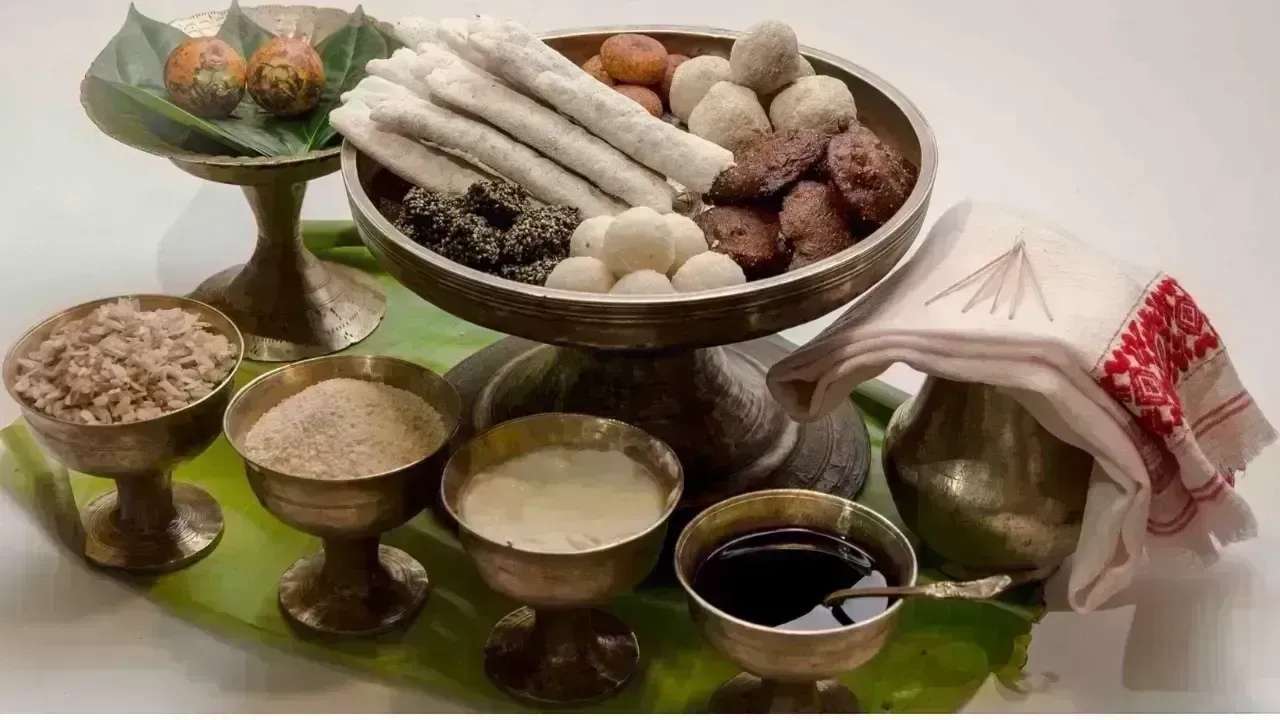
Magh Bihu is inseparable from its food. Rice, in its many forms, dominates the menu. Delicacies such as pitha, laru, chira, muri, and curd-based dishes reflect Assam’s culinary heritage. These foods are not elaborate in appearance, but rich in tradition and nourishment.
Each dish carries cultural meaning, often prepared using recipes passed down through generations.
The act of feasting during Magh Bihu is symbolic. Eating together reflects abundance and equality. No one eats alone, and food is offered freely. In many households, neighbours exchange homemade delicacies, reinforcing bonds of trust and affection.
Unlike festivals marked by elaborate temple rituals, Magh Bihu’s customs are simple and grounded. Early morning baths, offerings to fire, and shared meals form the core practices. These rituals emphasise humility and gratitude rather than spectacle.
The simplicity allows the festival to be accessible, inclusive, and deeply personal.
Underlying many Magh Bihu practices is respect—for land, for ancestors, and for communal harmony. The festival reinforces ecological awareness by acknowledging nature’s role in sustaining life, long before environmental consciousness became a global concern.
In rural Assam, Magh Bihu retains its most traditional form. Open fields, shared kitchens, and large community gatherings dominate the celebrations. Agricultural rhythms still dictate daily life, making the festival deeply relevant and emotionally charged.
In cities, Magh Bihu has adapted to modern settings. Apartment complexes organise community feasts, cultural programmes, and symbolic bonfires. While scale and setting may differ, the essence—sharing food and togetherness—remains intact.
Magh Bihu is a marker of Assamese identity. For those living outside the state, the festival becomes a powerful emotional anchor, reconnecting them with their roots. Celebrations in distant cities or countries often evoke nostalgia and pride.
The festival dissolves social hierarchies. Farmers, artisans, professionals, and elders celebrate side by side. This inclusivity reinforces social cohesion and reminds communities of shared values.
Traditional Magh Bihu celebrations are inherently sustainable. Materials used for Bhelaghar and Meji are biodegradable. Food is locally sourced. Waste is minimal. These practices reflect an intuitive understanding of ecological balance.
In recent years, there has been growing awareness about celebrating responsibly—ensuring bonfires are controlled and public spaces respected. This blend of tradition and responsibility keeps the festival relevant in changing times.
Children play a vital role in Magh Bihu. Through participation—helping cook, lighting bonfires, listening to elders—they absorb cultural knowledge naturally. This experiential learning ensures continuity beyond textbooks.
Magh Bihu proves that traditions can evolve without losing meaning. Whether celebrated in a village field or a city terrace, its soul remains unchanged—gratitude, abundance, and togetherness.
Magh Bihu is not merely a date on the calendar; it is a celebration of life after labour, warmth after cold, and community after isolation. Rooted in Assam’s agrarian heart, it transcends time and geography, carrying with it values of sharing, humility, and respect for nature.
As bonfires light the winter skies and kitchens overflow with food, Magh Bihu continues to remind people of what truly sustains society—not just harvests, but human connection. In an age of rapid change, this festival stands as a quiet yet powerful affirmation of cultural continuity and collective joy.
Disclaimer:
This article is intended for cultural and informational purposes. Customs and practices associated with Magh Bihu may vary across regions, communities, and families within Assam.










France’s Sesterce Plans $11 Billion AI Data Centre in Finland
Sesterce plans a $11 billion AI data centre in Finland, with major expansion, green energy plans and

Danaher to Launch AI-Powered Autonomous Research Lab in 2027
Danaher plans an AI research lab for 2027, combining robotics and automation to speed up drug discov

Musk Welcomes German Support for Tesla Driver Assistance Tech as EU Approval Push Continues
Elon Musk welcomes Germany's backing for Tesla FSD as the company seeks EU approval amid speed, safe

Microsoft and Nvidia CEOs to Unveil AI Laptop at San Francisco Event
Microsoft and Nvidia showcase a new AI laptop with RTX Spark chips as they push powerful local AI co

Man to face charges over perfume thefts at Changi Airport
A 47-year-old man faces charges over perfume theft at Changi Airport after six items worth nearly S$

Google Signs 3.6-GW Power Deal With Constellation Energy in US
Google signs a 3.6-GW power deal with Constellation Energy, including nuclear power upgrades to supp