You have not yet added any article to your bookmarks!
Join 10k+ people to get notified about new posts, news and tips.
Do not worry we don't spam!
Post by : Saif Rahman
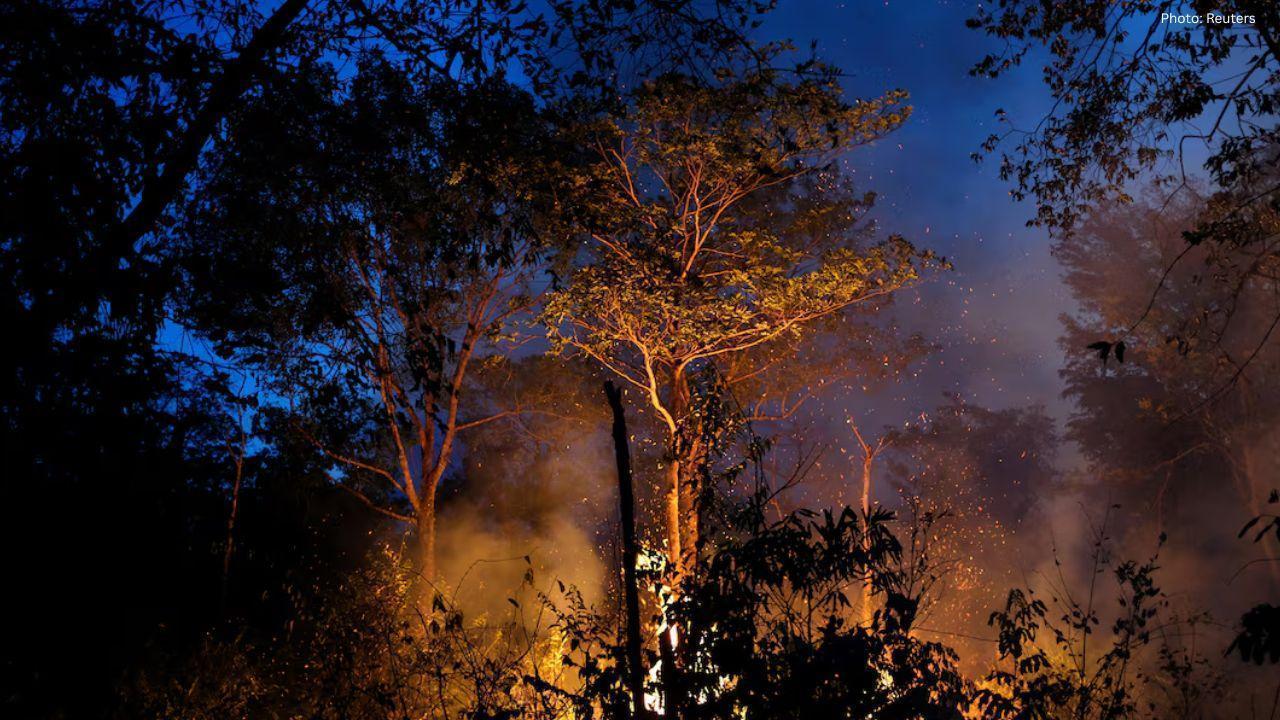
Several major soy trading corporations are contemplating a withdrawal from the Amazon Soy Moratorium in Brazil, an essential agreement that has safeguarded millions of acres of rainforest for almost two decades. Insiders informed Reuters that the companies are aiming to retain tax benefits offered in Mato Grosso, Brazil’s primary soy-producing region.
Initiated in 2006 by a coalition that includes ADM, Bunge, Cargill, Cofco, and Brazil's Amaggi, the Amazon Soy Moratorium prohibits the purchase of soy from areas deforested after July 2008. This initiative has been pivotal in decelerating deforestation rates and preserving rainforest areas equivalent to the size of Ireland.
However, a recent state law introduced in Mato Grosso, enacted in 2023, will revoke tax incentives from firms involved in the conservation initiative, effective January 2026. This regulation is perceived as a triumph for Brazil’s influential agricultural lobby, which has consistently criticized environmental regulations as impediments to market growth and profitability.
State audits reveal that soy traders have profited from tax incentives totaling around 4.7 billion reais ($840 million) from 2019 to 2024, with major beneficiaries like ADM and Bunge receiving approximately 1.5 billion reais ($269 million) each. Reports suggest that most companies may opt to exit the moratorium rather than sacrifice these financial perks.
Environmental advocates caution that withdrawing from the moratorium would represent a significant blow to Amazon preservation efforts. Cristiane Mazzetti from Greenpeace, who oversees the initiative, labeled the impending withdrawals as a “perilous precedent” during a global climate crisis. Without the moratorium in place, there could be a surge in deforestation as farmers convert land for soybean cultivation.
This shift aligns with broader environmental rollbacks within Brazil. Recently, the agricultural lobby has weakened environmental permitting laws and diminished protections for Indigenous territories. Experts are concerned that a departure from the soy moratorium could trigger further erosion of vital environmental legislation, including the country’s forestry code that curbs tree felling on extensive segments of private land in the Amazon.
The federal government under President Luiz Inacio Lula da Silva is challenging the Mato Grosso law in the courts. Andre Lima, a senior official at the Environment Ministry, cautioned that firms might withdraw from the moratorium for financial reasons should the law come into force, although companies have yet to make official announcements regarding their plans.
The potential withdrawal of these significant firms from the Amazon Soy Moratorium stresses the conflict between economic advantages and ecological preservation. Brazil, being the globe's leading soybean producer, faces international scrutiny over deforestation linked to soybean expansion. European agricultural groups have raised environmental concerns, questioning trade agreements between the European Union and South America's Mercosur alliance.
Legal disputes are in progress. Brazil’s Supreme Court has provisionally permitted the Mato Grosso law to take effect while suspending antitrust probes into the soy moratorium, leaving the future of the agreement in question. Environmental organizations continue their battle against the law, striving to maintain the pact that has contributed to saving vast rainforest areas.
The likely departure of these leading companies from the Amazon Soy Moratorium highlights the delicate balance between financial incentives and environmental stewardship. Without decisive measures, Brazil risks jeopardizing years of achievement in safeguarding the Amazon, one of the planet’s crucial ecosystems.








PSG Coach Luis Enrique Urges Players to Step Outside Comfort Zone
PSG coach Luis Enrique says players must leave their comfort zone and keep improving as the club tar

China’s Tiangong Sets New 400m Record at Robot Olympics
China’s Tiangong robot sets a new 400m record at the Robot Olympics, beating a South African robot i

George Russell Wins Dutch GP Sprint, Boosts Mercedes Morale
George Russell wins the Dutch GP Sprint from pole as Mercedes teammate Kimi Antonelli extends his F1

Australia 50/3 After Bangladesh Bowled Out for 64 in Second Test
Australia reached 50/3 after Bangladesh were bowled out for 64 in the second Test, with Mitchell Sta

Jordan Burroughs Returns to Wrestling with 2028 Olympic Dream
Jordan Burroughs returns to wrestling with Real American Freestyle as the Olympic champion eyes a po

Lamborghini Catches Fire on Singapore's ECP, Causing Heavy Traffic
A Lamborghini caught fire on Singapore's ECP, causing heavy traffic and bus delays. No injuries were