
You have not yet added any article to your bookmarks!
Join 10k+ people to get notified about new posts, news and tips.
Do not worry we don't spam!
Post by : Anis Farhan
In mid-January 2026, Earth experienced one of the most intense space weather events recorded in recent history. The Sun unleashed a massive solar radiation storm, classified as S4 (Severe) on the NOAA Space Weather Scales — a level not seen since 2003. This exceptional burst of high-energy particles, driven by intense solar activity, reached Earth’s magnetic environment and triggered widespread reactions in space systems and the upper atmosphere.
Solar radiation storms occur when the Sun emits bursts of charged particles — mainly protons — at high velocities. When these energetic particles stream toward Earth and penetrate the protective magnetic bubble around our planet, they can interact with the magnetic field and atmosphere, leading to increased radiation levels in near-space. The January 2026 storm was propelled by a powerful X-class solar flare and an associated coronal mass ejection (CME), a colossal cloud of plasma and magnetic fields thrown out by the Sun’s active surface.
This event was significant not only for its strength but also for its widespread visibility and potential impact. Space weather scientists and monitoring agencies around the world, including NOAA and ESA, have been closely tracking the storm as it evolves and interacts with Earth’s environment.
At the root of the January 2026 space weather event was a strong X1.9 solar flare emanating from an active region on the Sun’s surface. X-class flares represent the most powerful category of solar flares, capable of releasing enormous quantities of energy and propelling charged particles into space. Shortly after the flare’s eruption, a fast-moving coronal mass ejection (CME) was launched outward, carrying with it a massive cloud of solar material.
These CMEs travel through the solar system and — if directed toward Earth — can interact with our planet’s magnetic field. In this case, the CME arrived with remarkable speed, initiating intense geomagnetic activity and elevating levels of solar radiation in near-Earth space. This alignment of eruptive solar activity has created conditions ripe for a severe radiation storm.
The combination of an X-class flare and a CME is a well-known driver of major space weather events. When charged particles from a CME reach Earth’s magnetic field, they can induce disturbances in the magnetosphere — the magnetic bubble that shields our planet — leading to what scientists describe as geomagnetic storms. When these interactions are strong, they can produce striking visual phenomena and pose challenges for technological systems.
Solar radiation storms are categorised on a scale from S1 (minor) to S5 (extreme) based on the intensity of energetic particle fluxes. An S4 (Severe) rating indicates a very intense event in which high levels of radiation can affect satellites, spacecraft, and aviation operations. The current storm — rated at S4 — has reached such a level that it is considered the strongest since similar conditions occurred in 2003.
The storm’s severity is significant because it represents not just a theoretical measurement but real increases in energetic particles streaming through near-Earth space. Higher levels of radiation can have direct consequences for humans and machines beyond Earth’s atmospheric protection, particularly in low-Earth orbit or on high-latitude flight routes.
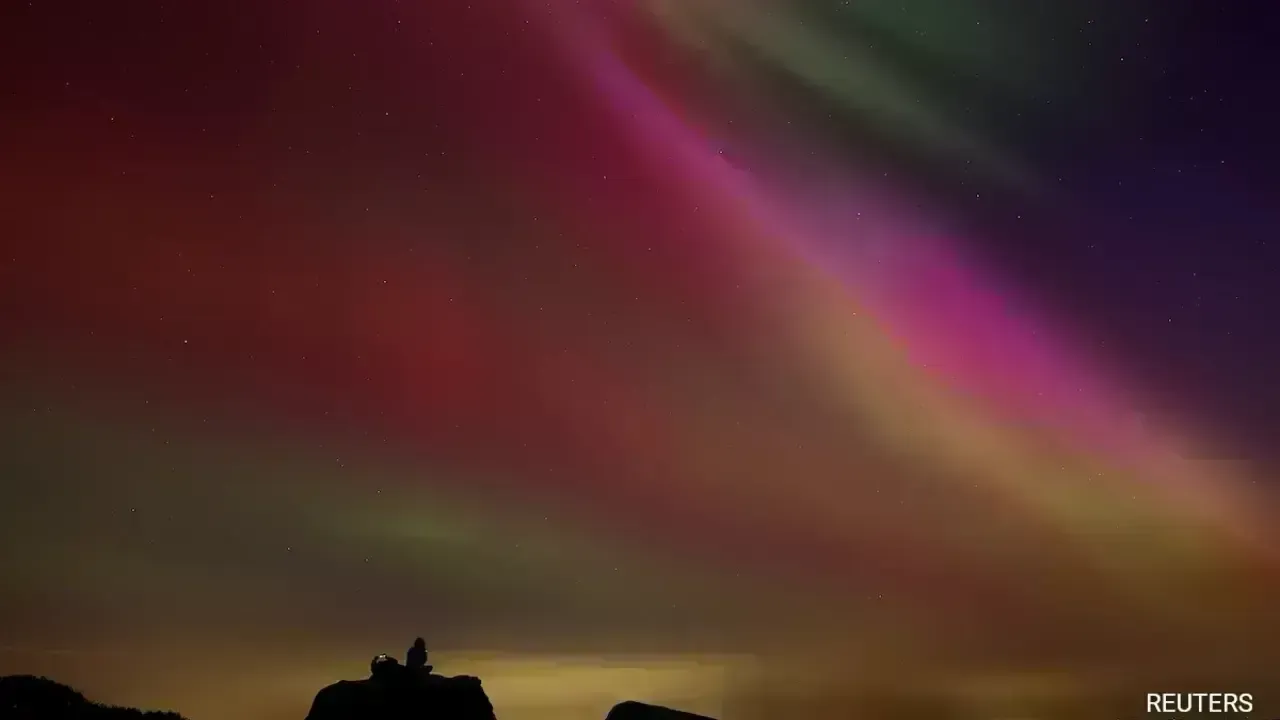
One of the most visible and dramatic outcomes of the solar radiation storm has been the widespread appearance of auroras — Northern and Southern Lights — at latitudes far beyond their usual range. Typically confined to high polar regions, auroras appeared across broad swaths of the United States, Europe, and even down toward mid-latitude areas.
Across North America, residents reported brilliant green, red, and pink auroral curtains lighting up the night sky as far south as California, Texas, and Alabama, where such displays are rare. In Europe, observers captured similarly breathtaking views, while communities in other parts of the world, including Ireland, were treated to vibrant auroras that officials described as historic and possibly once-in-a-lifetime events.
In the Southern Hemisphere, the aurora australis (southern lights) also made unusual appearances, with reports of visibility in regions of Australia and New Zealand that are not normally associated with strong auroral activity.
Such widespread auroral activity occurs when charged solar particles funnel along Earth’s magnetic field lines toward the poles, colliding with atoms and molecules in the upper atmosphere and causing them to emit light. During periods of intense geomagnetic disturbance, the auroral oval — the region where auroras are visible — can expand toward lower latitudes, offering spectacular sights to observers around the world.
While the visual effects of the storm have been magnificent, the increased radiation also poses challenges to modern technology. Satellites in orbit around Earth are particularly vulnerable to heightened levels of energetic particles, which can disturb onboard electronics, degrade solar panels, and affect navigation and communication systems.
Space agencies and satellite operators are monitoring these impacts closely. Protective measures, such as placing satellites into safe modes or adjusting operational parameters, are being implemented to mitigate potential disruptions. For example, precision navigation systems like GPS can experience brief accuracy issues during intense space weather conditions.
The storm also carries implications for aviation, particularly for flights that traverse polar routes. At high latitudes, increased solar radiation can elevate exposure levels for both passengers and crew. It may also interfere with high-frequency (HF) radio communications, which are used in remote polar regions where other forms of communication are less reliable.
Airlines and aviation authorities have been advised to assess routes and communication plans to ensure safety and continuity. While the risks do not typically threaten flight safety directly, they can affect operational efficiency and require careful management during severe space weather events.
Solar storms of this magnitude are uncommon but not unprecedented. The Halloween storms of 2003 — which the current event is often compared to — caused widespread geomagnetic activity, disruptions to power systems, and vivid auroras at low latitudes.
Historical records also include even more extreme events, such as the Carrington Event of 1859, which produced auroras around the world and caused telegraph systems to spark and fail. While the January 2026 storm does not match the intensity of the Carrington Event, it underscores the potential for significant space weather impacts during peaks in the solar activity cycle.
According to analyses of solar activity, the current period aligns with the ongoing Solar Cycle 25, a phase of increasing sunspot and flare activity. These cycles — which last roughly 11 years — naturally bring periods of higher solar eruption frequency and intensity.
Scientists and space weather agencies are utilising a network of satellites and ground-based instruments to track and analyse the solar storm’s development and effects. Instruments like those aboard NOAA’s GOES satellites measure solar wind properties, particle fluxes, and magnetic field interactions, providing real-time data to forecasters.
Collaboration among international agencies, including the European Space Agency (ESA), ensures that comprehensive data informs both scientific understanding and practical preparedness. Monitoring helps identify potential hazards, forecast auroral activity, and advise critical infrastructure operators on anticipated impacts.
As the storm continues to unfold, scientists will be watching for several key indicators:
Whether solar wind conditions remain elevated and continue to drive geomagnetic activity.
How long the enhanced auroral visibility persists at lower latitudes.
Any additional solar flares or CME events that could extend or intensify space weather effects.
Geomagnetic storms tend to subside over several days as Earth’s magnetic field stabilises and solar wind conditions moderate. However, lingering effects can persist, especially if additional solar activity occurs. Monitoring remains essential to assess both ongoing impacts and potential risks.
Disclaimer: This article is based on available scientific observations and reports at the time of writing. Space weather phenomena are inherently dynamic, and conditions can change rapidly. For the most up-to-date information, consult official space weather prediction centres and scientific agencies.










Google Signs 3.6-GW Power Deal With Constellation Energy in US
Google signs a 3.6-GW power deal with Constellation Energy, including nuclear power upgrades to supp

Harmanpreet Kaur Steps Down as India Captain Across All Formats
Harmanpreet Kaur steps down as India captain across all formats after a remarkable leadership journe

Michael Bracewell Chooses Casual Contract, Targets BBL Opportunity
Michael Bracewell moves to a casual contract as he eyes a BBL opportunity while remaining available

Tuchel Says Alex Scott Can Challenge Declan Rice for England Midfield Spot
Thomas Tuchel says Alex Scott can challenge Declan Rice for an England midfield place after his impr
Air Quality Turns Unhealthy in Central and Western Singapore Amid Haze
Singapore haze pushes PSI above 100 in central and western areas as smoke from regional hotspots rai

PM Modi Pays Tribute to Mahatma Gandhi, Urges People to Support Khadi
PM Modi pays tribute to Mahatma Gandhi on Gandhi Jayanti and urges citizens to support Khadi and the

