
You have not yet added any article to your bookmarks!
Join 10k+ people to get notified about new posts, news and tips.
Do not worry we don't spam!
Post by : Shweta
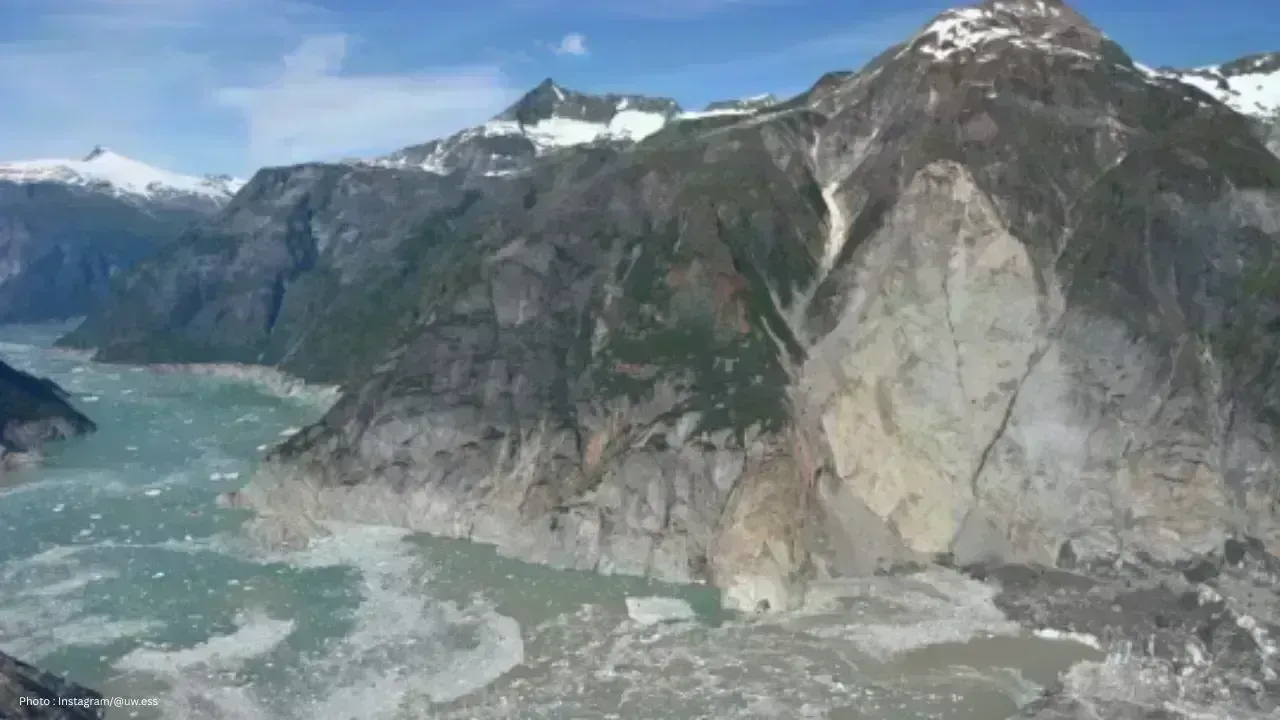
Recent satellite imagery has documented a monumental tsunami, resulting from a substantial mountain collapse in Alaska. This incident is considered the second-largest tsunami ever recorded, with wave heights reaching almost 200 meters after millions of tons of rock plunged into the fjord below.
The tsunami, generated in Dickson Fjord in eastern Greenland, was triggered by the failure of a mountainside impacted by thawing glaciers and unstable geological conditions. Although this landslide happened in a secluded region, its intensity was so significant that seismic sensors worldwide picked up the vibrations from the event. The waves oscillated within the fjord for several days following the collapse.
International researchers explained that Earth-observing satellites captured clear images and radar data that illustrated the waves' journey through the fjord post-collapse. The use of satellite technology was vital in analyzing the size and behavior of the tsunami in an area that is challenging for direct human observation.
The disaster originated from rising temperatures weakening the mountain's structure over time. The glaciers melting beneath the rock reduced stability, leading to the catastrophic release of millions of cubic meters of rock and ice into the fjord. This sudden descent caused immense water displacement, birthing what scientists term a “mega-tsunami.”
Experts clarified that mega-tsunamis are distinct from typical ocean tsunamis, which are conventionally triggered by seismic activity. Instead, these massive waves result primarily from landslides or geological collapses that plunge into restricted water bodies, often increasing wave height dramatically due to confinement.
This event has intensified concerns among scientists regarding climate change and its consequences on Arctic landscapes. Researchers underscore that rising global temperatures are accelerating glacier melt and destabilizing mountains, which could make similar geological disasters more prevalent. The rapid shifts in remote Arctic regions are alarming as ice diminishes at an increased pace.
While there were no casualties due to the remote setting, experts warn that the tsunami exemplifies the might of climate-induced geological phenomena. Ongoing studies on the landslide aim to enhance understanding of future landslides and mega-tsunamis in susceptible areas worldwide.
Satellite agencies and climate scientists are now leveraging the insights gained from this incident to refine tsunami detection strategies and risk evaluations. There is a hope that advanced satellite surveillance will facilitate early warnings for isolated coastal communities at risk for landslide-induced tsunamis.
This monumental event illustrates the profound capabilities of current satellite technology in capturing extreme natural occurrences in real-time. The results are anticipated to enhance research on climate dynamics, Arctic geology, and the global risk of tsunamis, as scientists further delve into the repercussions of rising temperatures on unstable mountain ecosystems.










PM Modi Pays Tribute to Mahatma Gandhi, Urges People to Support Khadi
PM Modi pays tribute to Mahatma Gandhi on Gandhi Jayanti and urges citizens to support Khadi and the

Amazon Seeks to Offload $8 Billion in Nvidia Chips to Investors
Amazon plans to move $8 billion in Nvidia chips to investors, using a new financing model to strengt

Samsung Raises Galaxy S26 Prices as Memory Chip Costs Rise
Samsung raises Galaxy S26 prices in South Korea as rising memory chip costs put pressure on smartpho

Lewis Hamilton Calls Singapore Grand Prix One of F1's Toughest Races
Lewis Hamilton discusses the demanding Singapore Grand Prix and brings Plus44 and Almave to Singapor

Denmark's Pandora Opens World's Largest Jewellery Factory in Vietnam
Pandora opens its largest jewellery factory in Vietnam, expanding global production, strengthening s

Gautam Gambhir Questions Batting-Friendly Pitches After India's Record ODI Chase
Gautam Gambhir questions batting-friendly ODI pitches after India’s record chase, calling for a bett

