You have not yet added any article to your bookmarks!
Join 10k+ people to get notified about new posts, news and tips.
Do not worry we don't spam!
Post by : Anis Farhan
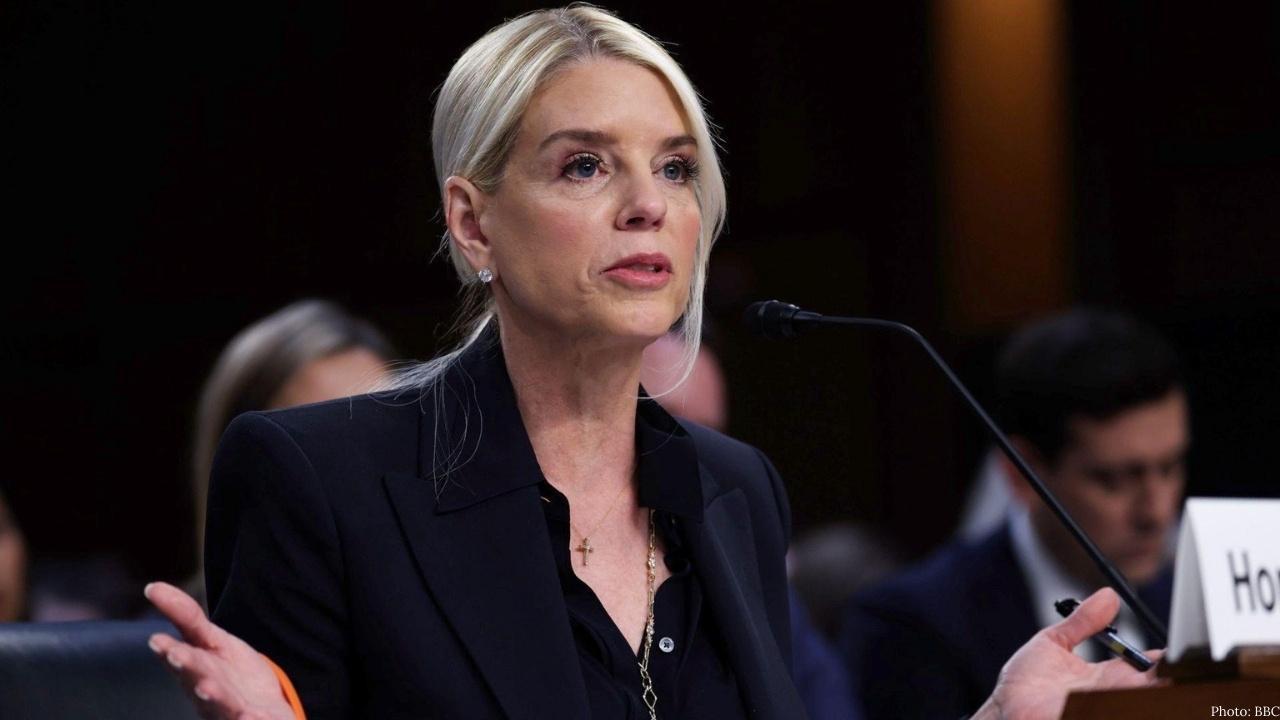
The US House Judiciary Committee hearing featuring Attorney General Pam Bondi was meant to provide clarity on one of the most politically radioactive issues in modern American public life: the government’s handling of the Jeffrey Epstein files.
Instead, it turned into something far more combustible — a four-hour confrontation filled with bitter accusations, raised voices, a dramatic walkout, and a deep sense that both lawmakers and the public are still far from satisfied.
Bondi appeared before lawmakers to defend the Justice Department’s release of millions of pages connected to Epstein’s investigations. The hearing was expected to be contentious, but the intensity surprised even seasoned observers. At different points, the exchange descended into open hostility, including Bondi calling a Democrat a “washed up loser” and dismissing certain questioning as “theatrics.”
Behind her sat several Epstein survivors — a powerful visual that lawmakers repeatedly referenced. Their presence made the debate over redactions and accountability feel less like a procedural dispute and more like a moral test of government competence.
By the end of the hearing, four themes had emerged clearly: the Justice Department’s struggle with victim protection, bipartisan anger over opaque redactions, renewed scrutiny on Prince Andrew, and a sharp clash over federal law enforcement actions in Minneapolis.
The hearing took place after the Justice Department released a major batch of documents connected to Epstein, the convicted sex offender whose crimes and network have continued to haunt institutions across the world.
The release was framed as a move toward transparency. But the process — especially the redactions — has triggered backlash from both parties.
Lawmakers accused the Justice Department of mishandling sensitive information, hiding key names without justification, and in some cases failing to properly protect victims.
Bondi, for her part, defended the department’s work under what she described as strict timelines created by legislation requiring the release.
But the deeper conflict wasn’t just about paperwork. It was about trust — and whether the public can believe that the government is capable of releasing truth without shielding powerful figures or harming survivors in the process.
The most emotionally charged moments of the hearing came when lawmakers focused on the survivors of Epstein’s abuse.
Several victims were seated behind Bondi. Their presence turned the hearing into something more than a legal discussion. It became a live confrontation between the state and those who were harmed under its watch.
In her opening remarks, Bondi described Epstein as a “monster” and apologised to the victims for the abuse they endured. That statement, however, did not stop lawmakers from turning sharply critical within minutes.
Democratic Representative Pramila Jayapal delivered one of the most pointed critiques. She alleged that the Justice Department failed to properly redact victims’ identities in the released files — and in some cases, even released nude images of survivors whose names had been protected for decades.
This wasn’t framed as a minor clerical issue. It was framed as a serious institutional failure.
Jayapal then asked the survivors in the room to stand if they had not been able to meet with the Justice Department. According to the account, all of them stood.
The moment was designed to be unmistakable: a visual statement that victims felt excluded from the process meant to bring justice and closure.
Jayapal asked Bondi directly to apologise for how the department handled redactions.
Bondi pushed back forcefully, calling the questioning “theatrics” and saying she would not “get in the gutter” with Jayapal.
That response became one of the hearing’s defining moments. For critics, it looked like defensiveness and disrespect. For supporters, it looked like Bondi refusing to be cornered in a politically staged exchange.
Bondi argued that the department was doing its best under a legally mandated deadline. She said that when names were released inadvertently, they were “immediately redacted” once identified.
But the damage from that exchange was already done. In a hearing where survivors were literally sitting behind the witness, the debate over redactions felt like a debate over dignity.
Even outside partisan politics, this exchange exposed a deeper problem: the government’s struggle to balance two conflicting public demands.
The public wants maximum transparency about Epstein’s network.
Victims want maximum protection of their identities and personal records.
In practice, those goals often collide.
The hearing showed that the Justice Department may have underestimated how explosive that collision could become — and how quickly a transparency push can backfire if victims feel harmed in the process.
One of the most striking aspects of the hearing was that criticism did not come only from Democrats.
A bipartisan group of lawmakers has accused the Justice Department of improperly redacting names of people who are not legally protected, suggesting that the department may have been overly aggressive — or politically selective — in what it chose to black out.
This turned the hearing into a rare moment where Republicans and Democrats were both dissatisfied, though for different reasons.
Lawmakers raised two conflicting complaints:
Some victims’ identities were allegedly not redacted properly.
Some non-victims’ names were allegedly redacted too aggressively.
Together, these accusations created a damaging impression: that the Justice Department managed to fail at both protecting victims and satisfying transparency demands.
Republican Representative Thomas Massie pressed Bondi directly on who was responsible for the redactions and whether anyone would be held accountable.
Massie described the issue as “bigger than Watergate” and suggested it spans multiple administrations, implying that the Epstein file controversy is not confined to one political era.
Bondi rejected the framing, calling the issue a “political joke” as Massie continued pressing her.
The exchange was tense, because it wasn’t a predictable party-line confrontation. It was a Republican publicly accusing a Republican administration’s Justice Department of mishandling one of the most sensitive document releases in decades.
Massie cited the example of billionaire Les Wexner, whose name was initially redacted.
Bondi was challenged on why Wexner’s name would be blacked out if he was not legally protected.
FBI Director Kash Patel, also present at the hearing, added that there was “no evidence” Epstein trafficked women to Wexner.
Wexner has long been linked to Epstein publicly because Epstein once worked as his financial adviser and Wexner later alleged Epstein stole millions from him.
A representative for Wexner said he was treated as a source of information in 2019 and was never considered a target.
The redactions debate is likely to continue, because it sits at the centre of what Americans believe the Epstein case represents:
institutional protection for the powerful
selective transparency
failures of accountability across decades
Even if the Justice Department believes it followed legal procedure, the hearing made it clear that public suspicion is not going away.
In one of the most internationally sensitive moments, Democratic Representative Ted Lieu brought up Andrew Mountbatten-Windsor, better known globally as Prince Andrew.
The former British royal has faced years of scrutiny due to accusations by Virginia Giuffre, who alleged she was trafficked by Epstein and forced into sexual encounters with Andrew when she was underage.
Prince Andrew has repeatedly denied wrongdoing and reached an out-of-court settlement with Giuffre in 2022 without admitting liability.
Lieu had a picture displayed that was included in the newly released Epstein files.
The image reportedly shows Andrew on all fours hovering over a female. No official context was provided with the photo, and the image itself does not prove criminal conduct.
But its use in the hearing was not about legal standards. It was about political and public pressure.
Lieu asked why the photo had not been used to prosecute Andrew.
Bondi responded by asking why Lieu did not direct those questions at former Attorney General Merrick Garland.
Lieu agreed, saying Garland “dropped the ball.”
This exchange became notable for two reasons:
It signalled that lawmakers are still actively searching for accountability in high-profile Epstein-linked cases.
It showed the Justice Department is still caught between political blame and legal reality.
Prince Andrew is not a US political figure. He is tied to a foreign monarchy and a complex diplomatic reality.
The fact that his name and image were used in a US congressional hearing shows how the Epstein case has become bigger than a criminal file.
It is now a global symbol of:
elite networks
cross-border influence
the difficulty of prosecuting powerful people
And while the hearing did not create a new legal case, it did fuel the perception that unresolved accountability remains one of the Epstein scandal’s most enduring features.
While Epstein dominated the hearing, lawmakers also pressed Bondi on other Justice Department controversies — including a case involving federal immigration agents in Minneapolis.
Tennessee Democratic Representative Steve Cohen confronted Bondi about a fatal shooting by federal agents, describing the deaths as “executions.”
He accused the Justice Department of failing to investigate.
Bondi defended the federal government’s actions in Minnesota.
She argued that protests and tensions were fuelled by elected officials who she claimed obstructed law enforcement and effectively declared themselves “at war” with the federal government.
This became another example of how Bondi’s approach in the hearing was consistent: she refused to accept the framing of critics and instead attacked their premise.
Republicans, including committee chair Jim Jordan, defended Bondi and praised her implementation of President Trump’s crackdown on illegal immigration.
This portion of the hearing showed that while Epstein created bipartisan frustration, immigration enforcement still produced predictable partisan divides.
The Minneapolis exchange mattered because it reinforced the larger theme of the day: a Justice Department under pressure from multiple directions at once.
Bondi was not simply defending document redactions.
She was defending a Justice Department identity — one that is being attacked simultaneously for:
secrecy
incompetence
overreach
politicisation
lack of accountability
The hearing exposed that the Justice Department is facing a crisis of confidence that goes far beyond the Epstein case.
By the end of the four-hour session, the hearing had delivered four big revelations.
Even after millions of pages, the release has not created closure. It has created more suspicion, more anger, and more questions about who is being protected.
Both sides referenced survivors — but the hearing showed that victims can be placed at the centre of a debate while still feeling excluded from decision-making.
Republicans and Democrats are angry, but not for the same reasons. That means reforms or investigations may still stall despite shared outrage.
Bondi did not approach the hearing like a cautious bureaucrat. She fought, insulted, and rejected demands in real time.
For supporters, this looked like strength. For critics, it looked like contempt.
But either way, her performance ensured that the hearing will be remembered not only for its subject matter, but for its theatrics.
The House Judiciary Committee hearing was expected to be tense. But it became something more: a public demonstration of how deeply the Epstein case continues to corrode trust in institutions.
Pam Bondi defended the Justice Department’s handling of the Epstein files and insisted officials are working within legal timelines. But lawmakers — including Republicans — made it clear they do not believe the public has been given a clean, honest, and victim-safe accounting of what the government knows.
The presence of Epstein survivors in the room amplified the stakes. The debate over redactions stopped being a technical issue and became a moral one.
And by dragging Prince Andrew back into the spotlight and expanding into disputes over immigration enforcement, the hearing underscored a broader truth: this Justice Department is being challenged not just on one scandal, but on the very idea of accountability.
In the end, the hearing did what most high-profile congressional hearings do. It created viral moments, political soundbites, and sharper divisions — while leaving the central question unresolved:
Will the Epstein files ever produce real answers, or will they remain an endless cycle of suspicion, redactions, and blame?
This article is based on publicly available reporting and the text provided in the prompt. It is intended for informational purposes only and does not constitute legal interpretation or endorsement of any political viewpoint.







George Russell Wins Dutch GP Sprint, Boosts Mercedes Morale
George Russell wins the Dutch GP Sprint from pole as Mercedes teammate Kimi Antonelli extends his F1

Australia 50/3 After Bangladesh Bowled Out for 64 in Second Test
Australia reached 50/3 after Bangladesh were bowled out for 64 in the second Test, with Mitchell Sta

Jordan Burroughs Returns to Wrestling with 2028 Olympic Dream
Jordan Burroughs returns to wrestling with Real American Freestyle as the Olympic champion eyes a po

Lamborghini Catches Fire on Singapore's ECP, Causing Heavy Traffic
A Lamborghini caught fire on Singapore's ECP, causing heavy traffic and bus delays. No injuries were

Bangkok Airport Duty-Free Area Flooded by Pipe Burst
A burst water pipe flooded the duty-free shopping area at Bangkok's Suvarnabhumi Airport on July 16,

Nine Monks Killed in Thailand Pickup Truck Tragedy
An 11-year-old boy driving a pickup truck crashed into monks during a pilgrimage in northeastern Tha