You have not yet added any article to your bookmarks!
Join 10k+ people to get notified about new posts, news and tips.
Do not worry we don't spam!
Post by : Saif Rahman
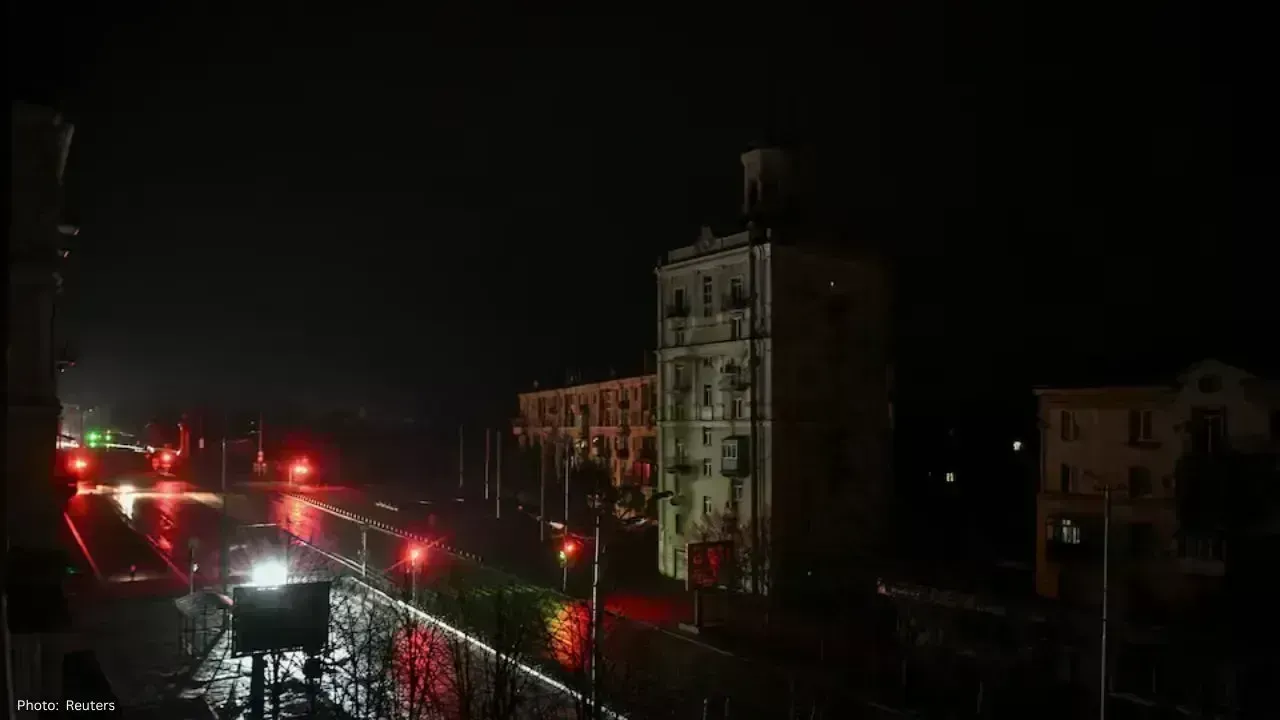
Recent air and drone attacks by Russia have led to significant power disruptions across southeastern Ukraine, intensifying the challenges for millions coping with the brutal winter. As reported by Ukraine’s energy ministry, the strikes on Wednesday night resulted in nearly total blackout in the Dnipropetrovsk and Zaporizhzhia regions.
Local authorities noted that critical facilities, including hospitals and water systems, are now reliant on backup power sources. Crews worked overnight to restore electricity, heating, and water services amid plummeting temperatures, with some areas expected to see lows of minus 20 degrees Celsius, heightening risks for residents.
The energy ministry stated that essential infrastructure was functioning solely on emergency reserves. Deputy Prime Minister Oleksiy Kuleba emphasized that repair efforts in Dnipropetrovsk are underway at maximum capacity, albeit with safety concerns for crews due to ongoing threats. Meanwhile, alternative power sources were employed in Zaporizhzhia to maintain water supply.
Historically, attacks on Ukraine’s energy network have been a frequent tactic in the conflict, but officials report a notable escalation in intensity recently. These assaults aim to disrupt daily life and exert pressure on civilians, notably during winter months when heating and electricity are vital.
Prime Minister Yulia Svyrydenko cautioned that heavy snowfall and severe cold would complicate repair efforts and stress already compromised systems. She commended energy workers who brave hazardous conditions to provide essential services to the population, while also warning that worsening weather conditions exacerbate the strain on fragile infrastructure.
In Dnipro, power outages halted metro services. Schools in certain areas were closed for an additional two days due to inadequate heating. Local officials have stated it remains uncertain when full power will be reinstated.
Kryvyi Rih, the hometown of President Volodymyr Zelenskiy, has faced particularly harsh conditions in two districts. Local leaders have advised residents and institutions to utilize generators as much as possible. Ukrainian Railways indicated that trains and signaling systems in affected regions switched to backup options, with many stations relying on generators.
The power outages in Zaporizhzhia also endanger public safety, with Governor Ivan Fedorov reporting that air raid sirens were inaudible during the blackout, posing significant risks for civilians. Although electricity has been restored in some major facilities, residents are being urged to limit mobile phone use, as networks operate in emergency mode.
These extensive outages underscore the ongoing hardships faced by Ukraine as the conflict endures. Beyond military engagements, attacks on energy infrastructure critically threaten daily life, putting civilians at greater risk during severe weather. As winter intensifies, the restoration and protection of energy systems remain imperative for Ukraine's resilience.









China’s Tiangong Sets New 400m Record at Robot Olympics
China’s Tiangong robot sets a new 400m record at the Robot Olympics, beating a South African robot i

George Russell Wins Dutch GP Sprint, Boosts Mercedes Morale
George Russell wins the Dutch GP Sprint from pole as Mercedes teammate Kimi Antonelli extends his F1

Australia 50/3 After Bangladesh Bowled Out for 64 in Second Test
Australia reached 50/3 after Bangladesh were bowled out for 64 in the second Test, with Mitchell Sta

Jordan Burroughs Returns to Wrestling with 2028 Olympic Dream
Jordan Burroughs returns to wrestling with Real American Freestyle as the Olympic champion eyes a po

Lamborghini Catches Fire on Singapore's ECP, Causing Heavy Traffic
A Lamborghini caught fire on Singapore's ECP, causing heavy traffic and bus delays. No injuries were

Bangkok Airport Duty-Free Area Flooded by Pipe Burst
A burst water pipe flooded the duty-free shopping area at Bangkok's Suvarnabhumi Airport on July 16,