You have not yet added any article to your bookmarks!
Join 10k+ people to get notified about new posts, news and tips.
Do not worry we don't spam!
Post by : Samjeet Ariff
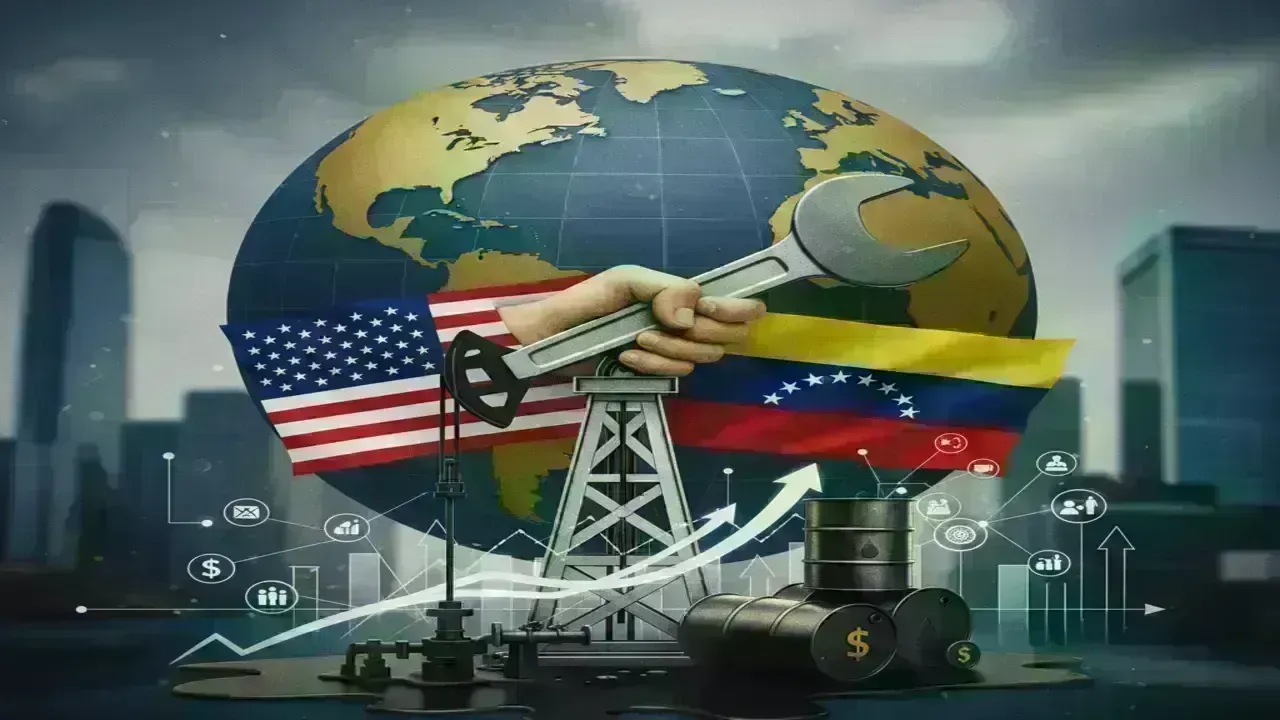
The term “U.S. influence over Venezuela’s oil industry” doesn’t imply American forces or corporations directly managing oil operations. Instead, it signals a strategic reorientation involving licensing, sanctions relief, economic oversight, and trade regulation, enabling the U.S. to significantly influence how Venezuela's oil is produced, marketed, and priced on the global stage. This form of influence is transforming energy exchanges, international alliances, and oil pricing trends.
To grasp the genuine implications, it's crucial to dissect the essence of this control, its timing, and its ramifications for global oil markets, developing nations, and daily fuel costs.
Venezuela is home to the largest proven oil reserves globally, surpassing even those of Saudi Arabia. The majority of this oil is heavy crude which, although needing specialized refining, becomes highly valuable when worldwide supply diminishes.
Nonetheless, despite this vast potential, Venezuelan oil production has plummeted over the past ten years due to:
Sanctions that hinder exports and payment processes
Mismanagement within the state-run oil entity PDVSA
A dearth of foreign partnerships and modern technology
Decrepit infrastructure
At its peak, Venezuela achieved an output of over 3 million barrels daily. Recently, it has sunk below 800,000 barrels per day, leading to a significant supply deficit that other producers find difficult to address.
The U.S. doesn’t own Venezuelan oil fields; rather, control is exerted through economic mechanisms rather than ownership.
Historically, U.S. sanctions restricted:
Whom could purchase Venezuelan oil
The allowable methods for payment transactions
The companies permitted to operate within the sector
By carefully adjusting sanctions, the U.S. determines how much Venezuelan oil enters the market and under what stipulations.
U.S. officials provide licenses to particular firms, notably American and allied entities, enabling them to:
Extract oil
Export crude oil
Legally receive payments
This establishes a system where oil flows exclusively through endorsed channels, effectively granting trade control to the U.S.
A majority of global oil transactions hinge on dollar-centric systems. Even when Venezuela trades oil with other nations, U.S.-regulated financial networks govern settlement, insurance, and compliance.
Any increase in oil exports is contingent upon political agreements, elections, or reforms. This endows the U.S. with enduring leverage that goes beyond immediate production advantages.
This realignment is spurred by global energy instability, rather than altruism.
Various conflicts involving Russia, the Middle East, and transportation routes have disrupted oil supplies globally. Sanctions against Russia have eliminated millions of barrels from Western markets.
OPEC and OPEC+ nations have routinely curtailed output to maintain prices, leaving consuming nations exposed.
Fuel costs significantly impact inflation, elections, and public perception. The U.S. seeks stable, manageable supply sources.
Venezuela stands out as a proximate, resource-rich alternative that can be mobilized swiftly under monitored conditions.
A mere recovery in Venezuelan production could alter the global balance considerably.
Even an increase of 300,000 to 500,000 barrels per day may:
Mitigate supply constraints
Stabilize price volatility
Reduce the necessity for emergency reserves
Markets consider not just actual barrels but also future supply expectations.
Venezuelan oil diminishes dependency on:
Middle Eastern shipping routes
Exports from Russia
Politically unstable transit areas
This enhances energy security for the U.S. and its allies.
The psychology behind oil prices can be as impactful as tangible factors.
Cap extreme price surges
Limit speculative price increases
Establish a price ceiling
Traders consider future supply in pricing today.
Notwithstanding the boost in supply:
Production recovery will be gradual
Infrastructure issues persist
OPEC can modify output to counterbalance
Therefore, Venezuelan oil acts to moderate prices rather than collapse them.
The return of Venezuelan oil alters the landscape of influence.
Many OPEC members depend heavily on higher prices. Increased supply:
Undermines coordinated price controls
Challenges internal negotiations
Heightens competition
Saudi Arabia and Gulf nations may:
Modify quotas
Postpone expansions
Concentrate on longer-term market share
Venezuela thus emerges as a balancing tool rather than a dominant player.
Historically, Venezuela sold oil at reduced prices to avoid sanctions.
As exports progress through licensed avenues:
Discounts decrease
Contract stipulations become stricter
Political power dynamics shift
Nations that previously enjoyed discounted oil may now have to align closer to market pricing.
Emerging markets may face:
Reduced availability
Boosted bidding wars
Less lenient payment arrangements
Such factors could influence fuel subsidies and inflation in developing countries.
Multinational corporations will benefit cautiously.
Companies will function under:
Strict compliance regulations
Limited rights for expansion
Ongoing political scrutiny
This arrangement minimizes risk but constrains profitability.
Gradual enhancements will:
Enhance extraction efficiency
Mitigate environmental impacts
Expand long-term output potential
However, full recovery will be protracted, taking years instead of months.
Consumers often do not experience immediate changes.
Price hikes may become milder during supply anomalies.
A diversified supply mitigates sudden shortages.
Nevertheless, taxes, refining fees, and local legislation predominantly affect retail fuel costs.
Exerting control through influence presents challenges.
Leadership transitions or compliance failures could:
Re-impose sanctions
Suddenly halt exports
Send shocks through the market
Years of neglect result in:
Equipment breakdowns
Environmental hazards
Production setbacks
There’s a risk that markets may overrate the speed of recovery, leading to misaligned pricing.
Venezuelan oil has now become a geopolitical lever.
Each barrel from Venezuela diminishes the West's dependency on Russian energy resources.
Regional political landscapes shift as Venezuela:
Re-engages economically
Aquires selective legitimacy
Forfeits unilateral control
The U.S.'s energy influence enhances its diplomatic bargaining capabilities across trade and security negotiations.
This marks not a complete recovery for Venezuela.
Boost in revenue
Infrastructure enhancement
Partial economic stabilization
Limited control over oil policies
Reliance on foreign approval
Delayed social recovery
Enhancing control leads to cash influx, yet not autonomy.
Markets are not forecasting a surge in Venezuelan oil production. Instead, they are pricing in:
Minimized extreme volatility
Enhanced supply predictability
Fewer unexpected disruptions
These aspects clarify why oil price alterations are subtle rather than dramatic.
This issue transcends mere barrels; it highlights precedents. It illustrates how modern geopolitical influence over energy operates through financial and regulatory control rather than outright ownership.
This model could inform future interventions in resource-rich nations.
The U.S.'s approach to managing Venezuela's oil industry signifies a departure from isolation toward managed integration. It bolsters supply security for consuming nations while minimizing price fluctuations but also recasts the concept of sovereignty within global energy markets.
Thus, energy is no longer just about reserve ownership; it is fundamentally about control over access, compliance, and flow.
This article serves informational and analytical purposes only, and does not offer financial, investment, legal, or geopolitical guidance. Energy markets and international policies are complicated and subject to rapid evolution. Readers are encouraged to seek authoritative sources or consult qualified experts before making decisions influenced by any geopolitical or market developments.








Meta Bans TikTok Ads on Facebook and Instagram in Seven Countries
Meta has banned TikTok ads in seven countries, escalating competition over social media users, adver

ASML and Zeiss Target Next-Generation Chip Technology in 10 Years
ASML and Carl Zeiss are developing Hyper NA technology to print smaller chip circuits, with the next

Rabada Misses First Australia Test as South Africa Pick Two Spinners
Kagiso Rabada misses the opener as South Africa vs Australia begins, with Anrich Nortje returning an

Starc Compares Australia's Tough Year to McIlroy's Major Sweep
Mitchell Starc says Australia winning three away Test series and the World Cup would match Rory McIl

France’s Sesterce Plans $11 Billion AI Data Centre in Finland
Sesterce plans a $11 billion AI data centre in Finland, with major expansion, green energy plans and

Danaher to Launch AI-Powered Autonomous Research Lab in 2027
Danaher plans an AI research lab for 2027, combining robotics and automation to speed up drug discov