
You have not yet added any article to your bookmarks!
Join 10k+ people to get notified about new posts, news and tips.
Do not worry we don't spam!
Post by : Badri Ariffin
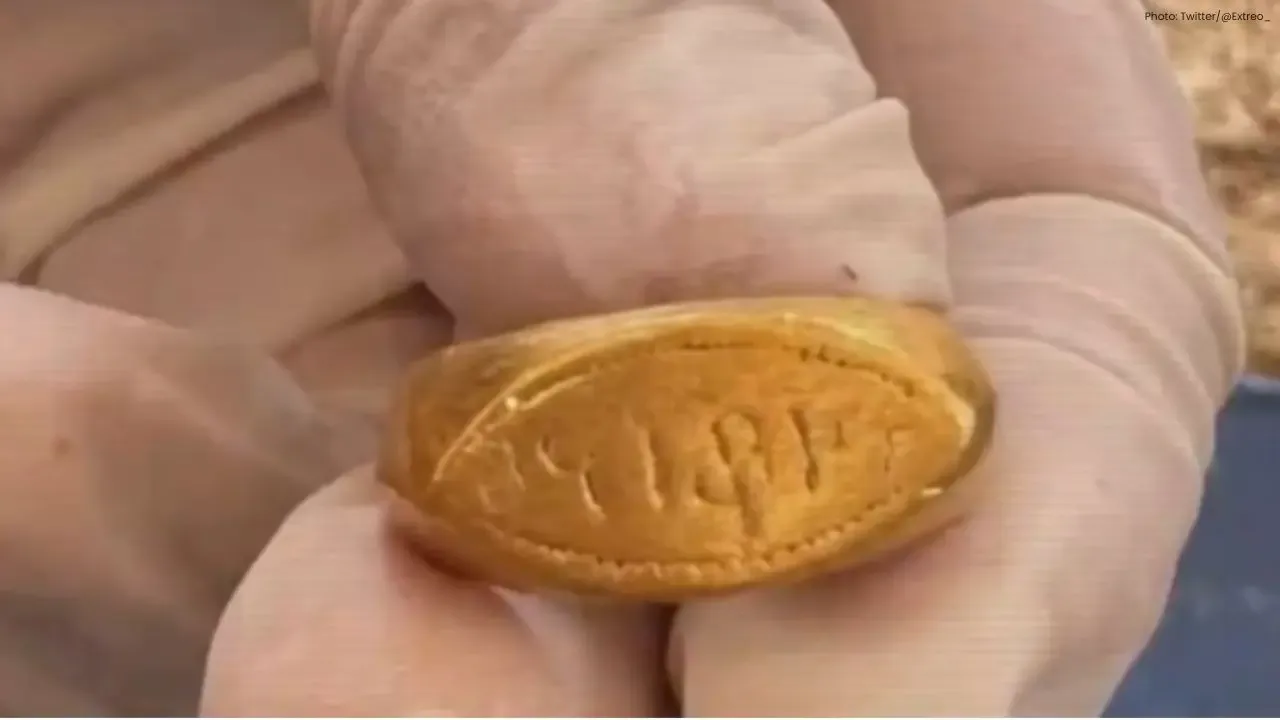
Archaeologists in Thailand have discovered two gold rings believed to be around 2,000 years old, including one engraved with an ancient Indian Brahmi inscription. The discovery provides new evidence of early cultural and trade connections between the Indian subcontinent and Southeast Asia.
The rings were found during an ongoing excavation at the recently identified Don Yai Thong archaeological site in Thailand's Phetchaburi province. According to Thailand's Fine Arts Department, the jewellery was recovered alongside human skeletal remains.
Experts believe the findings reflect strong Indian influence in the region during the Iron Age, a period when maritime trade between India and Southeast Asia was highly active.
One of the gold rings, uncovered last week, carries characters written in Brahmi, one of the oldest writing systems used in ancient India.
After an initial examination, experts said the inscription reads "pusarakhitasa," which means "the one protected by Pushya."
According to the Associated Press, Pushya is considered one of the most auspicious zodiac signs in Indian astronomy.
The second gold ring found with the same skeletal remains is plain and does not contain any inscription or decorative design.
Based on the design of the jewellery and the Brahmi inscription, archaeologists believe the person buried at the site may have been a merchant connected to the Vaishya community of the ancient Indian caste system.
The discovery is seen as another indication of the historical interaction between India and Southeast Asia through trade and cultural exchange.
The Don Yai Thong archaeological site is located around 130 kilometres southwest of Bangkok.
The site first came to the attention of archaeologists earlier this year after local residents found fragments of ancient bronze drums while working in a rice field.
The discovery led Thailand's Fine Arts Department to begin a full-scale excavation. Experts have dated the site to Thailand's late prehistoric period, also known as the Iron Age, which spans approximately 1,500 to 2,500 years ago.
Excavation work, which began in February, has so far uncovered eight human skeletons along with a variety of artefacts. These include gold and bronze jewellery, pottery and ceremonial objects.
Officials said the presence of valuable ornaments suggests that the people buried at the site held an important position in society.
The excavation is expected to continue for about another month before the site is closed for detailed analysis. Thailand's Fine Arts Department plans to preserve the artefacts before placing them on public display.









PM Modi Pays Tribute to Mahatma Gandhi, Urges People to Support Khadi
PM Modi pays tribute to Mahatma Gandhi on Gandhi Jayanti and urges citizens to support Khadi and the

Amazon Seeks to Offload $8 Billion in Nvidia Chips to Investors
Amazon plans to move $8 billion in Nvidia chips to investors, using a new financing model to strengt

Samsung Raises Galaxy S26 Prices as Memory Chip Costs Rise
Samsung raises Galaxy S26 prices in South Korea as rising memory chip costs put pressure on smartpho

Lewis Hamilton Calls Singapore Grand Prix One of F1's Toughest Races
Lewis Hamilton discusses the demanding Singapore Grand Prix and brings Plus44 and Almave to Singapor

Denmark's Pandora Opens World's Largest Jewellery Factory in Vietnam
Pandora opens its largest jewellery factory in Vietnam, expanding global production, strengthening s

Gautam Gambhir Questions Batting-Friendly Pitches After India's Record ODI Chase
Gautam Gambhir questions batting-friendly ODI pitches after India’s record chase, calling for a bett

