
You have not yet added any article to your bookmarks!
Join 10k+ people to get notified about new posts, news and tips.
Do not worry we don't spam!
Post by : Meena Ariff
Photo: Reuters
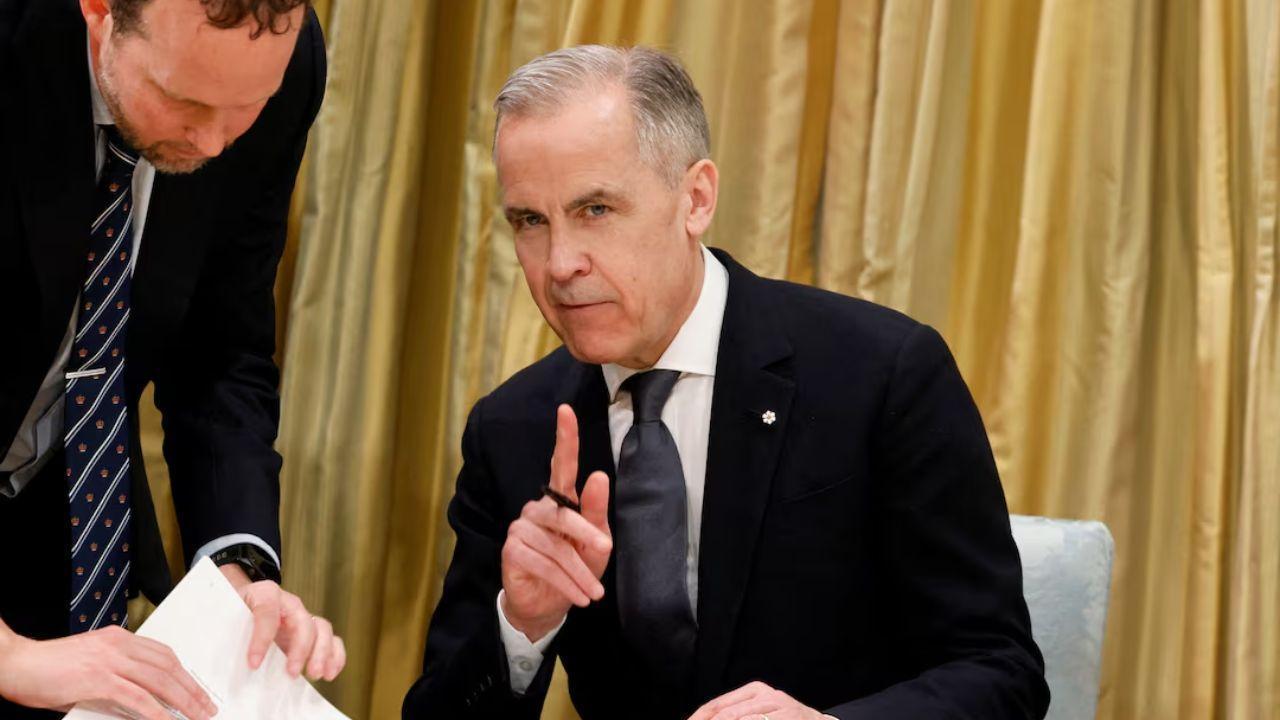
Prime Minister Mark Carney has announced a major policy shift to protect Canada's steel industry. At a press conference held in Ontario, he revealed new rules that will limit the import of cheap steel from foreign countries. This move comes after tough tariffs were placed on Canadian steel by the United States, which has badly hurt local manufacturers.
The prime minister also said that Canada would now focus on trading more with other countries besides the U.S. He promised that the government would make Canadian-made steel a priority for public projects, such as housing and defense.
U.S. Tariffs Hit Canadian Steel Hard
In recent months, U.S. President Donald Trump has imposed heavy tariffs on Canadian steel. In March, he announced a 25% tax on steel imports from Canada. Just a few months later, in June, he doubled that rate to 50%.
These taxes have made it harder for Canadian steelmakers to sell their products in the U.S., which has always been their biggest customer. As a result, many factories in Canada have seen a big drop in orders and production.
Canada Takes Action
To fight back, Canada is now setting strict limits on how much foreign steel can enter the country without extra taxes. Under the new plan, only 50% of the steel import volume from 2024 will be allowed to come in tariff-free from countries that do not have a free trade deal with Canada. That’s a big drop from the previous limit of 100%.
If a company tries to bring in more than that limit, it will have to pay a 50% tariff on the extra amount.
Special Focus on China
During his announcement, Carney made it clear that steel coming from China was a big concern. He said there would be an extra tariff on any steel coming from non-U.S. countries if it was originally melted and poured in China.
This move is meant to stop steel from being rerouted through other countries to avoid direct import from China. It also sends a message that Canada is serious about protecting its industry from low-cost, heavily subsidized Chinese steel.
No Changes to Free Trade Agreement Rules
Even though the new rules are strict, Carney said that products covered under the Canada-U.S.-Mexico free trade agreement (also known as CUSMA) will still be exempt from these extra tariffs. This means that steel traded under the rules of that agreement won’t be affected
.Canadian Steel for Canadian Projects
Carney also announced another major change. From now on, the Canadian government will require its contractors to use Canadian steel when building roads, bridges, homes, and other large projects. This rule will apply to all federal construction work.
He said that this would help Canadian steel producers bounce back and provide more secure jobs for Canadian workers.
The prime minister explained that Canada's large future projects—like building more homes and improving the country’s defense sector—would now use steel made at home.
“These changes will make sure we are giving ourselves far more than any foreign government can take away,” Carney said during the press conference.
Steel Industry in Trouble
Canada’s steel and aluminum industries have been struggling ever since the U.S. began imposing metal tariffs. Many companies have seen orders go down, profits shrink, and jobs lost.
Catherine Cobden, the head of the Canadian Steel Producers Association, said that steel production in Canada has dropped by 30% since the first round of U.S. tariffs in March.
“This is something we should have been doing all along, but it's fantastic to see that we are making progress,” she said about the government’s decision.
Canada’s Dependence on the U.S.
One big issue that led to this new policy is Canada’s heavy dependence on the U.S. for both buying and selling steel. Prime Minister Carney pointed out that about two-thirds of all steel used in Canada comes from foreign countries, and more than 90% of the steel made in Canada is sold to the U.S.
He called this level of dependence “unsustainable” and said it was time for Canada to take control of its industry.
Looking for New Trade Partners
As part of the changes, Carney said Canada would also try to build new trade relationships with countries besides the United States. This will help reduce the risk of future problems if the U.S. or any other major partner decides to raise tariffs again.
By having a wider range of trade partners, Canada can better protect itself from economic shocks and ensure its manufacturers have more markets to sell to.
Why This Matters to Canadians
The steel industry is an important part of Canada’s economy. It provides thousands of good-paying jobs and supports other industries like construction, manufacturing, and transportation. When the industry struggles, it affects not just the workers in steel factories but also many other parts of the economy.
Carney’s announcement shows that the government is ready to step in and help local industries that are under threat from unfair trade practices.
Big Projects Will Use Canadian Steel
Carney gave examples of some of the "big projects" that will now be built using only Canadian steel. These include:
These projects will create demand for Canadian steel and bring back work to steel factories that have seen slowdowns in recent years.
A Long-Term Strategy
This is not just a short-term fix. The new rules and policies are part of a longer plan to make the steel industry stronger and more independent.
By using more Canadian steel in public projects, limiting cheap imports, and finding new trade partners, the government hopes to build an industry that can stand on its own and grow.
Canada has taken a strong step to protect its steel industry by limiting cheap imports and requiring Canadian steel in government-funded projects. These new measures come in response to the heavy tariffs placed by the U.S. and are meant to make the country less dependent on its southern neighbor.
Prime Minister Mark Carney’s announcement is expected to bring relief to steel manufacturers and workers across the country, many of whom have struggled under the weight of U.S. tariffs and foreign competition.
With a clear focus on homegrown production and fair trade, Canada is working to ensure that its industries remain strong, competitive, and ready for the future.









PM Modi Pays Tribute to Mahatma Gandhi, Urges People to Support Khadi
PM Modi pays tribute to Mahatma Gandhi on Gandhi Jayanti and urges citizens to support Khadi and the

Amazon Seeks to Offload $8 Billion in Nvidia Chips to Investors
Amazon plans to move $8 billion in Nvidia chips to investors, using a new financing model to strengt

Samsung Raises Galaxy S26 Prices as Memory Chip Costs Rise
Samsung raises Galaxy S26 prices in South Korea as rising memory chip costs put pressure on smartpho

Lewis Hamilton Calls Singapore Grand Prix One of F1's Toughest Races
Lewis Hamilton discusses the demanding Singapore Grand Prix and brings Plus44 and Almave to Singapor

Denmark's Pandora Opens World's Largest Jewellery Factory in Vietnam
Pandora opens its largest jewellery factory in Vietnam, expanding global production, strengthening s

Gautam Gambhir Questions Batting-Friendly Pitches After India's Record ODI Chase
Gautam Gambhir questions batting-friendly ODI pitches after India’s record chase, calling for a bett

