You have not yet added any article to your bookmarks!
Join 10k+ people to get notified about new posts, news and tips.
Do not worry we don't spam!
Post by : Meena Ariff
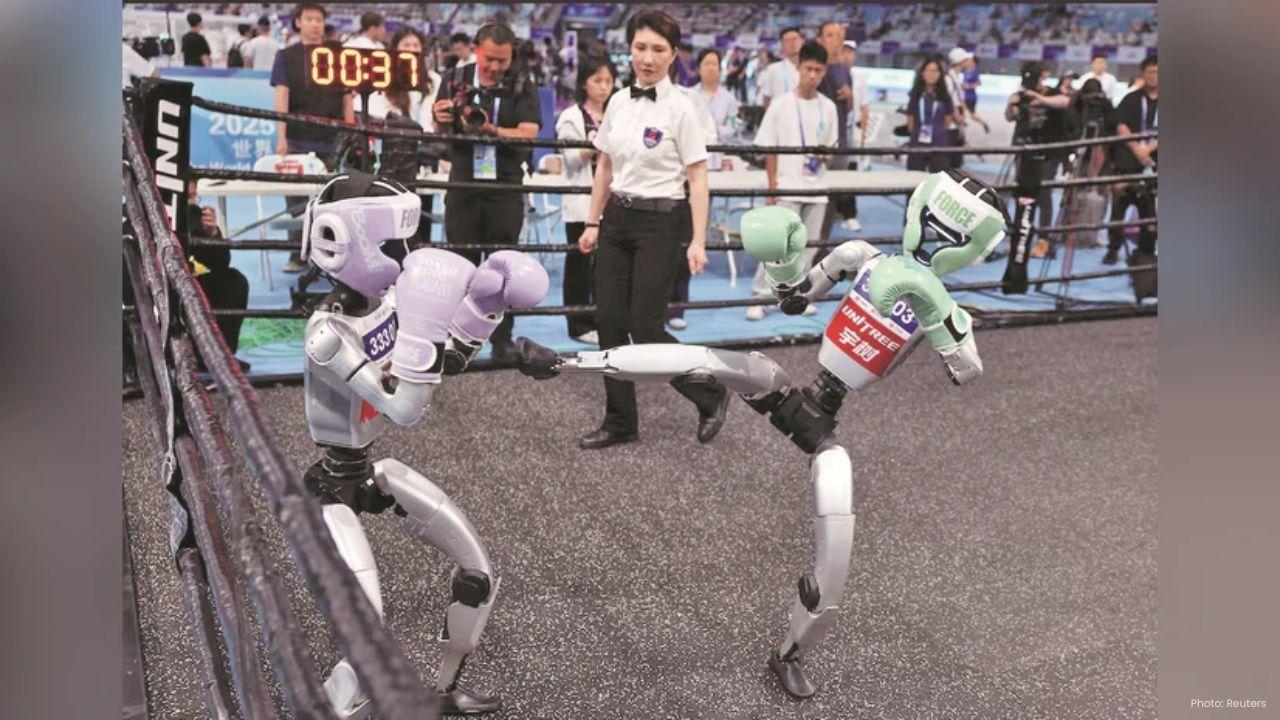
China has opened the doors to a truly unique international event — the World Humanoid Robot Games. This three-day competition is unlike any ordinary sports festival, as machines take center stage. Robots of different shapes and sizes are competing to show what they can do, from playing football to performing daily tasks. The grand event began on Friday in Beijing and has attracted 280 teams from 16 countries, turning the city into a hub of excitement, curiosity, and innovation.
For many, it is not just a contest. It is a celebration of technology, learning, and discovery. Students, engineers, and researchers from across the globe have gathered with one goal — to test how far humanoid robots can go in copying human actions.
Teams From Around the World
A total of 280 teams are participating, with 192 representing universities and 88 coming from private companies. Teams have arrived from countries such as the United States, Germany, Brazil, and many others. China’s robotics firms, including Unitree, Fourier Intelligence, and Booster Robotics, are also strongly represented. These well-known companies have provided humanoid robots for several teams, making the competition both a stage for international cooperation and a showcase of local talent.
For the young students and professionals involved, this event is more than a competition. It is a chance to test their ideas, share their knowledge, and learn from others.
Robots Compete in Sports and Daily Life Tasks
The games are not limited to traditional sports like running or football. Organizers have designed special challenges that mirror real-life situations. Robots are being tested on their ability to sort medicines, handle materials carefully, and even perform cleaning tasks. These activities have been chosen for an important reason: to explore how robots might be used one day in hospitals, factories, or homes.
In the sports section, robots are seen competing in track races, table tennis, and football matches. Each event pushes the machines to demonstrate skills like balance, speed, coordination, and decision-making. Just like human athletes, the robots are expected to show both strength and intelligence.
Robots Falling, Standing, and Winning Applause
The competitions have turned out to be both serious and fun. During football matches, robots sometimes stumble, bump into each other, or fall down in piles, causing the crowd to burst into laughter and cheers. In one funny moment, four robots collided and tumbled together, resembling clumsy players on a real football field.
The 1500-metre race also captured the audience’s attention when one robot suddenly collapsed while running at full speed. Instead of disappointment, spectators reacted with gasps, applause, and encouragement. The excitement grew even more when some robots managed to stand up by themselves without human help. Each time a robot rose on its own, the audience responded with loud applause, celebrating these small yet important steps in robot development.
Why These Games Are Important
While the sight of robots falling may look amusing, the purpose of the games is much deeper. Every challenge is designed to collect useful information about how humanoid robots move, react, and work together. For instance, a football match is not just about scoring goals. It also tests how well robots can cooperate, make decisions quickly, and act as a team — abilities that could one day be used in factories where many robots must work side by side on assembly lines.
These contests also allow researchers to study mistakes. If a robot falls or fails at a task, it becomes an opportunity to improve design and programming. Each error brings new knowledge that helps scientists and engineers build stronger and smarter robots in the future.
A Platform for Research and Innovation
The event is giving teams from around the world a chance to experiment. A German team, the HTWK Robots Football Team from Leipzig University of Applied Sciences, expressed its excitement. One of their members, Max Polter, explained that while they came to win, the most important part was research. “These contests give us the chance to test new ideas,” he said. “If something doesn’t work, we lose the game, which is sad, but at least we don’t waste a lot of money on a failed product.”
This spirit of innovation shows how competitions like these are not just about trophies. They are open laboratories where new ideas are born, tested, and improved.
China’s Push in Robotics
China has been investing heavily in robotics in recent years. The country is facing challenges such as an ageing population, which could lead to a shortage of workers in the future. Humanoid robots are seen as one possible answer to this problem. At the same time, China is competing with countries like the United States to take a leading role in modern technologies.
In the past months, China has organised several major events related to robotics. These include the world’s first humanoid robot marathon, major technology conferences, and even retail stores dedicated to selling robots. To support the growth of this industry, the government has given over $20 billion in subsidies in just one year. Plans are also being discussed to create a massive fund worth one trillion yuan (about $137 billion) to support new robotics and artificial intelligence startups.
Growing Public Interest
It is not only scientists and engineers who are showing interest in humanoid robots. Large crowds of ordinary people are attending the games, showing how the idea of “embodied intelligence” is slowly becoming accepted in society. Analysts believe that this public curiosity is important because it will attract more talent, funding, and business opportunities to the robotics industry.
When the public is excited about new technology, it helps the industry grow faster. More students may choose to study robotics, more companies may invest money, and more customers may be willing to buy or use robots in their homes and workplaces.
Robots for Homes, Hospitals, and Factories
Companies such as Booster Robotics believe that sports like football are excellent training grounds for humanoid robots. Football requires skills such as quick thinking, movement control, and teamwork — the very same abilities that robots would need in real-life situations.
Imagine a future where robots work in hospitals to deliver medicines, assist in surgeries, or take care of elderly patients. In factories, they could help assemble cars, build electronics, or manage materials. At home, robots might clean rooms, prepare meals, or lend a helping hand to families. The competitions in Beijing are helping to make these possibilities real by testing robots in both simple and complex tasks.
A Step Into the Future
Although many robots stumbled, fell, or needed help during the games, the progress is undeniable. Only a few years ago, it was hard to imagine robots running, playing football, or competing in races. Today, it is happening in front of cheering audiences.
The event is not only entertaining but also a window into the future. Each robot that stands up after a fall, each team that tries a new idea, and each crowd that applauds with excitement brings the dream of everyday robots closer to reality.
The World Humanoid Robot Games in China have brought together brilliant minds, advanced machines, and curious audiences for three days filled with learning, competition, and fun. From clumsy falls that made the crowd laugh to impressive recoveries that won applause, the event showed both the difficulties and the great promise of humanoid robots.
With billions of dollars in investments, strong government support, and increasing public interest, China is placing itself at the front of the global race in robotics. The robots may not yet be perfect, but every fall and every victory is a step closer to a future where machines work side by side with humans — in homes, schools, hospitals, and factories.










Starc Compares Australia's Tough Year to McIlroy's Major Sweep
Mitchell Starc says Australia winning three away Test series and the World Cup would match Rory McIl

France’s Sesterce Plans $11 Billion AI Data Centre in Finland
Sesterce plans a $11 billion AI data centre in Finland, with major expansion, green energy plans and

Danaher to Launch AI-Powered Autonomous Research Lab in 2027
Danaher plans an AI research lab for 2027, combining robotics and automation to speed up drug discov

Musk Welcomes German Support for Tesla Driver Assistance Tech as EU Approval Push Continues
Elon Musk welcomes Germany's backing for Tesla FSD as the company seeks EU approval amid speed, safe

Microsoft and Nvidia CEOs to Unveil AI Laptop at San Francisco Event
Microsoft and Nvidia showcase a new AI laptop with RTX Spark chips as they push powerful local AI co

Man to face charges over perfume thefts at Changi Airport
A 47-year-old man faces charges over perfume theft at Changi Airport after six items worth nearly S$