
You have not yet added any article to your bookmarks!
Join 10k+ people to get notified about new posts, news and tips.
Do not worry we don't spam!
Post by : Badri Ariffin
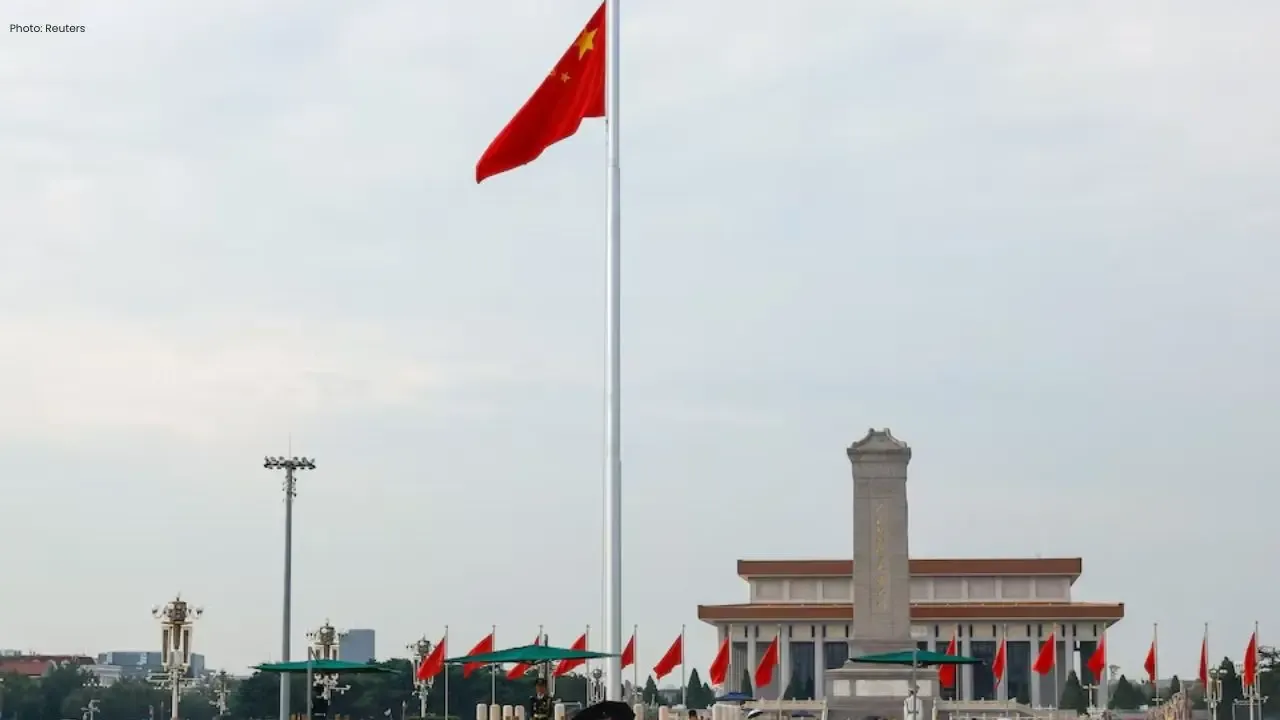
China lowered the national flag at government headquarters on Tuesday, August 18, to mourn former Premier Zhu Rongji, who died last week at the age of 97. The former Chinese premier was remembered for his tough approach to economic reform and his major role in reshaping China's economy during the 1990s.
Zhu's death has also revived public discussion about the impact of his reforms, particularly among workers and families affected by large-scale changes to China's state-owned industries.
Security was heavily increased across Beijing as preparations were made for Zhu Rongji's cremation. Authorities paid particular attention to areas around Tiananmen Square and Zhongnanhai, the central complex where China's top political leaders work and live.
The locations are along the route leading toward Babaoshan, a Beijing crematorium traditionally used for the funerals of senior Chinese officials.
The heightened security reflected the sensitivity surrounding the death of a former senior Chinese leader. Chinese authorities have historically closely monitored public mourning for prominent political figures because large gatherings can sometimes develop into wider expressions of public dissatisfaction.
Zhu Rongji played a major role in China's economic transformation. He served as vice premier from 1991 to 1998 before becoming premier in 1998, a position he held until 2003.
During his time in government, Zhu introduced and supported a series of major economic reforms. His policies focused on controlling inflation, strengthening China's tax system and improving the country's banking sector.
One of his most controversial reforms involved restructuring state-owned enterprises. Thousands of inefficient or loss-making companies were reorganised or closed, resulting in millions of workers losing their jobs.
While the reforms helped modernise China's economy, they also created significant social costs and left many former workers with difficult memories of the period.
Zhu's economic reforms also played an important role in preparing China for greater integration with the global economy.
His government pushed through changes that helped clear the way for China's entry into the World Trade Organization in 2001. WTO membership accelerated China's participation in international trade and contributed to the country's rapid economic expansion in the following years.
For many Chinese citizens, Zhu's era is therefore remembered as a period when China was moving quickly from a relatively closed economy toward a much more globally connected one.
Zhu Rongji was also known for his direct and outspoken style.
Before becoming premier, he served as mayor of Shanghai and built a reputation as a strong administrator who was willing to speak openly about economic problems.
In a 1988 speech to officials in Shanghai, Zhu described independent thinking as one of his defining characteristics and stressed the importance of expressing what he genuinely believed.
His political career was not without controversy. Zhu had previously said that his membership in the Communist Party was revoked in the late 1950s following a short speech considered politically inappropriate. His membership was restored roughly two decades later.
News of Zhu Rongji's death triggered a strong response on Chinese social media. Many people expressed sadness and nostalgia for the period when China was undergoing rapid economic growth.
However, the reaction was not universally positive.
Some former workers and their families criticised Zhu because they associated his economic restructuring policies with widespread layoffs at state-owned companies. Some critical comments appeared online before being removed by Chinese authorities.
Others defended Zhu, arguing that his reforms were necessary for China's economic development and helped establish the foundation for the country's later growth.
The mixed reaction reflects Zhu's complicated legacy. He is remembered by some as a reformer who modernised China's economy, while others remember the social hardship caused by the restructuring of state-owned industries.
The death of a senior former Chinese leader can carry political and social significance because public mourning has historically sometimes become an expression of broader public sentiment.
After Premier Zhou Enlai died in 1976, tens of thousands of people gathered in and around Tiananmen Square. The mourning eventually became connected to criticism of the Cultural Revolution and the political figures associated with it.
Similarly, the 1989 death of former Communist Party leader Hu Yaobang helped trigger large pro-democracy demonstrations that eventually led to the violent Tiananmen Square crackdown.
Because of this history, public remembrance of former leaders in China is often closely monitored by authorities.
Despite tighter controls over public expression, Zhu Rongji's death has brought renewed interest in China's reform era.
Some citizens have recalled the rapid economic changes of the 1990s and early 2000s, when China was opening further to the world and experiencing strong economic growth.
A Beijing-based IT worker identified only by his surname, Zhao, said Zhu's death brought back memories of how people felt about China's reform period decades ago. He said some people still feel nostalgic about that era.
Zhu Rongji's legacy therefore remains divided. His supporters credit him with imposing financial discipline, reforming state-owned enterprises and helping China enter the global trading system. Critics point to the job losses and social disruption caused by those same reforms.
His death has once again highlighted the lasting impact of the economic transformation he helped lead.










PM Modi Pays Tribute to Mahatma Gandhi, Urges People to Support Khadi
PM Modi pays tribute to Mahatma Gandhi on Gandhi Jayanti and urges citizens to support Khadi and the

Amazon Seeks to Offload $8 Billion in Nvidia Chips to Investors
Amazon plans to move $8 billion in Nvidia chips to investors, using a new financing model to strengt

Samsung Raises Galaxy S26 Prices as Memory Chip Costs Rise
Samsung raises Galaxy S26 prices in South Korea as rising memory chip costs put pressure on smartpho

Lewis Hamilton Calls Singapore Grand Prix One of F1's Toughest Races
Lewis Hamilton discusses the demanding Singapore Grand Prix and brings Plus44 and Almave to Singapor

Denmark's Pandora Opens World's Largest Jewellery Factory in Vietnam
Pandora opens its largest jewellery factory in Vietnam, expanding global production, strengthening s

Gautam Gambhir Questions Batting-Friendly Pitches After India's Record ODI Chase
Gautam Gambhir questions batting-friendly ODI pitches after India’s record chase, calling for a bett

