
You have not yet added any article to your bookmarks!
Join 10k+ people to get notified about new posts, news and tips.
Do not worry we don't spam!
Post by : Badri Ariffin
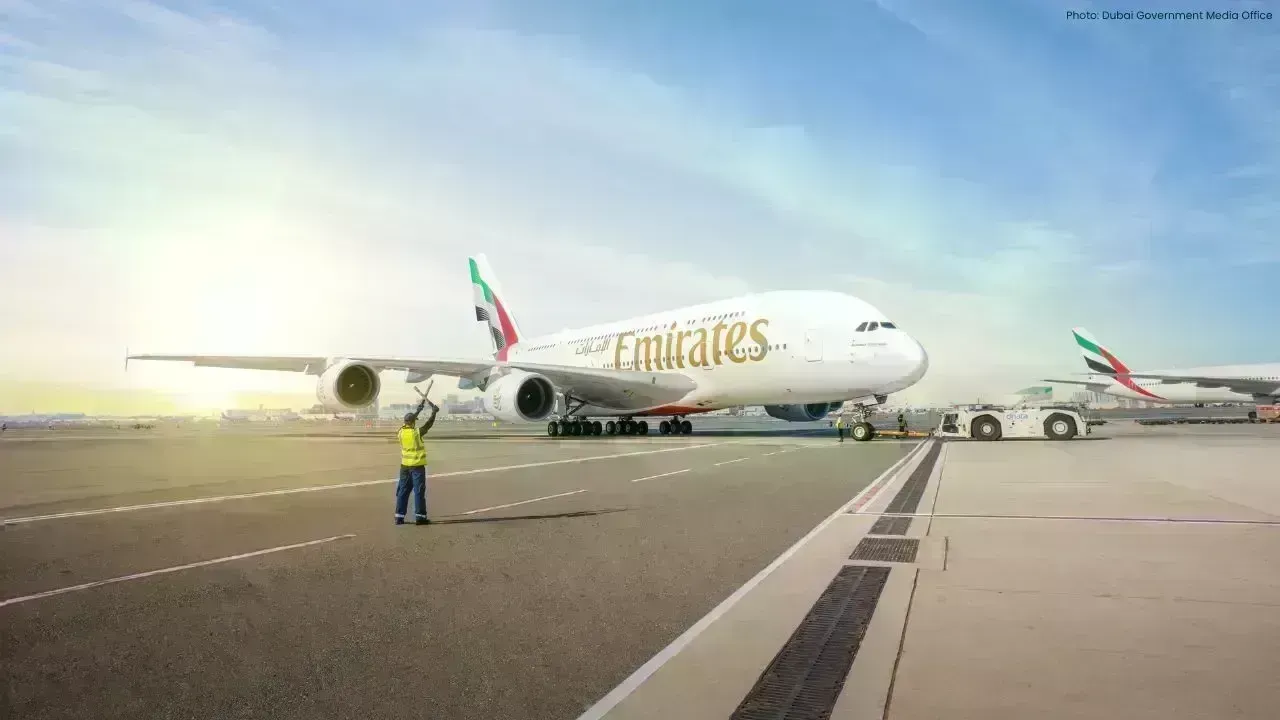
In a remarkable financial announcement, the Emirates Group has declared its highest-ever profits for the fiscal year 2025-26, overcoming significant disruptions in the Gulf region during the reporting period.
Concluding on March 31, 2026, the Dubai-based aviation powerhouse recorded a pre-tax profit of AED 24.4 billion (approximately US$ 6.6 billion), reflecting a 7% rise from the previous year. Additionally, the group’s revenue reached AED 150.5 billion (around US$ 41 billion), marking an annual increase of 3%.
The Group's cash reserves enhanced by 12% to AED 59.6 billion (about US$ 16.2 billion), while the EBITDA reported is AED 41.1 billion (nearly US$ 11.2 billion), signifying strong operational efficiency.
Accounting for the UAE's new corporate tax rate of 15%, aligned with the Pillar Two tax regulations, the net profit was AED 21 billion (approximately US$ 5.7 billion), up 3% compared to the previous financial year.
Emirates Maintains Title of Most Profitable Airline Worldwide
Emirates airline secured its reputation as the globe's most profitable airline throughout the 2025-26 fiscal year, reporting a pre-tax profit of AED 22.8 billion (around US$ 6.2 billion), a 7% increase, with a profit margin recorded at 17.4%.
Revenue climbed 2% to AED 130.9 billion (approximately US$ 35.7 billion), and cash reserves surged to AED 54.9 billion (about US$ 15 billion).
During the year, Emirates served 53.2 million passengers and achieved a passenger seat factor of 78.4%. The increase of 4% in passenger yield was attributed to robust travel demand and enhanced premium service offerings.
The cargo division, Emirates SkyCargo, successfully transported 2.4 million tonnes of freight, marking a 3% year-on-year growth, generating AED 16.2 billion in revenue.
Operational Challenges from Regional Tensions
Chairman and Chief Executive HH Sheikh Ahmed bin Saeed Al Maktoum expressed pride in the Group's performance, achieved amid military disruptions impacting air traffic in the Gulf in February 2026.
He noted that both Emirates and dnata acted swiftly to assist passengers, safeguard operations, and restore services at Dubai International Airport. Even though passenger capacity remained below pre-disruption figures, cargo operations expanded to facilitate the transport of essential goods.
Sheikh Ahmed emphasized that the Group's resilient business model and significant investments in technology, infrastructure, and customer service were crucial in navigating these challenges effectively.
Investment in Growth and Fleet Expansion
In the financial year of 2025-26, the Emirates Group channeled AED 17.9 billion (approximately US$ 4.9 billion) into acquiring new aircraft, advancing technology, and enhancing facilities to bolster future growth.
Emirates enriched its fleet with 15 Airbus A350 aircraft and expanded its operations to include four new destinations: Da Nang, Shenzhen, Hangzhou, and Siem Reap.
As of March 2026, Emirates operated flights to 152 different cities across 80 countries, with expanded partnerships enabling access to over 1,700 destinations globally.
At the Dubai Airshow 2025, the airline announced aircraft orders totaling US$ 41.4 billion, adding 65 Boeing 777-9 aircraft and eight additional Airbus A350-900 jets to its fleet.
The overall fleet comprised 277 aircraft, with an average age of 10.8 years.
dnata’s Strong Performance
dnata also recorded notable progress across its business ventures.
The aviation and travel service provider reported a pre-tax profit of AED 1.6 billion (about US$ 437 million), up 2% from the previous year.
Revenue surged by 12% to AED 23.6 billion (around US$ 6.4 billion), while cash assets increased by 28% to AED 4.7 billion (approximately US$ 1.3 billion).
dnata managed close to 889,000 aircraft movements globally and processed 3.2 million tonnes in cargo throughout the year.
The company is expanding its operations through investments in airport facilities, catering, and cargo infrastructures in nations like Australia, the Netherlands, and Italy.
Workforce and Future Perspectives
The Emirates Group's workforce has grown by 8%, reaching a total of 130,919 employees worldwide, with the number of UAE national employees surpassing 4,000 during the year.
Looking forward, Sheikh Ahmed affirmed the Group's financial stability despite ongoing geopolitical uncertainties in the Middle East.
He indicated that Emirates is well-prepared against fuel price fluctuations until 2028-29, and the Group will persist with investments in aircraft deliveries, customer experience enhancements, and operational growth initiatives.
The Group has also declared a dividend of AED 3.5 billion (approximately US$ 1 billion) to its owner, the Investment Corporation of Dubai.
Commitment to Sustainability and Community Engagement
Throughout 2025-26, the Emirates Group advanced its sustainability efforts through investments in sustainable aviation fuel research, electric ground vehicles, and waste reduction programs.
Furthermore, the Group actively supported numerous community and charitable initiatives globally, focusing on education, medical missions, youth sports programs, and food donation campaigns.










PM Modi Pays Tribute to Mahatma Gandhi, Urges People to Support Khadi
PM Modi pays tribute to Mahatma Gandhi on Gandhi Jayanti and urges citizens to support Khadi and the

Amazon Seeks to Offload $8 Billion in Nvidia Chips to Investors
Amazon plans to move $8 billion in Nvidia chips to investors, using a new financing model to strengt

Samsung Raises Galaxy S26 Prices as Memory Chip Costs Rise
Samsung raises Galaxy S26 prices in South Korea as rising memory chip costs put pressure on smartpho

Lewis Hamilton Calls Singapore Grand Prix One of F1's Toughest Races
Lewis Hamilton discusses the demanding Singapore Grand Prix and brings Plus44 and Almave to Singapor

Denmark's Pandora Opens World's Largest Jewellery Factory in Vietnam
Pandora opens its largest jewellery factory in Vietnam, expanding global production, strengthening s

Gautam Gambhir Questions Batting-Friendly Pitches After India's Record ODI Chase
Gautam Gambhir questions batting-friendly ODI pitches after India’s record chase, calling for a bett

