
You have not yet added any article to your bookmarks!
Join 10k+ people to get notified about new posts, news and tips.
Do not worry we don't spam!
Post by : Badri Ariffin
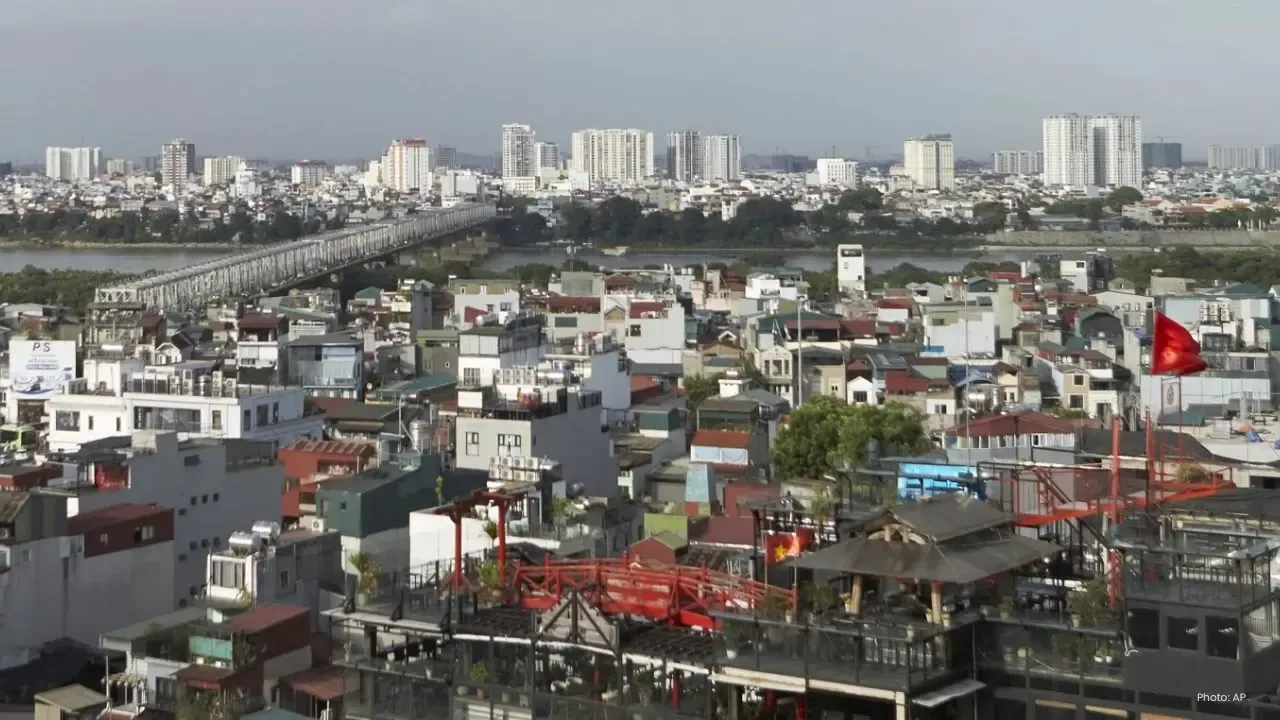
The sound of construction has become part of daily life across Hanoi as hydraulic breakers, excavators and demolition equipment reshape Vietnam's capital. Long-standing neighborhoods are being cleared as authorities move forward with an ambitious redevelopment plan designed to modernize the city for the next century.
During the first half of 2026, Hanoi spent $2.4 billion on land clearance for nearly 1,500 development projects, marking one of the biggest transformations in one of the world's oldest continuously inhabited capitals.
Officials say the redevelopment is intended to prepare the city for future growth while addressing environmental challenges. Planned improvements include flood-control systems and measures to reduce air pollution as Hanoi faces increasingly severe weather linked to climate change. Vietnam remains among the countries most vulnerable to extreme weather, including powerful typhoons, flooding and extreme heat. Hanoi also frequently ranks among the world's most polluted cities due to heavy smog.
However, the large-scale rebuilding has brought significant disruption. Dust from demolished buildings now spreads across surrounding neighborhoods, while many families have lost homes, businesses and familiar surroundings.
Among those affected is Nguyen Thi Nhan, who previously sold fruit from her 300-square-meter (3,230-square-foot) street-front home. The property was demolished to make space for a new road.
Nhan said she has not yet received compensation and is currently renting accommodation for her family and elderly parents. "We just have to wait. I don't know where they will relocate us," she said.
Large billboards across Hanoi present images of a modern city featuring glass towers, business districts, wide boulevards, parks and waterfront promenades.
The redevelopment includes replacing colonial-era villas, traditional narrow shophouses and densely packed low-rise buildings with new roads, bridges and transport links connecting airports and neighboring provinces.
At the center of the plan is a $28 billion redevelopment project covering both banks of the Red River. The project spans 11,400 hectares (28,170 acres)—an area larger than central Paris—and will introduce new roads, parks, urban districts and major drainage systems to reduce the city's long-standing flood problems.
Another major proposal is a $35.2 billion Olympic sports complex backed by Vingroup, Vietnam's largest company. The development will feature one of the world's biggest football stadiums, designed in the shape of a drum and capable of accommodating 135,000 spectators.
Authorities are also planning a large transport overhaul aimed at creating multiple transportation hubs to reduce pressure on Hanoi's historic center and support future urban growth.
Urban development experts believe the new infrastructure could strengthen Vietnam's economy by attracting more foreign investment and creating business opportunities.
Nguyen Khac Giang, a visiting fellow at the ISEAS–Yusof Ishak Institute in Singapore, said the modern infrastructure is important for Vietnam's long-term development. However, he warned that the construction boom could divert investment away from the high-tech industries the country wants to expand.
Giang also cautioned that rapidly rising property prices could expose banks to greater financial risks if the housing market weakens.
Housing costs have climbed sharply across Vietnam's largest cities, making home ownership increasingly difficult for many people. At the same time, numerous property developers carry heavy debt burdens that exceed those of similar companies in countries such as Indonesia and the Philippines, according to a 2025 S&P Global report.
Although real estate contributes around 3.5% of Vietnam's gross domestic product, it represents roughly 25% of total bank lending.
"There are huge economic opportunities arising from those projects, but at the same time, there are risks that need to be considered," Giang said.
As reconstruction continues, many residents worry about the future of their neighborhoods and the traditions that have shaped Hanoi for generations.
Even relatively small changes have affected daily life. Since November, city authorities have intensified efforts to remove illegal parking, street vendors and commercial structures from sidewalks. Police vehicles regularly patrol Hanoi's Old Quarter, using loudspeakers to instruct vendors to clear plastic stools and tables placed on public walkways.
A beef noodle soup vendor identified only as Thuy said removing the four tables and stools outside her shop has reduced the number of customers she can serve.
"My profits are already small to begin with," she said.
Meanwhile, residents of the Bac Cau community along the Red River have publicly displayed banners asking authorities to halt redevelopment plans that could force thousands of families to relocate.
Local resident Van, who gave only her first name because of concerns about speaking publicly, said the community hopes to remain where generations of families have lived. "We want to continue to live here, we've been here for generations," she said.
Hanoi has established compensation and resettlement policies covering land acquired for redevelopment, including payments for damaged buildings, relocation costs and financial assistance for families relocating graves.
Despite these policies, several residents say they have not yet received compensation and remain uncertain about where they will be relocated.
Giang said the issue is not modernization itself but the speed of redevelopment and limited consultation with residents and experts. He believes greater efforts should be made to preserve Hanoi's history, traditional streets and local livelihoods while carrying out modernization.
He pointed to Beijing, where most of the city's centuries-old walls were demolished during the 1960s to make way for its first subway line and a major ring road. Similar redevelopment projects in China and other Asian cities also led to disputes after residents were relocated to suburban areas with limited public services, weakening long-established communities. "Once we depart from the city's history, it's very hard to revert or to turn back," Giang said.
Linh Nguyen, lead analyst at Control Risks, said Hanoi's current redevelopment differs from the city's expansion over the past two decades.
Instead of building entirely new urban areas, authorities are now focusing on rebuilding existing neighborhoods and relocating institutions. This process is more complicated because it involves residents, property ownership, compensation and coordination between multiple government agencies.
According to Nguyen, the success of the redevelopment will largely depend on how effectively authorities manage land acquisition, relocation and project implementation.
"The last 20 years were about building a bigger Hanoi. The next 20 years will be about rebuilding the Hanoi that already exists. That's a fundamentally different challenge," she said.









PM Modi Pays Tribute to Mahatma Gandhi, Urges People to Support Khadi
PM Modi pays tribute to Mahatma Gandhi on Gandhi Jayanti and urges citizens to support Khadi and the

Amazon Seeks to Offload $8 Billion in Nvidia Chips to Investors
Amazon plans to move $8 billion in Nvidia chips to investors, using a new financing model to strengt

Samsung Raises Galaxy S26 Prices as Memory Chip Costs Rise
Samsung raises Galaxy S26 prices in South Korea as rising memory chip costs put pressure on smartpho

Lewis Hamilton Calls Singapore Grand Prix One of F1's Toughest Races
Lewis Hamilton discusses the demanding Singapore Grand Prix and brings Plus44 and Almave to Singapor

Denmark's Pandora Opens World's Largest Jewellery Factory in Vietnam
Pandora opens its largest jewellery factory in Vietnam, expanding global production, strengthening s

Gautam Gambhir Questions Batting-Friendly Pitches After India's Record ODI Chase
Gautam Gambhir questions batting-friendly ODI pitches after India’s record chase, calling for a bett

