You have not yet added any article to your bookmarks!
Join 10k+ people to get notified about new posts, news and tips.
Do not worry we don't spam!
Post by : Meena Ariff
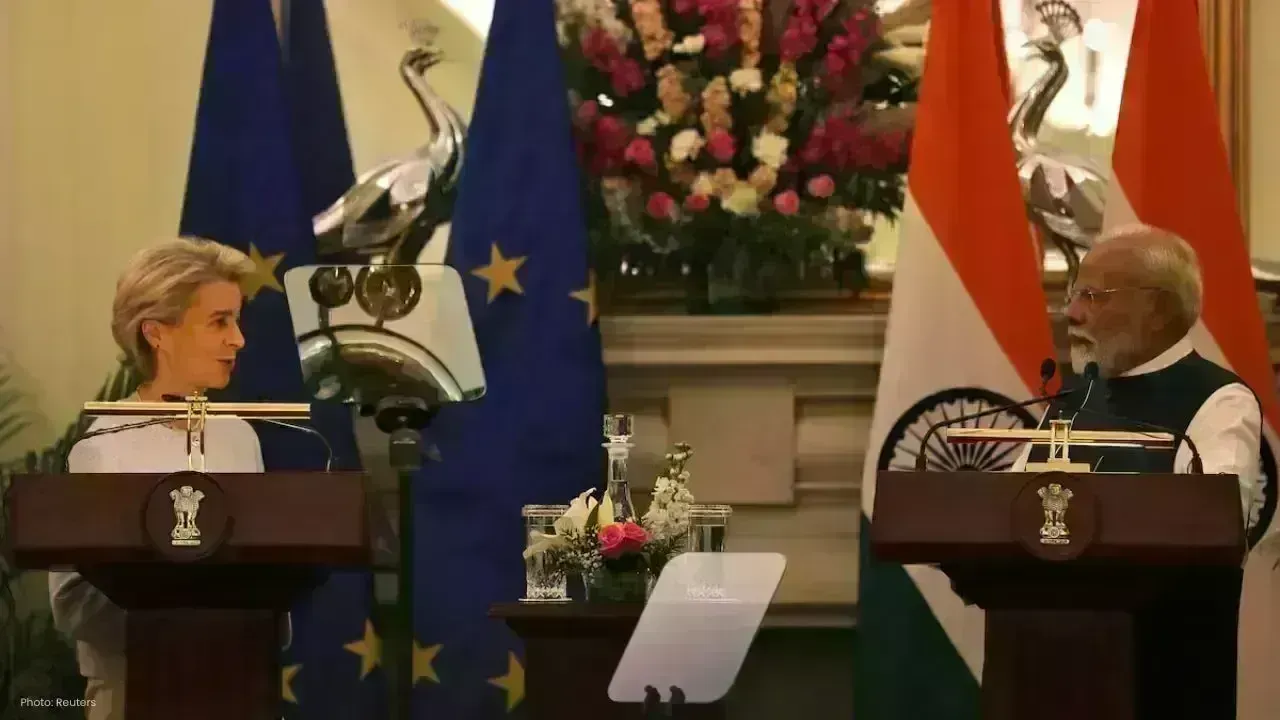
European Council President Antonio Luís Santos da Costa and European Commission President Ursula von der Leyen will attend India’s Republic Day celebrations next Monday as chief guests. While the visit includes ceremonial events, the key focus will be on strengthening India-European Union trade ties at a time when global trade is facing fresh uncertainty.
Along with state banquets and official meetings, both leaders are expected to hold discussions aimed at moving forward the long-pending India-EU Free Trade Agreement (FTA). The talks are gaining momentum as Europe and India seek stronger partnerships beyond traditional allies, especially after ongoing disagreements over tariffs and trade policies involving the United States.
The presence of the EU’s top leadership at India’s national event is being seen as more than a symbolic gesture. Analysts believe it reflects India’s effort to maintain a balanced and diversified foreign policy while stepping up economic engagement with global partners.
The move also comes as trade tensions between India and the United States remain unresolved, with the issue of a 50% tariff dispute continuing into the new year. In this environment, closer trade coordination with the EU becomes strategically important for New Delhi.
Reports suggest that a major breakthrough could happen as early as 27 January, when leaders from both sides are set to meet during a high-level summit. The proposed agreement has been described by senior leaders on both ends as the “mother of all deals”, underlining the scale and importance of the pact.
Negotiations have been going on for nearly two decades, often slowed by differences over market access, regulations, and sensitive domestic sectors. However, the latest developments indicate both sides may now be closer than ever to reaching the finish line.
If finalised, the India-EU pact would become India’s ninth FTA in the last four years. India has recently signed or advanced trade agreements with countries like the UK, Oman, New Zealand, and others as part of its broader push to diversify trade routes and reduce dependence on any single market.
For the European Union, the agreement would build on its recent trade progress with global partners, including deals with Japan, South Korea, Vietnam, and the Mercosur bloc.
The European Union sees India as a rising global economic force. India is currently the fourth-largest economy and one of the fastest-growing major economies in the world. It is also expected to cross $4 trillion in GDP, which would place it ahead of Japan this year.
EU leadership has highlighted that deeper cooperation with India could create a vast market of around two billion consumers, representing nearly a quarter of global economic activity. This makes India an increasingly valuable long-term partner for Europe as it rebalances trade priorities.
For India, the EU remains its largest trading bloc, and a trade agreement could strengthen India’s exports to European markets. India exported around $76 billion worth of goods to the EU while importing about $61 billion, giving India a trade surplus.
A major advantage of this deal would be restoring stronger market access after the EU’s Generalised System of Preferences (GSP) benefits were withdrawn in 2023. The removal of these benefits reduced competitiveness for several Indian exports in Europe.
If an FTA is signed, India could see lower tariff burdens on key export categories such as garments and textiles, pharmaceuticals, steel, petroleum products, machinery and industrial goods. This would also help Indian companies absorb the impact of higher tariffs and disruptions in other global markets.
India is expected to protect politically sensitive areas such as agriculture and dairy during negotiations. Meanwhile, tariff reductions in sectors like cars, wine, and spirits may happen gradually through a phased approach, similar to how India structured earlier agreements, including the one with the UK.
This step-by-step method allows India to move forward with major deals while leaving the most sensitive issues for later rounds, helping manage domestic concerns.
Even with strong progress, the agreement still faces some serious hurdles. The EU wants stronger safeguards on issues like intellectual property protection, data protection standards, and stronger patent regulations.
For India, a major dispute point is the EU’s new carbon-related mechanism called CBAM (Carbon Border Adjustment Mechanism), which begins this year. Experts say CBAM could act like an additional cost on Indian exports even if import duties are reduced under the trade deal.
This could be especially difficult for micro, small and medium enterprises (MSMEs), due to increased compliance requirements, reporting complexity, and potential penalties based on default emissions estimates.
Despite the unresolved issues, many experts believe the India-EU pact could become a strong long-term partnership. It may help both sides reduce their vulnerability to sudden tariff shocks, supply-chain disruptions, and shifting trade policies across major powers.
Some concerns have also been raised in Europe regarding India’s carbon emissions and human rights discussions, which may lead to debate in the EU parliament, whose approval will be needed for the deal to take effect.
However, analysts say India’s reported reduction in Russian crude oil purchases since November 2025 could improve the agreement’s acceptance within the EU.
The deal is moving faster now largely because both sides see the need for stable trade partnerships amid growing geopolitical uncertainty. With global trade increasingly influenced by political tensions, India and Europe appear ready to take a major step toward a deeper economic alliance.
If finalised, this agreement could become one of the most important trade deals for India in recent years, and a strategic boost for Europe’s efforts to secure reliable partners in Asia.




Indian National Among 4 Killed In Georgia Shooting, Suspect Held
An Indian national was among four people killed in a Georgia home shooting linked to a family disput
Trump Slams Canada Over “Golden Dome”, Warns China May Take Over Soon
Trump criticised Canada for rejecting the “Golden Dome” plan over Greenland and warned China could d

Pritchard’s 32 Points Push Celtics Past Nets 130-126 in 2OT Thriller
Payton Pritchard scored 32 as Boston beat Brooklyn 130-126 in double overtime, sealed by Amari Willi

Indian Man Dies Mysteriously at Phuket Music Festival, Cause Unknown
remove news channal name give me rewrit in this news and full detaike news.news like orignal and tre

Manchester City Signs England Defender Marc Guehi From Crystal Palace
Manchester City signs 25-year-old England defender Marc Guehi from Crystal Palace for £20m, boosting

Japan Snap Election Sparks Bond Surge Amid Finance Concerns
Japan’s PM calls early election to back reflation plan. Bond yields hit decades-high as voters weigh