You have not yet added any article to your bookmarks!
Join 10k+ people to get notified about new posts, news and tips.
Do not worry we don't spam!
Post by : Anis Farhan
On January 26, 2026, India observes its 77th Republic Day, commemorating the day the Constitution of India came into force and established the nation as a sovereign democratic republic. This annual celebration is one of the most revered national occasions in the country, marked by grand parades, cultural pageantry, military displays, and patriotic fervour across cities and towns. Republic Day holds a unique place in Indian civil life, serving as a reminder of the collective aspirations enshrined in the Constitution and the enduring commitment to democratic values, justice, liberty, equality, and fraternity.
Unlike Independence Day (celebrated on August 15 to mark freedom from colonial rule), Republic Day honours the adoption and implementation of the Constitution in 1950 — establishing India’s governance framework and institutional identity. Since the first celebration in 1950, Republic Day has become a symbol of India’s constitutional tradition and its evolution as the world’s largest democracy.
A recurring question each year is whether the celebration in 2026 should be counted as the 77th or 78th Republic Day. The answer lies in how the count originates. India began observing Republic Day on January 26, 1950, when the Constitution came into effect. That landmark event is considered the first Republic Day. Counting forward from 1950, by 2026, the nation has completed 77 such observances, making January 26, 2026 the 77th Republic Day.
The confusion sometimes arises when people mistakenly start counting from a subsequent year or add calendar years without acknowledging that the count begins with the first Republic Day itself — rather than a “zero year.” This clear arithmetic and historical context affirm that 2026 marks 77 years since the Constitution’s enforcement and thus the 77th Republic Day.
India’s Republic Day finds its roots in developments that unfolded over several years. After achieving Independence on August 15, 1947, India did not immediately have a permanent constitutional framework. Until a Constitution was framed, the country continued to operate under the Government of India Act, 1935, a relic of colonial rule.
The need for a sovereign, self-determined legal structure led to the formation of a Constituent Assembly, chaired by Dr B.R. Ambedkar, which devoted nearly three years to framing a comprehensive Constitution that would reflect the diverse aspirations and democratic ethos of India.
After extensive debate, revision, and deliberation, the Constitution was adopted on November 26, 1949. However, it was set to come into full force on January 26, 1950 — chosen deliberately to commemorate the Purna Swaraj Declaration of 1930, when Indians first asserted the demand for complete independence from colonial rule.
On January 26, 1950, India transitioned from a dominion within the British Commonwealth to a sovereign republic governed by a constitution of its own choosing. It was on this day that:
Dr Rajendra Prasad became the first President of India.
The Constituent Assembly became the sovereign Legislature — the Parliament of India.
The Constitution of India replaced the colonial Government of India Act, 1935, marking a new era of democratic governance.
Thus, Republic Day is not just a celebration of a calendar date but a tribute to India’s constitutional identity and democratic evolution.
Republic Day celebrations often embody themes that reflect India’s current aspirations and national priorities. In 2026, while the official narrative emphasises ‘Vande Mataram’ and ‘Aatmanirbhar Bharat’ (self-reliant India), broader themes such as national unity, economic resilience, technological progress, and cultural diversity continue to underscore the celebrations.
Republic Day serves as a platform to highlight India’s achievements across defence, space, infrastructure, digital innovation, and social welfare — blending tradition with the promise of a future defined by sustainability, equity, and global engagement.
Republic Day also holds diplomatic significance. In 2026, leaders such as the European Council President and European Commission President are invited as chief guests, symbolising India’s strengthened strategic partnerships and global outreach.
This aspect of Republic Day highlights its role not just as a domestic celebration but as a medium for showcasing India’s international relations and collaborative progress.
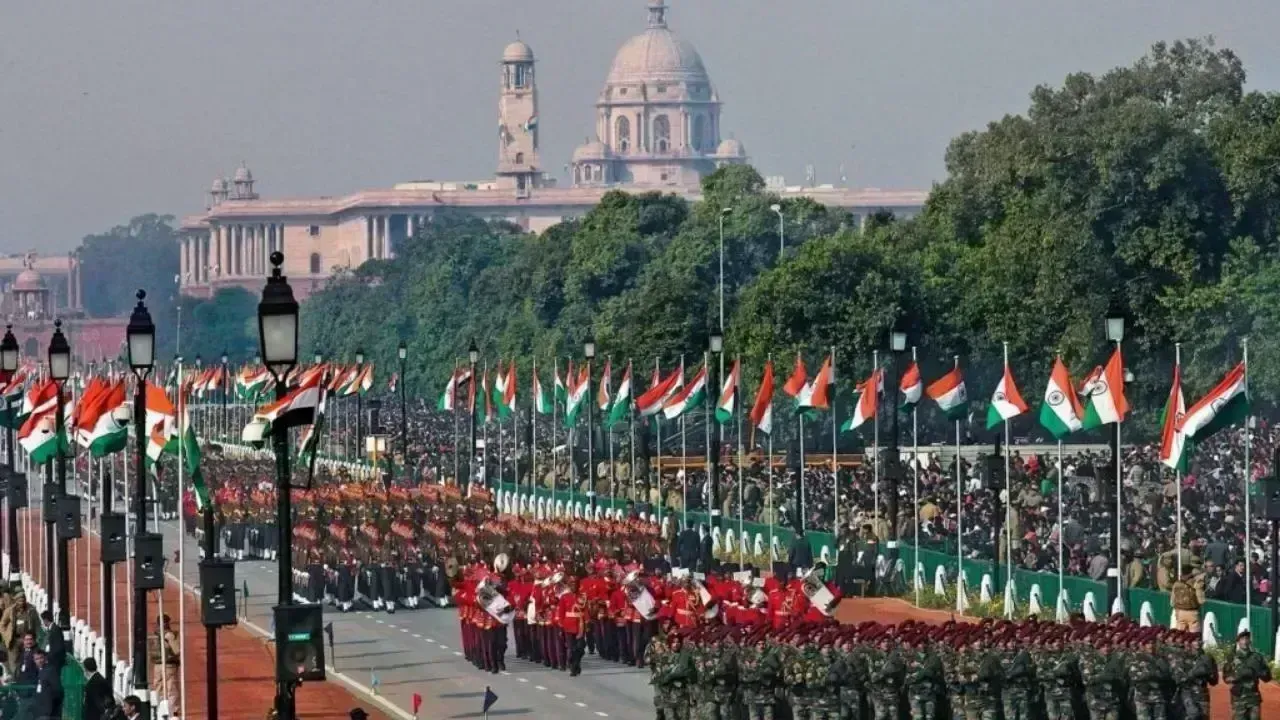
The Republic Day Parade stands as the most iconic element of the celebrations. The procession takes place at Kartavya Path (formerly known as Rajpath) in New Delhi, spreading from Rashtrapati Bhavan through India Gate to the Red Fort.
Each year’s parade is meticulously choreographed, combining:
Military formations and armed forces contingents
Cultural tableaux representing states and ministries
Marching bands and aerial displays
Performance sequences symbolising India’s heritage, progress, and unity
Flag Hoisting and Presidential Address:
The President of India hoists the Tri-Colour and addresses the nation, invoking the spirit of the Constitution and reinforcing unity.
Military and Defence Display:
The parade features battalions from the Army, Navy, and Air Force, showcasing weapons, vehicles, and equipment that reflect India’s defence capabilities.
Cultural and Social Tableaux:
States present artistic representations of cultural heritage, technological achievements, and community values — weaving a narrative of diversity and unity.
Aerial Display:
The Indian Air Force performs precision flying, often in formations bent in the colours of the national flag.
Awards and Honours:
The day also celebrates the conferment of Padma Awards and other honours that recognise contributions to national life.
The parade culminates in a celebration of Indian identity — affirming the democratic principles that guide the nation.
Beyond the capital, Republic Day is observed across India with flag-hoisting ceremonies in schools, colleges, universities, and municipal bodies. Citizens stand in salute as the national anthem is played and interpretive events pay homage to the sacrifices and ideals of freedom struggle leaders.
Republic Day is also an occasion for cultural programmes that emphasise patriotism, civic awareness, and social harmony. Schools often organise debates, quizzes, and performances that reinforce constitutional values among younger generations.
In many regions, local governments and community organisations host events that reflect regional heritage — yet align with the national narrative of unity in diversity.
The scale of Republic Day celebrations necessitates rigorous security arrangements to ensure safety and smooth conduct of public events. Law enforcement agencies deploy layered security protocols, including CCTV surveillance, crowd management strategies, and emergency coordination mechanisms.
With large crowds expected in the capital and around major observance centres nationwide, authorities issue travel advisories — especially near Indira Gandhi International Airport, where temporary flight disruptions or airspace restrictions may apply around Republic Day parades.
Public cooperation is sought to adhere to guidelines, arrive early for ceremonies, and follow safety instructions — ensuring a dignified and peaceful celebration.
Republic Day resonates beyond formal ceremonies — it flourishes in popular culture and digital spaces. Patriotic messages, historical retrospectives, iconic images from parades, and stories of national heroes flood social media platforms. Quotes, poems, and reflections become part of everyday discourse, reinforcing collective memory and national pride.
Across India’s linguistic and regional spectrum, tributes to Republic Day capture diverse expressions of love for the nation — transforming January 26 into a shared cultural moment.
Republic Day 2026 stands as a significant milestone marking India’s 77th anniversary of adopting its Constitution. It is a reminder that nearly eight decades of constitutional governance have shaped India’s journey from colonial legacy to a resilient modern republic. The celebrations encapsulate democratic ideals, cultural vibrancy, national unity, and the collective pursuit of progress.
As the nation unfurls the Tricolour, witnesses majestic parades, and engages in cultural reflection, Republic Day remains a testament to the enduring spirit of India — a celebration rooted not merely in commemoration, but in the ongoing promise of liberty, justice, and equity for all citizens.
Disclaimer:
The content above is a comprehensive analysis of India’s Republic Day 2026 based on current information and historical context. It is intended for informational and educational purposes only, and should not be construed as official government communication.







Danaher to Launch AI-Powered Autonomous Research Lab in 2027
Danaher plans an AI research lab for 2027, combining robotics and automation to speed up drug discov

Musk Welcomes German Support for Tesla Driver Assistance Tech as EU Approval Push Continues
Elon Musk welcomes Germany's backing for Tesla FSD as the company seeks EU approval amid speed, safe

Microsoft and Nvidia CEOs to Unveil AI Laptop at San Francisco Event
Microsoft and Nvidia showcase a new AI laptop with RTX Spark chips as they push powerful local AI co

Man to face charges over perfume thefts at Changi Airport
A 47-year-old man faces charges over perfume theft at Changi Airport after six items worth nearly S$

Google Signs 3.6-GW Power Deal With Constellation Energy in US
Google signs a 3.6-GW power deal with Constellation Energy, including nuclear power upgrades to supp

Harmanpreet Kaur Steps Down as India Captain Across All Formats
Harmanpreet Kaur steps down as India captain across all formats after a remarkable leadership journe