You have not yet added any article to your bookmarks!
Join 10k+ people to get notified about new posts, news and tips.
Do not worry we don't spam!
Post by : Meena Ariff
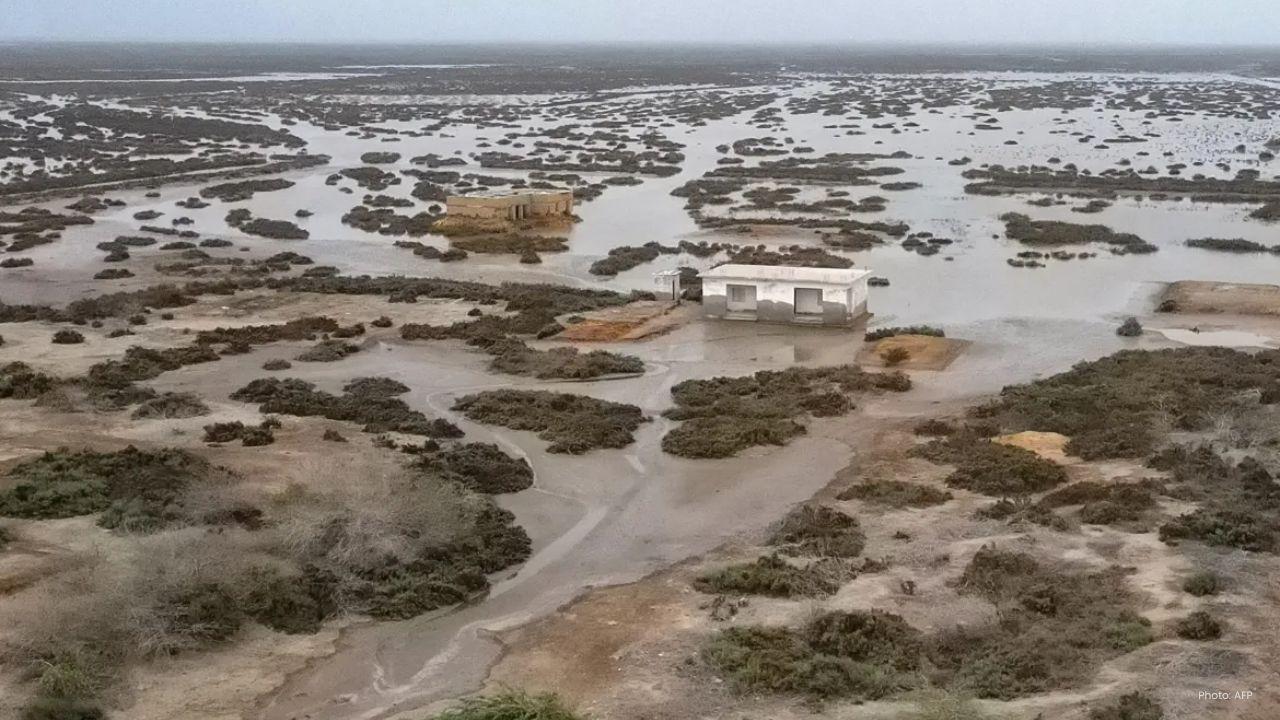
In a quiet village of the Indus delta, 54-year-old Habibullah Khatti walks across dry, salty land to visit his mother’s grave one last time. His village, Abdullah Mirbahar in Kharo Chan town, is slowly being swallowed by seawater. Once full of life and families, it is now nearly empty. Wooden and bamboo homes stand deserted, and silence fills the air at night. Only stray dogs roam around, adding to the sadness.
Khatti is one of the few remaining residents—only four out of 150 households remain. Once a fisherman, he switched to tailoring when the fish disappeared. Now, that work too is gone. With no water for crops, no fish in the sea, and no customers left, Khatti is preparing to move his family to Karachi, the country’s largest city.
Kharo Chan’s Slow Disappearance
Kharo Chan town once had around 40 villages. Over the years, many have vanished under rising seawater. In 1981, the population was about 26,000. By 2023, it had dropped to 11,000. People are not just leaving because they want to — they are forced to. Fields have turned salty. Fish, shrimp, and crabs that once supported families are gone. Villagers say it feels like being trapped, with seawater surrounding them from all sides.
Why Is This Happening?
The Indus delta is where the mighty Indus River meets the Arabian Sea in southern Pakistan. The river starts far away in Tibet, flows through Kashmir, and crosses Pakistan from north to south. It is the lifeline of the country, helping grow food and giving water to millions.
But things have changed. Over the last 70 years, the amount of freshwater reaching the delta has fallen by 80%. This is because of:
Because of this, seawater has started to move further inland. The salt from the sea destroys farmland and kills plants. A study found that water salinity has gone up by 70% since 1990. Around 16% of once-fertile farmland is now unusable.
The Struggle for Drinking Water
In the town of Keti Bandar, the situation is even worse. Salt covers the land like white snow. Drinking water is brought in by boats from far away. People use donkeys to carry it back to their homes.
Haji Karam Jat, a local man, lost his home to the rising seawater. He had no choice but to rebuild farther inland, hoping others would do the same. He says, “Who leaves their homeland willingly? A person only leaves when there is no other option left.”
Impact on People and Culture
This crisis has forced tens of thousands of people to leave their homes. Some studies say more than 1.2 million people have been displaced from the Indus delta in just the last 20 years. Cities like Karachi are seeing a huge increase in migrants from the region.
Women are facing major difficulties. For generations, they have helped support families by stitching fishing nets and processing seafood. But in the cities, these traditional skills are no longer useful. Finding jobs is hard. Fatima Majeed, a climate activist whose family also left the delta, said, “We haven’t just lost our land; we’ve lost our culture.”
How Did It All Begin?
The changes to the Indus River didn’t start recently. The British, during their rule, built the first canals and dams. Later, Pakistan added many more, including hydropower projects. Earlier this year, new military-led canal projects were stopped after protests by farmers in Sindh, a southern province.
These changes reduced the natural flow of water to the delta, making it dry and weak against the sea. What was once a lush green area full of mangroves and wildlife is now dry and salty.
Efforts to Save the Delta
The government, along with the United Nations, launched the “Living Indus Initiative” in 2021. This plan tries to save the river by:
Protecting agriculture and mangroves
Restoring soil health
Improving water management
In Sindh, local authorities are also trying to grow mangroves again. These trees act as a natural wall, stopping the seawater from moving inland. But at the same time, mangrove forests are being cut down for new housing projects and land development. This makes the situation worse.
Threat from India
There is also tension between Pakistan and India over the Indus River. India recently canceled a 1960 water treaty that divided control of the river. India now says it may build more dams upstream, reducing the water that flows into Pakistan. Pakistani officials have called this a serious threat and even described it as “an act of war.”
Hope, But a Long Road Ahead
The Indus delta is dying, and with it, an entire way of life. Farming, fishing, and centuries-old traditions are disappearing. The people of the delta are not just losing land—they are losing their identity, culture, and future.
Still, there is hope. If steps are taken to manage water wisely, restore nature, and protect people’s rights, the delta may still survive. But time is running out. And for people like Habibullah Khatti, the decision to leave is not one of choice, but of heartbreak.








PSG Coach Luis Enrique Urges Players to Step Outside Comfort Zone
PSG coach Luis Enrique says players must leave their comfort zone and keep improving as the club tar

China’s Tiangong Sets New 400m Record at Robot Olympics
China’s Tiangong robot sets a new 400m record at the Robot Olympics, beating a South African robot i

George Russell Wins Dutch GP Sprint, Boosts Mercedes Morale
George Russell wins the Dutch GP Sprint from pole as Mercedes teammate Kimi Antonelli extends his F1

Australia 50/3 After Bangladesh Bowled Out for 64 in Second Test
Australia reached 50/3 after Bangladesh were bowled out for 64 in the second Test, with Mitchell Sta

Jordan Burroughs Returns to Wrestling with 2028 Olympic Dream
Jordan Burroughs returns to wrestling with Real American Freestyle as the Olympic champion eyes a po

Lamborghini Catches Fire on Singapore's ECP, Causing Heavy Traffic
A Lamborghini caught fire on Singapore's ECP, causing heavy traffic and bus delays. No injuries were