You have not yet added any article to your bookmarks!
Join 10k+ people to get notified about new posts, news and tips.
Do not worry we don't spam!
Post by : Rohit Dhiman
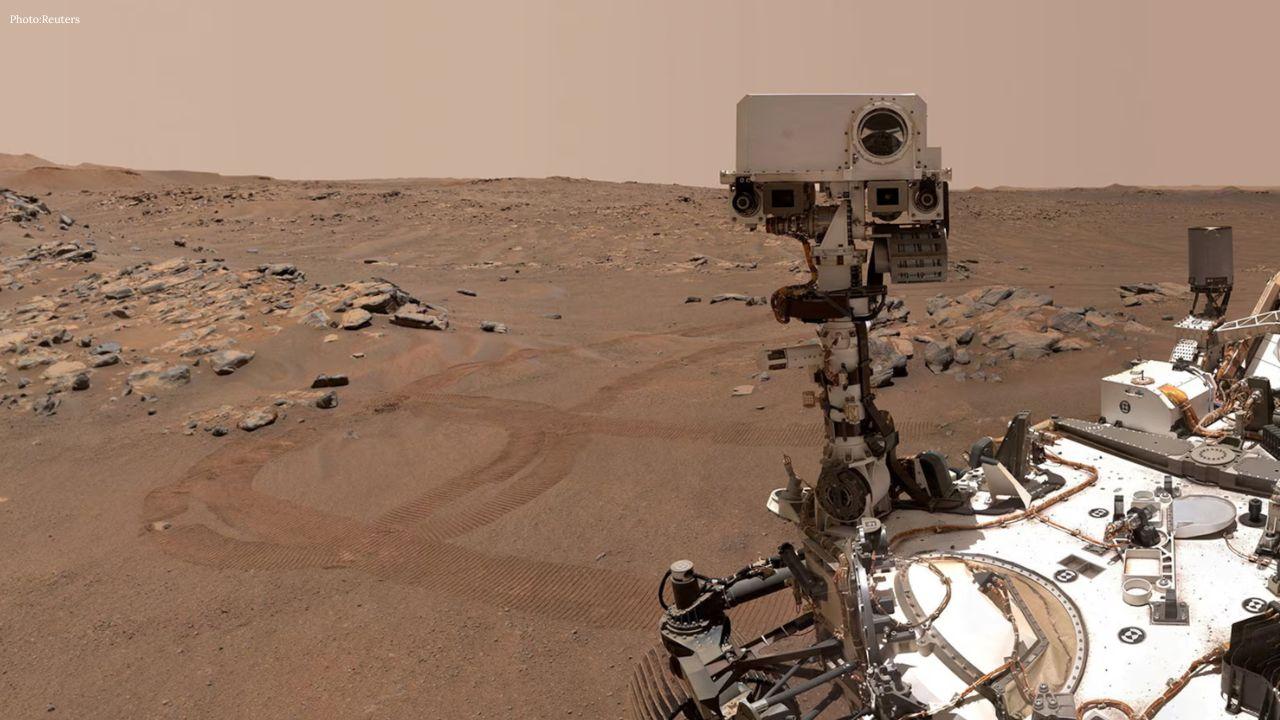
NASA’s Perseverance rover has set a new record for driving distance on the surface of another world, excluding Earth. Since landing on Mars in 2021, the six-wheeled robotic vehicle has travelled approximately 28.1 miles, or 45.2 kilometres, surpassing the previous record held by NASA’s Opportunity rover. The US space agency announced the achievement on October 13, 2026, marking an important milestone in a mission designed to investigate the planet’s ancient environment and determine whether conditions that could have supported microbial life once existed there. The car-sized rover has been operating on Mars for around five and a half years. During that time, it has travelled across challenging terrain, examined ancient rocks and collected scientific data to help researchers understand the planet’s geological history. The record is particularly significant because Perseverance was originally expected to drive only about 20 kilometres during its mission. It has now covered more than twice that planned distance, while NASA says its major engineering systems remain in excellent condition.
Before Perseverance reached the new milestone, NASA’s Opportunity rover held the record for the longest driving distance on the surface of Mars. Opportunity travelled approximately 28.06 miles, or around 45 kilometres, during its mission from 2004 to 2018. Perseverance has now moved beyond that distance, making it the farthest-driving vehicle on the surface of another world outside Earth. Both rovers have also travelled farther than vehicles previously operated on the Moon. The achievement highlights how robotic exploration has advanced over the past two decades. Engineers have continued improving navigation, onboard computing and mobility systems, allowing newer rovers to cover more ground and work more independently. Steven Lee of NASA’s Jet Propulsion Laboratory in California, who manages the Perseverance and Curiosity rover projects, said an assessment of the rover’s systems found them capable of continuing to operate well into the 2030s, and potentially beyond.
Read Also: CJP Leaders Detained After Entering Delhi's Jantar Mantar
Perseverance is exploring Jezero Crater, a region in the northern hemisphere of Mars that scientists believe once contained a lake and was flooded by water billions of years ago. The area is especially valuable to researchers because ancient river channels, lake sediments and other geological features may preserve evidence of the planet’s distant past. By studying these formations, scientists hope to establish how Mars changed from a world that may once have had environments suitable for life into the cold, dry planet seen today. The rover achieved its driving record while travelling towards a region known as Idubi, passing through terrain near the crater’s western rim called Lac de Charmes. This landscape may provide information about the early geological development of Mars, including the effects of large meteorite impacts. Jezero Crater itself was formed by a major impact early in Martian history. Scientists are interested in such locations because some researchers have proposed that similar warm, water-rich environments may have played a role in the origins of life on Earth.
One of the main reasons behind Perseverance’s long-distance achievement is its autonomous navigation technology, known as AutoNav. NASA says approximately 90 per cent of the rover’s drives are completed autonomously, meaning the vehicle can make many navigation decisions without continuous human intervention. Communication between Earth and Mars takes time, so a rover cannot rely on immediate instructions for every movement. Instead, Perseverance uses cameras to examine the terrain ahead, creates a three-dimensional digital map and calculates a safer route towards its destination. This process allows the vehicle to identify obstacles and select a path through unfamiliar ground. Autonomous driving reduces the need for ground teams to plan every small movement individually and helps the rover make progress across complex terrain. Earlier Mars rovers had to pause more frequently to process information between sections of a drive. Improvements in computing and navigation have helped Perseverance move more efficiently across the Martian landscape.
NASA is also testing the rover’s mobility systems to assess how far they could potentially carry it. According to Lee, the mechanisms are being evaluated to demonstrate the ability to drive 100 kilometres, or approximately 62 miles, or more. The testing programme is designed to assess the hardware against distances equivalent to around 150 to 300 kilometres, or approximately 93 to 186 miles. These figures refer to the scope of the engineering tests and should not be confused with the distance the rover has already travelled. The tests could help NASA understand how much operational life remains in the rover’s mobility equipment and how far the vehicle may be able to travel in the future. Perseverance’s power system, which uses plutonium to generate electricity, is also performing as expected. NASA says the system still has many years of useful energy available.
Although the driving record is a major engineering achievement, NASA’s central scientific objective remains the search for evidence that Mars may once have supported microbial life. Lee identified the rover’s discovery of a potential biosignature, announced in 2025, as one of the mission’s most important achievements. A biosignature is a feature or substance that could indicate past or present life, although further scientific investigation is needed before such evidence can be considered conclusive. The potential biosignature was identified in reddish rock believed to have formed between 3.2 billion and 3.8 billion years ago. The rock is associated with a river channel that once fed the lake thought to have occupied Jezero Crater. The discovery is significant because liquid water is considered an important requirement for life as scientists understand it. However, evidence that a rock may contain a biosignature does not by itself prove that life existed on Mars. Researchers must examine alternative explanations and assess the evidence carefully.
NASA has approved an extension allowing Perseverance to continue exploring the rim of Jezero Crater until approximately the end of 2028. The extended mission gives the rover more time to investigate geological formations that may preserve clues about the planet’s early history. Areas around the crater rim are particularly interesting because impact events and possible hydrothermal activity may have altered the rocks and created different environments in the ancient past. The extension also allows NASA to make further use of a rover that continues to operate beyond its original driving target. Its ongoing performance will depend on the condition of its instruments, power supply, mobility mechanisms and other essential systems. Perseverance’s progress demonstrates how long-running robotic missions can continue producing scientific results well after their initial objectives have been met. Each additional journey provides researchers with more observations from a planet whose ancient environment remains only partly understood.
The new record is more than a measure of distance. It demonstrates the growing capability of robotic vehicles to navigate independently across another planet while carrying out complex scientific work. Perseverance combines autonomous driving, advanced computing and scientific instruments to explore areas that would be difficult to investigate from orbit alone. Its observations help researchers connect individual rock samples and landforms with the wider history of Mars.







Beauden Barrett Opens Up About Mental Struggles During All Blacks Exile
Beauden Barrett discusses his confidence struggles after missing six tests, his return against Austr

IMF Says AI Investment Supports Global Growth Despite Energy Shock
IMF says AI investment is supporting global growth near 3%, with Asian economies benefiting from ris

Will O'Rourke Ruled Out of New Zealand's India Series
New Zealand fast bowler Will O'Rourke will miss the India series with hamstring and calf injuries as

AI Companies Expected to Drive Most US Earnings Growth in Q3
AI companies are expected to drive US third-quarter earnings growth as investors assess tech profits

Money Market Funds See Record Inflows as Global Bond Selloff Intensifies
Global money market funds attract $153.81 billion as bond yields rise, inflation fears persist and i

Meta Bans TikTok Ads on Facebook and Instagram in Seven Countries
Meta has banned TikTok ads in seven countries, escalating competition over social media users, adver