You have not yet added any article to your bookmarks!
Join 10k+ people to get notified about new posts, news and tips.
Do not worry we don't spam!
Post by : Rohit Dhiman
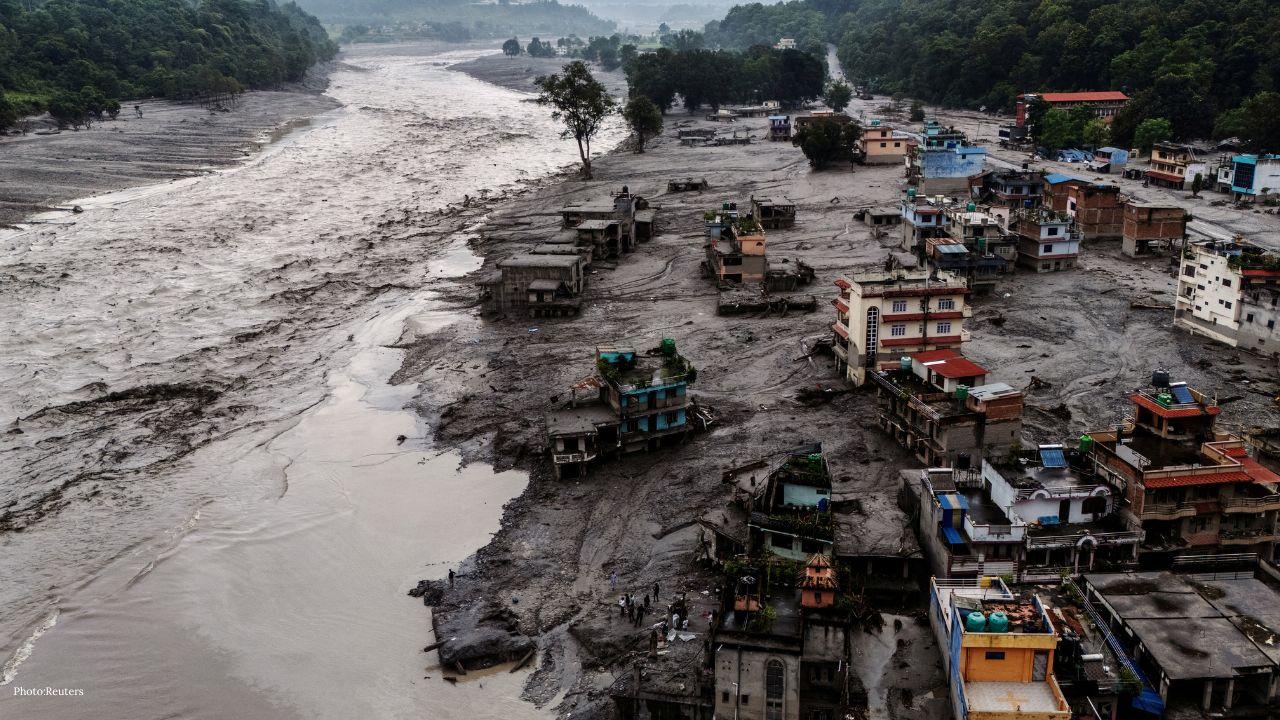
Nepal’s devastating floods have raised fresh concerns in India, particularly across the northern and eastern regions that depend on rivers originating in the Himalayan country. The two nations share a large network of rivers, meaning severe weather and flooding in Nepal can have consequences downstream in India. Nepal has more than 6,000 rivers and streams, with most flowing south towards India and eventually joining the Ganges system. The Kosi, Gandaki, Karnali and Mahakali are among the major river systems connecting the two countries. Smaller rivers such as the Bagmati, Kamala, Rapti and Babai can also create sudden and difficult-to-predict flooding. The situation is particularly important for Bihar, where around three-quarters of north Bihar is officially considered flood-prone. Eastern Uttar Pradesh, Uttarakhand and parts of North Bengal also face risks from rivers originating or flowing through Nepal.
The biggest connection between the two countries is their shared river system. Heavy rainfall in Nepal can increase the amount of water moving towards the Indian plains, but experts say the final impact in India depends on several factors. Rainfall in Nepal can influence the peak flow arriving at the border. However, the seriousness of flooding inside India is also determined by rainfall in India, river levels, embankments, barrages, drainage systems and settlements located on floodplains. This means a flood in Nepal does not automatically translate into a disaster in India. The outcome depends on how the incoming water interacts with conditions on the Indian side.
Bihar remains the Indian state most vulnerable to floods linked to rivers flowing from Nepal. The Kosi, often called the “sorrow of Bihar”, has historically caused devastating flooding, while the Gandak, Bagmati and Kamala also pose significant risks. Eastern Uttar Pradesh is another important area of concern. Rivers including the Ghaghara, Rapti and Gandak affect districts such as Gorakhpur, Bahraich, Lakhimpur Kheri and Shravasti. The risk is therefore not limited to one state. A major change in rainfall and river conditions across the Himalayan region can potentially affect several downstream areas.
The 2008 Kosi disaster demonstrates that extreme rainfall or exceptionally high river flow is not always necessary for a catastrophic flood. Nearly 400 people died in Bihar after the Kosi breached an embankment. According to experts cited in the source report, the river was carrying only a fraction of the capacity the embankment had been designed to withstand. The disaster was linked to the failure of an ageing and poorly maintained embankment. The incident showed that flood risk is determined not only by the amount of water but also by the condition of infrastructure designed to control it. This remains an important lesson for India as it prepares for increasingly unpredictable conditions across the Himalayan region.
India can sometimes receive advance information before floodwaters arrive, but the available warning period varies considerably. For conventional monsoon flooding, the warning window can range from roughly 12 hours to two days. Water from the Nepal mountain region can reach the Bihar plains in about a day along the Kosi and Gandak, while the Ghaghara may take somewhat longer. Smaller rivers in the Chure region can move much faster. Flash floods and debris flows may reach downstream areas within only a few hours. During the latest flooding described in the source report, a surge from Rasuwa reportedly reached Triveni near the Indian border in around seven and a half hours.
India and Nepal already exchange rainfall and river-level information through monitoring stations. Nepal’s Department of Hydrology and Meteorology provides data to India’s Central Water Commission, which uses the information for flood forecasting. However, experts point to several gaps. These include limited real-time monitoring in some rapidly responding catchments, the absence of a single forecasting model shared by both countries, and limited routine information exchange about embankments, river channels and sediment. Another major challenge is getting warnings to people on the ground. Information reaching government officials does not necessarily mean that families living in vulnerable areas receive the warning quickly enough. Improved early warning systems, continuous monitoring and faster information sharing could therefore help reduce the impact of future disasters.
Experts also caution against the common belief that Nepal deliberately releases large quantities of water into India during floods. Nepal has very limited large-scale reservoir storage. The Kosi and Gandak barrages are operated by India, while much of the floodwater entering the Indian plains is the result of rainfall upstream. At the same time, rainfall in Nepal is extremely important because a substantial portion of the water flowing through northern India originates in the Himalayan region. Nepal contributes around 40% of the Ganges’ average annual flow, with its contribution particularly important during the dry season. The issue, experts argue, should therefore be understood as a shared river and climate risk rather than a simple question of blame.
Read Also: Nepal Holds Funerals for Missing Victims After Deadly Floods
The latest disaster also highlights a wider concern beyond conventional river flooding. Experts say the Himalayan region is facing a combination of intense rainfall, melting ice, landslides, rock, sediment and other hazards that can transform ordinary flooding into extremely destructive events. Recent disasters in India, including the Chamoli disaster and the Dharali disaster, have shown how rapidly water and debris can move through mountain valleys. A debris-filled flood can behave very differently from normal flooding. Huge quantities of mud, rocks and sediment can travel with the water, increasing its destructive power and damaging roads, bridges, homes and infrastructure. The source report says the latest Nepal event was described by one expert as potentially several times larger than some comparable recent Indian disasters.
Climate change is adding another layer of uncertainty to the Himalayan flood risk. Experts say the region is warming faster than the global average, while a warmer atmosphere can hold more moisture and contribute to heavier bursts of rainfall. At the same time, changing conditions in high mountain areas can increase the possibility of glacial lake outbursts, rock-ice avalanches and other rapid events that are difficult to predict. More intense rainfall and mountain instability can also increase landslides and sediment entering rivers. This can raise riverbeds and reduce the capacity of channels to carry water safely. For India, the lesson from Nepal’s floods is therefore much broader than the movement of water across an international border. The two countries are connected by the same Himalayan river system and share exposure to increasingly complex natural hazards. The key priority is stronger India Nepal cooperation, better data sharing, improved forecasting and faster early warning systems so that communities on both sides of the border can respond before dangerous floodwaters arrive.





Smriti Mandhana Becomes Women's Cricket's Leading Run-Scorer
Smriti Mandhana becomes the leading women's cricket run-scorer after a record century against Hong K

France Begins Road Tests of Tesla Self-Driving Technology
France begins testing Tesla FSD on public roads as Europe considers wider approval of the technology

CapitaLand Investment Lays Off About 90 Employees in Singapore
CapitaLand Investment has cut about 90 jobs in Singapore during a restructuring exercise, affecting

Japan to Make Driving Tests Harder for Some Older Motorists
Japan will tighten driving tests for some elderly motorists as authorities address rising accidents

Alcaraz Raises Concerns, Says Busy Schedule Is Increasing Injury Risk
Carlos Alcaraz plans longer breaks as the packed tennis calendar raises concerns over player fatigue

Despite Trump's Threats, Iran Hits Back, Attacking US Targets
Iran strikes US targets across the Middle East despite Trump’s threats, escalating tensions and rais