
You have not yet added any article to your bookmarks!
Join 10k+ people to get notified about new posts, news and tips.
Do not worry we don't spam!
Post by : Rohit Dhiman
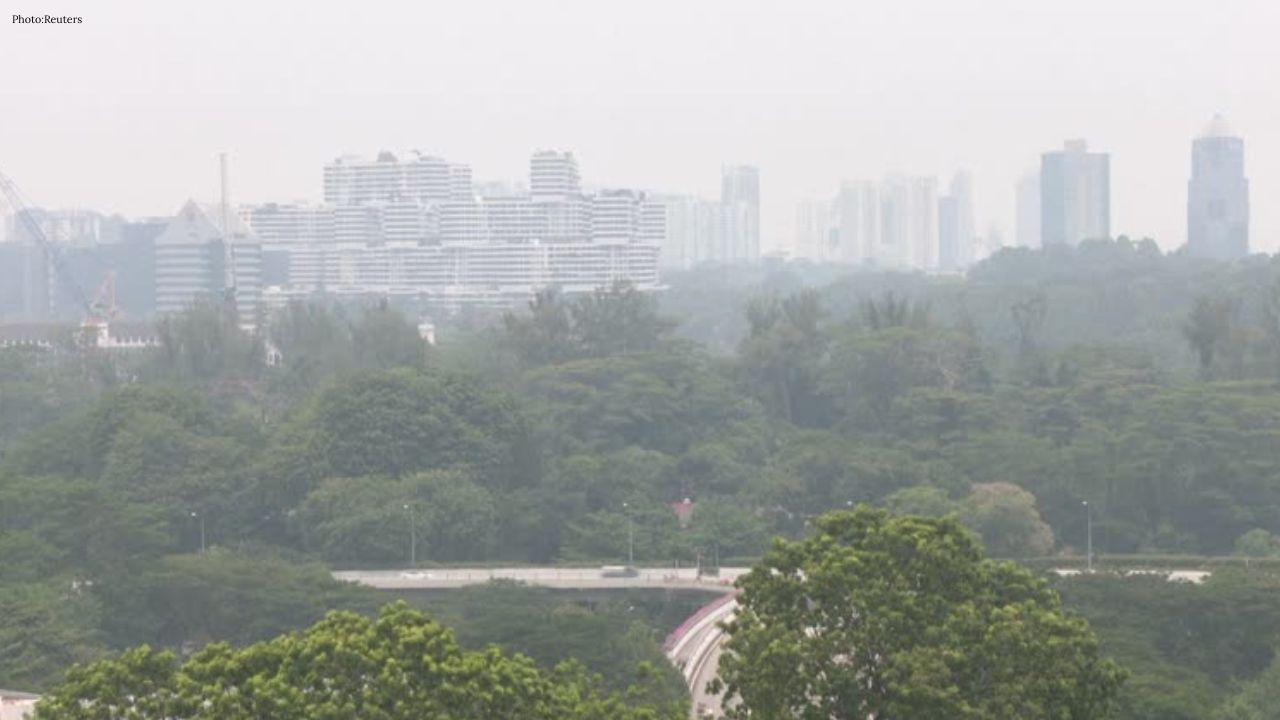
Singapore's air quality deteriorated on Monday, October 5, with conditions in the central and western parts of the city-state moving into the unhealthy range as haze continued to affect the region. At noon, the 24-hour Singapore haze reading showed a Pollutant Standards Index (PSI) level of 117 in the central region, while the western region recorded a PSI of 108. Both readings fall within the unhealthy category under Singapore's air-quality classification system. The remaining parts of Singapore continued to experience moderate air quality. The situation, however, remained closely monitored as smoke and haze from parts of Southeast Asia continued moving towards the region.
The latest readings showed a noticeable difference in air conditions across Singapore. As of the morning update, the 24-hour PSI stood at 117 in the central region and 108 in the west. The north recorded 86, while the east stood at 94 and the south at 90. Under Singapore's PSI Singapore classification, readings between 51 and 100 are considered moderate. Once the index moves between 101 and 200, air quality is classified as unhealthy. This means residents in the central and western areas were experiencing poorer air conditions compared with people in other parts of the country. The 24-hour PSI is designed to provide an overall picture of air quality by taking several pollutants into account. These include fine particulate matter, particulate matter, ozone, sulphur dioxide, nitrogen dioxide and carbon monoxide.
While the 24-hour PSI is useful for understanding the broader air-quality situation, authorities have also advised residents to monitor the hourly PM2.5 reading when deciding whether to carry out outdoor activities. The 1-hour PM2.5 reading provides a more immediate indication of pollution levels because it focuses specifically on fine particulate matter measured over the previous hour. On Monday afternoon, the western region recorded an elevated PM2.5 level, while readings elsewhere were described as normal. PM2.5 particles are extremely small and can penetrate deep into the respiratory system. During periods of haze, they are considered an important pollutant affecting public health. For healthy individuals, authorities advise reducing strenuous outdoor activity when the hourly PM2.5 concentration reaches the elevated range. People who are more vulnerable to the effects of air pollution are advised to avoid strenuous outdoor activity during such periods.
The deterioration in Singapore's air quality Singapore conditions comes as authorities continue to track fire hotspots and smoke movement across parts of Southeast Asia. The National Environment Agency said clusters of scattered hotspots had been detected in southern Sumatra and southern Kalimantan. Isolated hotspots were also identified in parts of Java, Sulawesi and the Lesser Sunda Islands. Moderate to dense smoke plumes were observed over southern Sumatra, with the smoke moving northwards towards parts of Peninsular Malaysia and Singapore.
The combination of ongoing hotspots, dry weather and shifting winds has increased the possibility that smoke from fires in neighbouring areas could continue affecting Singapore.
Read Also: Flydubai Attack Suspect Was Previously Barred From Flying in Oman
The regional situation has renewed attention on transboundary haze, a recurring environmental issue in Southeast Asia in which smoke from fires in one area can travel across national borders. Authorities expect the hotspot and haze situation to remain elevated, with a continued possibility of smoke affecting Singapore. Dry conditions are expected to persist across much of the southern Southeast Asian region. Some showers are forecast for northern areas of Sumatra, Borneo and Peninsular Malaysia, but these are not expected to immediately remove the broader regional haze risk. Weather conditions, wind direction and the location of active hotspots will remain important factors in determining how the situation develops over the coming days.
A 24-hour PSI reading between 101 and 200 is classified as unhealthy. The next category, from 201 to 300, is considered very unhealthy, while readings above 300 are classified as hazardous. The classification is intended to help residents understand the potential health implications of changing air conditions. For immediate outdoor decisions, authorities recommend paying attention to the latest 1-hour PM2.5 information rather than relying only on the 24-hour PSI. The 24-hour PSI forecast and accompanying health advisories are more useful when residents are planning outdoor activities for the following day.
Monday's deterioration had already been anticipated by Singapore's authorities. The previous day's forecast had indicated that the 24-hour PSI could move from the upper end of the moderate range towards the lower end of the unhealthy category. With smoke continuing to drift from parts of southern Sumatra and other regional areas, conditions could change depending on wind patterns and weather developments. For residents, the latest air-quality readings remain important, particularly for people planning exercise, outdoor work or other physically demanding activities. The current situation also highlights how weather and fire activity outside Singapore can have a direct impact on the city's environment, making regional cooperation and monitoring essential during periods of prolonged dry weather.
The central and western parts of Singapore entered the unhealthy air-quality range on Monday, with 24-hour PSI readings of 117 and 108 respectively. Other regions remained within the moderate range at the time of the reported readings.
The haze is linked to smoke plumes from regional hotspots, particularly areas of southern Sumatra and Kalimantan. Weather and wind conditions can carry the smoke across borders towards Singapore and neighbouring parts of Malaysia.
Residents should check the latest 1-hour PM2.5 reading for immediate outdoor activity decisions, while the 24-hour PSI forecast and health advisories are more suitable for planning activities for the next day.









Michael Bracewell Chooses Casual Contract, Targets BBL Opportunity
Michael Bracewell moves to a casual contract as he eyes a BBL opportunity while remaining available

Tuchel Says Alex Scott Can Challenge Declan Rice for England Midfield Spot
Thomas Tuchel says Alex Scott can challenge Declan Rice for an England midfield place after his impr

Air Quality Turns Unhealthy in Central and Western Singapore Amid Haze
Singapore haze pushes PSI above 100 in central and western areas as smoke from regional hotspots rai

PM Modi Pays Tribute to Mahatma Gandhi, Urges People to Support Khadi
PM Modi pays tribute to Mahatma Gandhi on Gandhi Jayanti and urges citizens to support Khadi and the

Amazon Seeks to Offload $8 Billion in Nvidia Chips to Investors
Amazon plans to move $8 billion in Nvidia chips to investors, using a new financing model to strengt

Samsung Raises Galaxy S26 Prices as Memory Chip Costs Rise
Samsung raises Galaxy S26 prices in South Korea as rising memory chip costs put pressure on smartpho

