
You have not yet added any article to your bookmarks!
Join 10k+ people to get notified about new posts, news and tips.
Do not worry we don't spam!
Post by : Badri Ariffin
The upper stage of a SpaceX rocket, which was launched to deploy two lunar landers, has collided with the moon after a prolonged drift of more than a year in space. Researchers reported that the impact occurred as anticipated, with the rocket striking at speeds around 5,400 mph (8,700 kph) on Wednesday.
While the crash itself wasn't directly observed, scientists have gathered strong indicators supporting that it took place. A telescope in Chile identified a debris plume in the aftermath of the impact, confirming predictions made by space tracking professionals who stated that the rocket's crash was inevitable.
Carl Schmidt from Boston University expressed that his team is "100% certain" the telescope observations confirmed the lunar impact. The Very Large Telescope from the European Southern Observatory detected a plume of sodium and lithium extending tens of kilometers into space, observable for five to ten minutes post-collision.
Though images of the crash were unattainable, the telescope's data powerfully suggests confirmation of the event.
Retired astrophysicist Jonathan McDowell reported that the 4-ton upper stage was on a trajectory leading directly toward the moon. The predicted landing area was near the Einstein Crater, characterized as a dusty patch located on the sunlit western edge of the moon, challenging to observe from Earth.
McDowell stated he has "no doubt" that the rocket fragmented upon impact near the Einstein Crater and noted that, as a physicist, he expected the object to eventually descend after being abandoned in space.
Astronomers were aware that observing the effects of the impact from Earth would be notably challenging. Orbital spacecraft around the moon stood the best chance of either capturing the event or later documenting the newly formed crater.
Dutch scientist Marco Langbroek also endeavored to observe the impact but reported missing it. Nonetheless, he expressed unwavering confidence that the rocket successfully impacted the moon as forecasted.
McDowell mentioned that visual confirmation is anticipated only after the Lunar Reconnaissance Orbiter from NASA surveys the impact site, with photographs expected to be available next week.
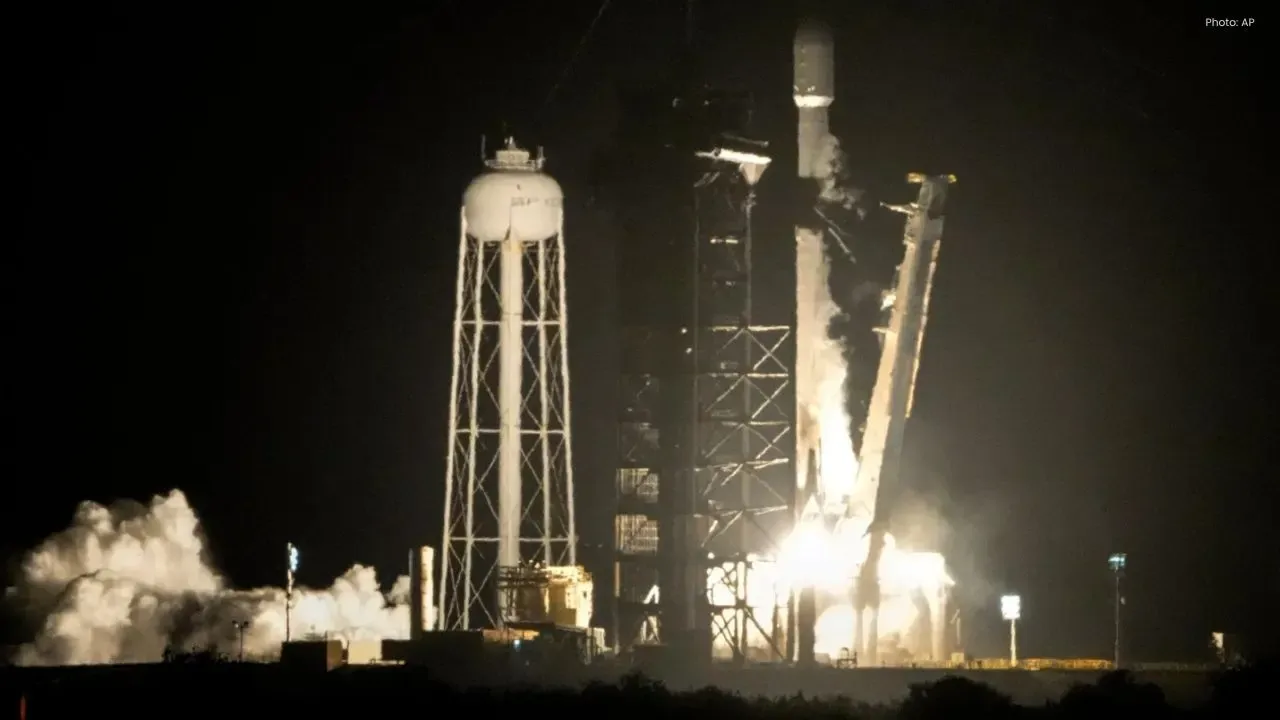
The object that crashed was the upper stage of the Falcon rocket, which measures over 40 feet (12 meters) in length. It was launched from Cape Canaveral on January 15, 2025, carrying two commercial lunar landers into orbit.
The rocket successfully deployed Firefly Aerospace's Blue Ghost and ispace's Resilience towards the moon before becoming adrift in space. Notably, Blue Ghost achieved the milestone of being the first private spacecraft to land on the moon, while Resilience experienced a crash.
Julianna Scheiman from SpaceX stated that the company collaborates with NASA to avoid similar accidents in the future. She clarified that this collision was not anticipated.
According to Scheiman, a blend of solar activity and gravitational influences gradually shifted the rocket's path, ultimately guiding it to collide with the moon.
The recent impact has intensified scrutiny over the increasing problem of space debris surrounding the moon as more mission launches continue. Scientists noted a prior incident where a Chinese rocket unintentionally crashed into the moon in 2022 after completing its lunar operation, alongside other discarded rocket stages that may have impacted the lunar landscape unnoticed in past decades.
NASA is gearing up for additional robotic missions aimed at establishing a sustainable human presence on the moon. Companies like SpaceX and Blue Origin, led by Elon Musk and Jeff Bezos respectively, are developing lunar landers for NASA's Artemis program.
SpaceX continues testing its Starship in Texas, while Blue Origin's Blue Moon lander remains yet to be launched. One or both vehicles are anticipated to contribute to Artemis III next year during a critical docking rehearsal in Earth orbit, which may lead to a crewed moon landing as soon as 2028.
McDowell concluded that lunar activities will continue to escalate, noting that as more spacecraft operate in the vicinity, future impacts that generate significant lunar dust clouds will become increasingly concerning.










PM Modi Pays Tribute to Mahatma Gandhi, Urges People to Support Khadi
PM Modi pays tribute to Mahatma Gandhi on Gandhi Jayanti and urges citizens to support Khadi and the

Amazon Seeks to Offload $8 Billion in Nvidia Chips to Investors
Amazon plans to move $8 billion in Nvidia chips to investors, using a new financing model to strengt

Samsung Raises Galaxy S26 Prices as Memory Chip Costs Rise
Samsung raises Galaxy S26 prices in South Korea as rising memory chip costs put pressure on smartpho

Lewis Hamilton Calls Singapore Grand Prix One of F1's Toughest Races
Lewis Hamilton discusses the demanding Singapore Grand Prix and brings Plus44 and Almave to Singapor

Denmark's Pandora Opens World's Largest Jewellery Factory in Vietnam
Pandora opens its largest jewellery factory in Vietnam, expanding global production, strengthening s

Gautam Gambhir Questions Batting-Friendly Pitches After India's Record ODI Chase
Gautam Gambhir questions batting-friendly ODI pitches after India’s record chase, calling for a bett

