You have not yet added any article to your bookmarks!
Join 10k+ people to get notified about new posts, news and tips.
Do not worry we don't spam!
Post by : Sameer Farouq
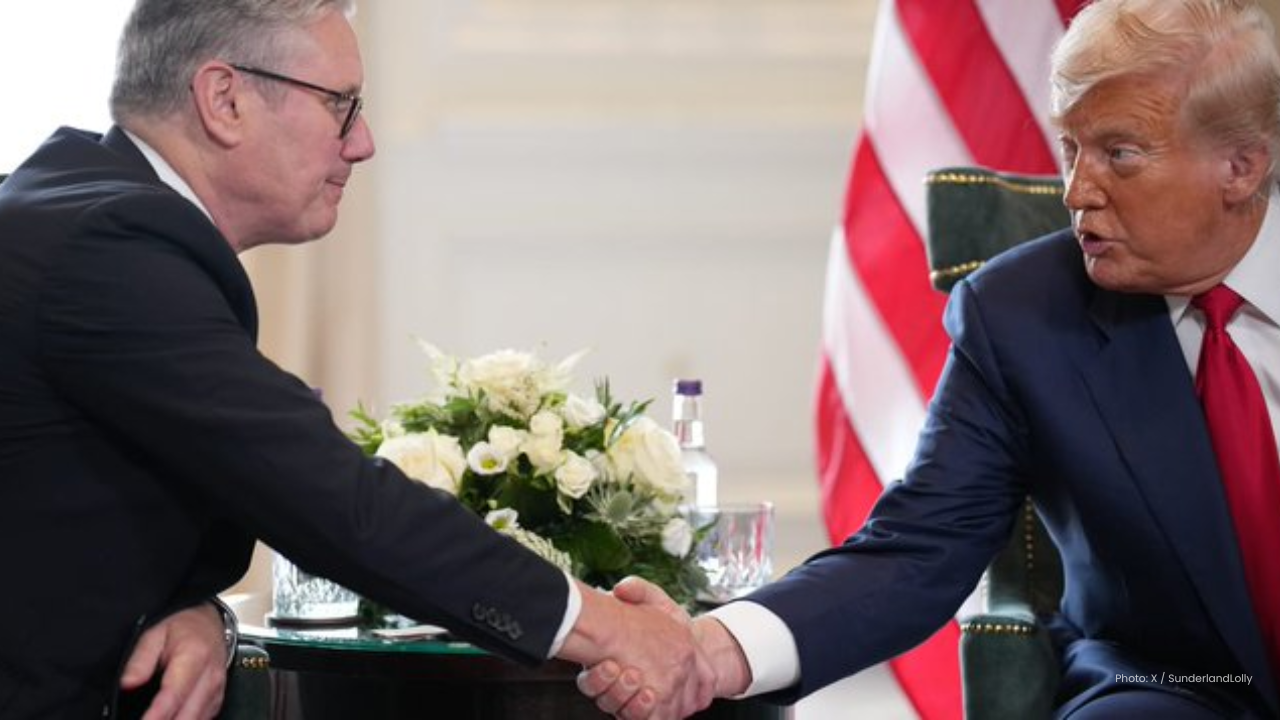
After a day full of royal pageantry, U.S. President Donald Trump and British Prime Minister Keir Starmer sat down for serious talks on Thursday. The two leaders are focusing on strengthening ties between their countries, celebrating a massive 150 billion pound ($205 billion) package of U.S. investment in the United Kingdom.
This investment package, which covers areas such as technology, energy, and life sciences, is being described as a renewal of the “special relationship” between Britain and the United States. Starmer, who has been working hard to build close ties with Trump since he entered office earlier this year, hopes the new agreements will boost Britain’s economy and show that the partnership between the two nations remains strong.
Trump’s visit began with grandeur. He rode in a royal carriage with King Charles and later attended a state banquet at Windsor Castle, one of the world’s most historic royal residences. During the banquet, Trump called his visit "truly one of the highest honours of my life," praising Britain’s role in laying the foundations of liberty, law, and free speech.
Starmer welcomed Trump warmly at his official country residence, Chequers, alongside his wife Victoria. The two leaders entered to the sound of traditional bagpipes before heading into their private meeting.
The centerpiece of this meeting is the huge 150 billion pound investment package by American companies into the British economy. This deal will focus on:
Technology – including artificial intelligence, quantum computing, and cybersecurity.
Energy – with promises to support clean energy and civil nuclear development.
Life Sciences – boosting cooperation in health research and innovation.
Major U.S. companies, including Microsoft, Nvidia, Google, and OpenAI, have pledged 31 billion pounds ($42 billion) in new technology investments alone over the next few years.
Starmer hopes these deals will strengthen Britain’s position as a global hub for financial services, technology, and energy. While he has accepted that the U.S. is unlikely to lower tariffs on steel and aluminum any further, he can still highlight how Britain is attracting large-scale American investments.
Despite the positive tone, the meeting is not without risks. Journalists are expected to ask tough questions during the press conference. Topics may include:
Jeffrey Epstein scandal: Starmer recently had to dismiss Peter Mandelson as ambassador to the U.S. due to his ties with Epstein. Trump himself has faced scrutiny for his past links to the late financier.
Free speech disputes: Trump has been pressuring broadcasters to silence content he finds offensive. Just hours before the meeting, he praised the suspension of late-night host Jimmy Kimmel for comments about conservative activist Charlie Kirk’s assassination.
Britain’s online safety laws: Trump may raise concerns over regulations limiting online content, clashing with his strong focus on unrestricted speech.
Israel and Gaza: The ongoing conflict in Gaza may surface, with Starmer under pressure to challenge Trump on Israel’s military actions.
Starmer also plans to use this meeting to focus on urgent foreign policy issues.
Starmer wants Trump to take stronger action against Russia after its ongoing war against Ukraine. Trump recently described Russia as “the aggressor,” which pleased European allies, but he is demanding that Europe first stop all purchases of Russian oil before agreeing to impose tougher sanctions.
Britain is under pressure to speak out against Israel’s air strikes on Gaza. Trump has expressed some frustration over these strikes but continues to back Israeli Prime Minister Benjamin Netanyahu. He has criticized some European countries for recognizing a Palestinian state, saying it amounts to “rewarding Hamas.”
Starmer may try to carefully raise the humanitarian crisis in Gaza without creating a rift with Trump. Analysts predict that conversations around Russia and Israel are likely to be the most difficult parts of the talks.
Starmer has been facing a challenging time at home, with rising living costs and political troubles. A positive international partnership with the United States could help him shift the narrative and show that he is strengthening Britain’s global role.
For Trump, the visit is also important. He wants to prove that his leadership can create stronger bonds with close allies and deliver real economic benefits through investment deals. Both leaders understand that despite disagreements, their partnership can bring value to their countries.
The meeting between Trump and Starmer is being closely watched around the world. For Britain, the massive U.S. investment deal is a major achievement. For the United States, the meeting shows that the special relationship with Britain is alive and well.
Still, the deeper questions remain: Can these leaders navigate their differences on free speech, Israel, and Russia without weakening their partnership? Or will these sensitive issues overshadow the positive progress being made?
What is clear is that both Starmer and Trump have much to gain from cooperation — and much to lose if disagreements become too public.







Rabada Misses First Australia Test as South Africa Pick Two Spinners
Kagiso Rabada misses the opener as South Africa vs Australia begins, with Anrich Nortje returning an

Starc Compares Australia's Tough Year to McIlroy's Major Sweep
Mitchell Starc says Australia winning three away Test series and the World Cup would match Rory McIl

France’s Sesterce Plans $11 Billion AI Data Centre in Finland
Sesterce plans a $11 billion AI data centre in Finland, with major expansion, green energy plans and

Danaher to Launch AI-Powered Autonomous Research Lab in 2027
Danaher plans an AI research lab for 2027, combining robotics and automation to speed up drug discov

Musk Welcomes German Support for Tesla Driver Assistance Tech as EU Approval Push Continues
Elon Musk welcomes Germany's backing for Tesla FSD as the company seeks EU approval amid speed, safe
Microsoft and Nvidia CEOs to Unveil AI Laptop at San Francisco Event
Microsoft and Nvidia showcase a new AI laptop with RTX Spark chips as they push powerful local AI co