
You have not yet added any article to your bookmarks!
Join 10k+ people to get notified about new posts, news and tips.
Do not worry we don't spam!
Post by : Samjeet Ariff
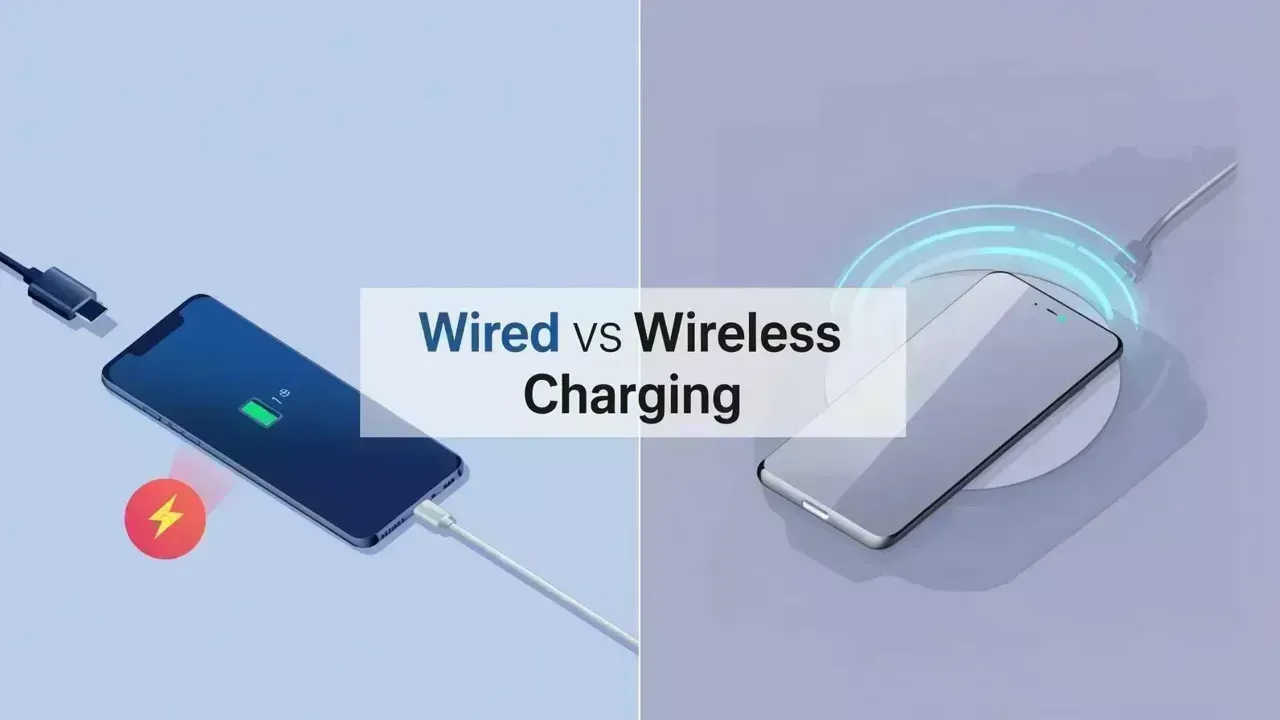
Charging smartphones is now quicker and more user-friendly than ever. Users can opt for either a wired connection or place their device on a charging mat. While both options accomplish the same task, their operational differences influence charging speed, efficiency, and battery health.
Curious about which charging style is better for your device? Here’s a straightforward guide to help you make an informed choice.
The conventional method of powering devices involves wired charging, where you connect your phone to a charger via a cable, enabling immediate power transfer to the battery.
Leading brands such as Apple and Samsung have incorporated advanced fast-charging technologies that rapidly elevate your device’s charge status.
This method is efficient due to the minimal energy loss during transmission, making wired charging a rapid option.
This method eliminates cables, leveraging electromagnetic energy to charge your device from a dedicated pad.
Most recent smartphones utilize the Qi standard for wireless charging, which has attained widespread adoption.
Its main advantage is ease of use: simply place your phone on the pad, and charging begins automatically. However, some energy is inevitably lost in this indirect transfer.
Wired charging is clearly the superior choice for rapid charging.
Its direct connection allows for efficient power delivery, culminating in a significantly faster charge—especially when utilizing fast chargers. This is particularly beneficial for users in urgent need of a battery boost.
Although wireless charging is improving, it still typically lags behind due to:
For quick boosts, wired charging remains the optimal solution.
Battery performance is significantly influenced by heat and charging routines.
Wireless charging tends to produce more heat from energy loss, potentially affecting battery performance over long-term use.
In contrast, wired charging generally results in less heat, though frequent fast charging can also heat up the device.
In general:
Wireless charging excels in terms of convenience; no plugging or unplugging is necessary, making it ideal for desks, nightstands, or quick recharges.
Wired charging prioritizes performance and consistency, making it the better choice for speed and reliable power delivery.
Wired charging is best suited for:
This is the go-to method when every minute counts.
Wireless charging is most effective when:
It's perfect for daily convenience and light usage.
Many believe wireless charging is detrimental to batteries, but this is not entirely true. Contemporary smartphones are designed for safe operation with either method.
The primary consideration is heat rather than the charging method itself. If you ensure prudent use of quality chargers and heed heat levels, wireless charging is entirely safe.
Additionally, some think it wastes a lot of energy. While it is indeed less efficient than wired options, the energy loss is minimal for everyday use.
Your selection between wired and wireless charging depends significantly on your lifestyle.
If you favor speed and efficiency, go for wired charging. If you lean towards basic ease, wireless charging may be your perfect match.
Many users effectively utilize both—eschewing wired for when they need fast charging and preferring wireless for casual day-to-day use.
This article serves informational purposes only. Result outcomes can vary by device type, charger quality, and usage patterns. Always opt for trusted and compatible accessories to charge safely.
Is wired charging always quicker?
Yes, most often wired charging is swifter due to direct power transfer.
Does wireless charging diminish battery longevity?
It doesn't inherently, though excess heat may impact battery life if not managed correctly.
Can I alternate between both charging types?
Yes, utilizing both methods is completely safe and increasingly common.
Which method is more energy-efficient?
Wired charging has the edge in efficiency since it loses less energy.
Is fast charging detrimental to batteries?
Occasional fast charging is safe, but prolonged heat can adversely influence battery health.










PM Modi Pays Tribute to Mahatma Gandhi, Urges People to Support Khadi
PM Modi pays tribute to Mahatma Gandhi on Gandhi Jayanti and urges citizens to support Khadi and the

Amazon Seeks to Offload $8 Billion in Nvidia Chips to Investors
Amazon plans to move $8 billion in Nvidia chips to investors, using a new financing model to strengt

Samsung Raises Galaxy S26 Prices as Memory Chip Costs Rise
Samsung raises Galaxy S26 prices in South Korea as rising memory chip costs put pressure on smartpho

Lewis Hamilton Calls Singapore Grand Prix One of F1's Toughest Races
Lewis Hamilton discusses the demanding Singapore Grand Prix and brings Plus44 and Almave to Singapor

Denmark's Pandora Opens World's Largest Jewellery Factory in Vietnam
Pandora opens its largest jewellery factory in Vietnam, expanding global production, strengthening s

Gautam Gambhir Questions Batting-Friendly Pitches After India's Record ODI Chase
Gautam Gambhir questions batting-friendly ODI pitches after India’s record chase, calling for a bett

