You have not yet added any article to your bookmarks!
Join 10k+ people to get notified about new posts, news and tips.
Do not worry we don't spam!
Post by : Anis Farhan
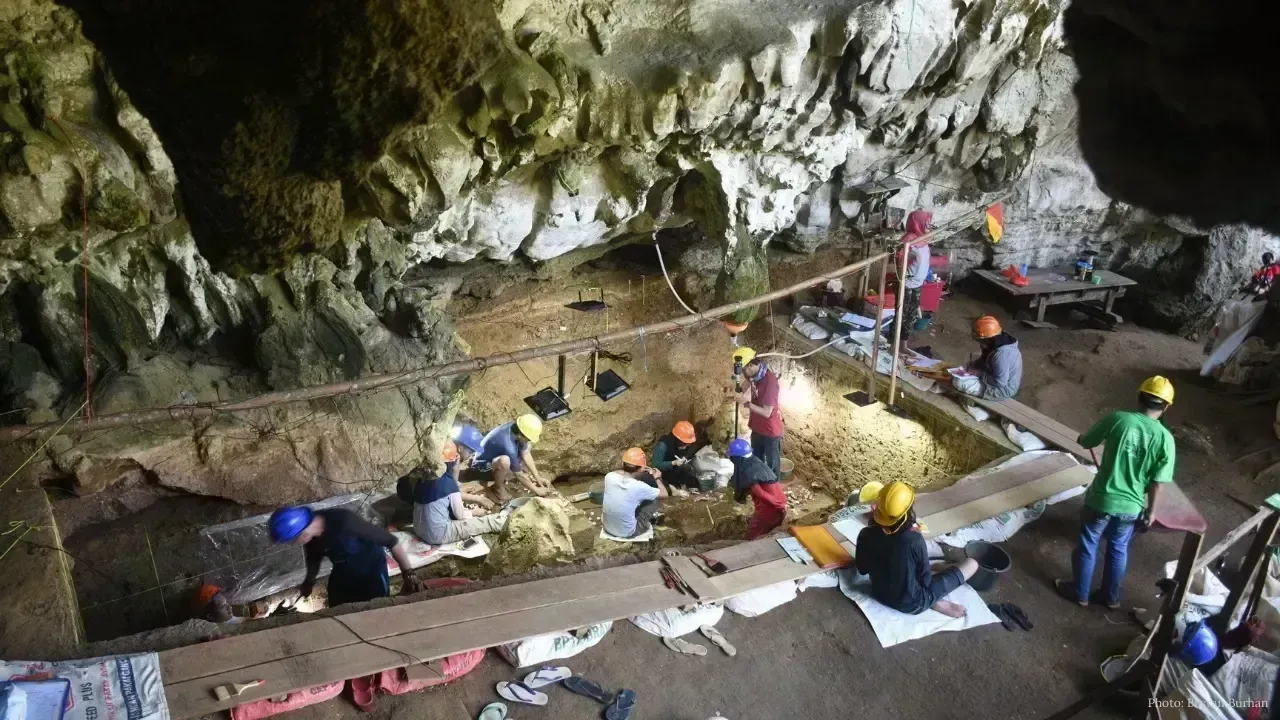
The Leang Bulu Bettue archaeological site on the Indonesian island of Sulawesi has emerged as one of the most significant windows into deep human history in Southeast Asia. For over a decade, archaeologists have excavated this limestone cave in the Maros-Pangkep karst region, unearthing a near-continuous record of hominin activity that extends far beyond what was previously known for the region. What makes this site particularly remarkable is its deep sequence of stratified deposits — some potentially as old as 208,000 years — which preserve successive phases of stone tools, faunal remnants and cultural materials.
Until recently, the narrative of early human occupation in Island Southeast Asia was constrained by limited finds and scarce data. Leang Bulu Bettue is changing that, offering archaeologists and paleoanthropologists a rare opportunity to see how different human lineages might have lived on Sulawesi across extended periods of time, and how these ancient inhabitants adapted, innovated and possibly interacted with each other.
Unlike many other sites in the region, Leang Bulu Bettue provides a deep stratigraphic sequence of archaeological deposits. Through systematic excavation, researchers have revealed layers that extend at least eight meters below the current surface. These layers contain stone tools and animal remains that date back to roughly 208,000 years ago, making this one of the oldest human occupation records in Sulawesi.
Such depth is extraordinarily valuable because it allows scientists to trace changes in hominin behavior and technology over long spans of time. Instead of isolated finds, the site’s deposits preserve transitions in stone tool technology, faunal consumption patterns and even evidence of early symbolic behaviour.
The oldest artifacts found in the lower layers at Leang Bulu Bettue include heavy-duty stone tools — such as picks and flake implements — alongside animal bones bearing clear signs of butchery. These tools and remains attest to an active hominin presence in the region long before the arrival of modern humans.
These early tool technologies differ substantially from later toolkits, indicating a distinct cultural tradition. Archaeologists interpret these findings as evidence for the existence of archaic hominins — human relatives whose specific species designation remains uncertain, but who clearly were capable tool users and adapted to hunting and processing large vertebrates.
The morphological identity of these archaic hominins has not yet been definitively established through fossil remains. Nevertheless, the cultural and technological signatures preserved in the deepest layers make it clear that a fundamentally different hominin tradition once thrived on Sulawesi.
One of the most compelling aspects of the Leang Bulu Bettue sequence is the clear behavioral transition reflected in the archaeological layers. Around 40,000 years ago, there is a noticeable shift in technology and cultural expression. Tools become more complex, and the archaeological record shows the first evidence of symbolic behavior, such as the use of pigments — features typically associated with modern humans (Homo sapiens) rather than earlier hominin cultures.
This shift aligns with broader evidence that modern humans reached Island Southeast Asia long before this period, potentially as early as 65,000 years ago during migrations that also led to the initial colonization of Australia. The appearance of these newer technologies and behaviors suggests that modern humans either replaced or assimilated the earlier hominin populations, leaving behind a sequence of material culture that distinguished them from their predecessors.
One of the most intriguing implications of the Leang Bulu Bettue findings is the possibility that archaic hominins and early modern humans may have coexisted, or at least overlapped chronologically, in Sulawesi. The depth and continuity of the site’s deposits position it uniquely for investigating this question.
If confirmed, such overlap would add Southeast Asia to the list of regions where interactions between different human species — similar to what has been documented in Eurasia between Neanderthals, Denisovans and Homo sapiens — may have occurred. This possibility makes Leang Bulu Bettue a flagship site for understanding human evolutionary dynamics beyond Africa and Europe.
Researchers underscore that the archaeological sequence at the site preserves distinct cultural phases that appear to reflect not just different technologies but potentially different populations. While the arrival of modern humans is marked by refined tools and symbolic expression, the earlier cultural phase carries hallmarks of an archaic hominin tradition that persisted for an extended period.
The discoveries at Leang Bulu Bettue challenge long-held assumptions about the timing, routes and interactions of early human populations in Australasia and Southeast Asia. The site’s extensive record predates what had been thought to be the earliest hominin presence in this part of the world, offering new perspectives on how and when early human relatives spread across island landscapes separated by deep ocean channels.
By providing one of the most complete sequences of early human occupation in Wallacea — the biogeographic region bridging continental Asia and Sahul (ancient Australia-New Guinea landmass) — the research contributes to broader debates on the adaptability, migration patterns and cultural evolution of early humans and their relatives.
Despite the remarkable progress at Leang Bulu Bettue, archaeologists believe that even older deposits lie beneath the current deepest levels of excavation. These layers may contain additional evidence about the first inhabitants of Sulawesi and the nature of their environments, tools and behaviors.
Further excavation and analysis are likely to provide even deeper insights into how early hominin populations adapted to island ecosystems, how they interacted with changing climate conditions, and possibly how they responded to the arrival of competing hominin lineages.
The archaeological discoveries at Leang Bulu Bettue have opened a new chapter in the story of human evolution. The deep stratigraphic record, spanning at least 200,000 years, reveals an archaic hominin tradition that preceded modern humans in Sulawesi, complex shifts in tool technology and cultural behavior, and the exciting possibility of overlap between different human lineages.
As excavations continue, Leang Bulu Bettue remains one of the most important sites for understanding the complexity of human history in Southeast Asia — a place where ancient tools, animal remains, and symbolic objects become pages in the broader narrative of our shared past.
Disclaimer:
This article is based on current archaeological research and interpretations available at the time of writing. Scientific understanding of human evolution and prehistoric contexts evolves with new discoveries and analyses; readers are encouraged to consult additional research for comprehensive study.










Danaher to Launch AI-Powered Autonomous Research Lab in 2027
Danaher plans an AI research lab for 2027, combining robotics and automation to speed up drug discov

Musk Welcomes German Support for Tesla Driver Assistance Tech as EU Approval Push Continues
Elon Musk welcomes Germany's backing for Tesla FSD as the company seeks EU approval amid speed, safe

Microsoft and Nvidia CEOs to Unveil AI Laptop at San Francisco Event
Microsoft and Nvidia showcase a new AI laptop with RTX Spark chips as they push powerful local AI co

Man to face charges over perfume thefts at Changi Airport
A 47-year-old man faces charges over perfume theft at Changi Airport after six items worth nearly S$

Google Signs 3.6-GW Power Deal With Constellation Energy in US
Google signs a 3.6-GW power deal with Constellation Energy, including nuclear power upgrades to supp

Harmanpreet Kaur Steps Down as India Captain Across All Formats
Harmanpreet Kaur steps down as India captain across all formats after a remarkable leadership journe