You have not yet added any article to your bookmarks!
Join 10k+ people to get notified about new posts, news and tips.
Do not worry we don't spam!
Post by : Rameen Ariff
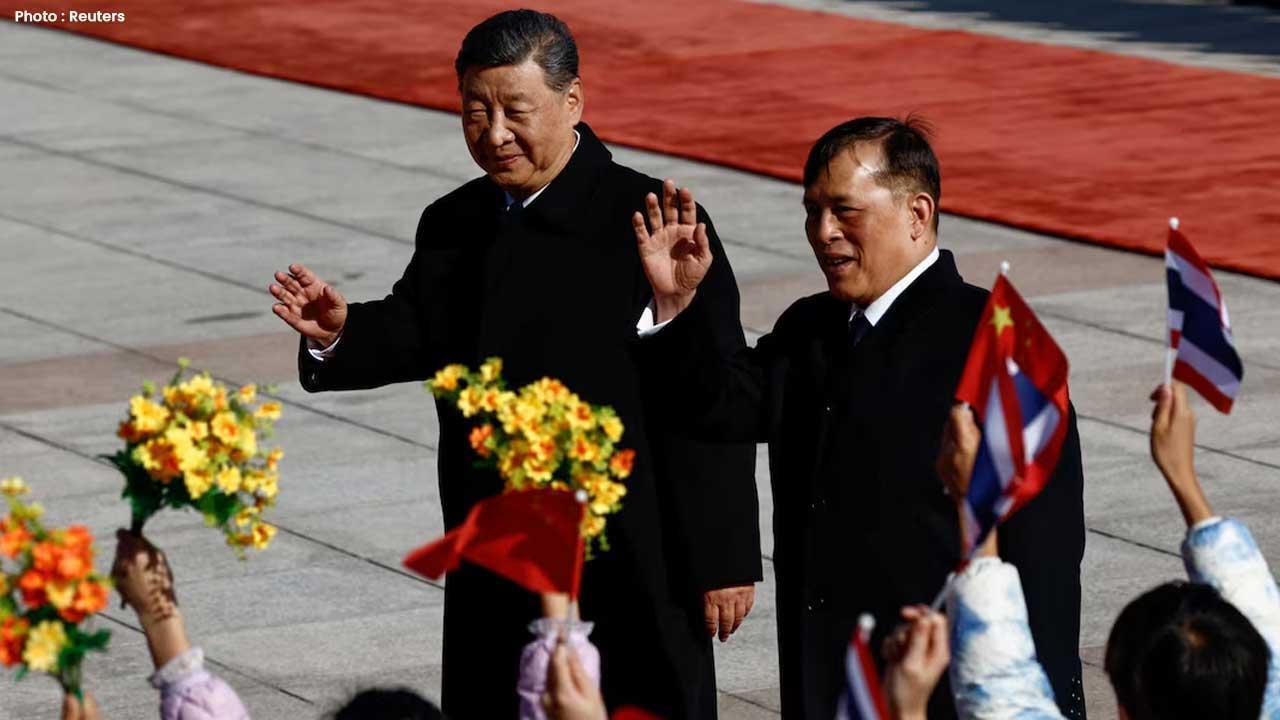
Chinese President Xi Jinping extended an elaborate welcome to Thailand’s King Maha Vajiralongkorn and Queen Suthida on Friday, marking the first visit by a Thai monarch since diplomatic relations were established five decades ago. The high-profile trip, filled with symbolism and strategic messaging, underscores China’s efforts to present itself as a dependable regional partner amid shifting global economic and political dynamics.
The royal visit comes as Beijing looks to strengthen its influence in Southeast Asia, positioning itself as a stable and supportive neighbour. Xi Jinping highlighted the “shared future” between China and Thailand, stating that both nations have maintained “brotherly relations” built on trust, cooperation, and cultural ties.
Chinese state media portrayed the visit as a testament to China’s commitment to peaceful coexistence and regional stability. The timing also aligns with China’s push to contrast its economic reliability with the uncertainty surrounding global markets.
With ongoing concerns over international trade disruptions—including those fuelled by U.S. President Donald Trump’s tariff escalations earlier this year—Beijing is eager to reinforce its reputation as a predictable economic ally. The visit by the Thai monarch, closely following the state visit of Spain’s King Felipe VI and Queen Letizia, has been used to spotlight China’s global appeal and diplomatic confidence.
King Vajiralongkorn’s high-level reception signals the importance China places on its ties with Thailand, a key partner in trade, tourism, and regional security. Both sides are expected to discuss investments under China’s Belt and Road Initiative, technological cooperation, and cultural exchanges aimed at deepening people-to-people links.
Analysts note that the visit is part of Beijing’s broader diplomatic strategy—using soft power, symbolism, and economic reassurance to strengthen bonds with nations that play crucial roles in Southeast Asia’s geopolitical landscape.
The back-to-back royal visits have been framed domestically as a powerful endorsement of China’s global stance. They are meant to reflect not only longstanding friendships but also rising confidence in China’s governance and economic trajectory, even as global powers navigate trade tensions and shifting alliances.
As China and Thailand celebrate 50 years of diplomatic relations, both nations appear eager to reinforce their partnership. The visit serves as a reminder that royal diplomacy remains a valuable tool in international relations—especially in moments where symbolism and stability are needed most.









Rabada Misses First Australia Test as South Africa Pick Two Spinners
Kagiso Rabada misses the opener as South Africa vs Australia begins, with Anrich Nortje returning an

Starc Compares Australia's Tough Year to McIlroy's Major Sweep
Mitchell Starc says Australia winning three away Test series and the World Cup would match Rory McIl

France’s Sesterce Plans $11 Billion AI Data Centre in Finland
Sesterce plans a $11 billion AI data centre in Finland, with major expansion, green energy plans and

Danaher to Launch AI-Powered Autonomous Research Lab in 2027
Danaher plans an AI research lab for 2027, combining robotics and automation to speed up drug discov

Musk Welcomes German Support for Tesla Driver Assistance Tech as EU Approval Push Continues
Elon Musk welcomes Germany's backing for Tesla FSD as the company seeks EU approval amid speed, safe

Microsoft and Nvidia CEOs to Unveil AI Laptop at San Francisco Event
Microsoft and Nvidia showcase a new AI laptop with RTX Spark chips as they push powerful local AI co