
You have not yet added any article to your bookmarks!
Join 10k+ people to get notified about new posts, news and tips.
Do not worry we don't spam!
Post by : Rohit Dhiman
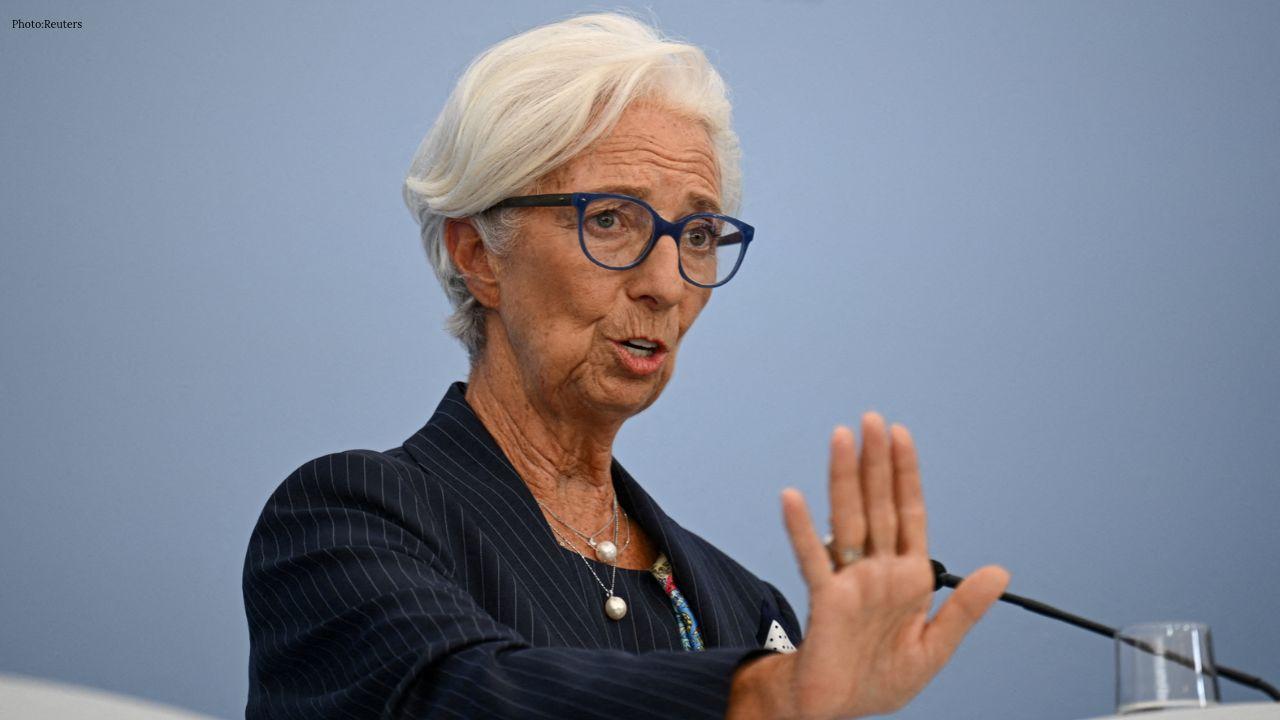
FRANKFURT, October 29, 2026: European Central Bank President Christine Lagarde has announced that she will step down from her position on February 7, 2027, bringing her tenure to an early end after months of speculation about her future. The decision comes at a critical time for Europe's economy, as policymakers face persistent inflation, higher energy costs and rising government borrowing expenses. The European Central Bank confirmed on Thursday that Lagarde had informed its Governing Council and European Council President António Costa of her decision to leave the role. Her departure will come almost nine months before the scheduled end of her term in October 2027. The announcement sets the stage for a major leadership transition at one of the world's most influential monetary institutions. European leaders will now need to choose a successor while the central bank continues to manage inflation risks and financial pressures across the eurozone.
Lagarde's decision follows months of speculation about whether she would complete her full term. Her tenure had officially been scheduled to end on October 31, 2027, but reports in recent months had repeatedly raised the possibility of an earlier exit. The ECB's announcement confirmed February 7, 2027, as her departure date. It did not provide a detailed explanation for the decision. Speculation about Lagarde's possible next role had also circulated in financial and political circles. The World Economic Forum had been mentioned in reports as a potential destination, although the ECB's announcement did not confirm any future appointment. The early departure is significant because it gives European Union leaders more time to select the next central bank president before France's 2027 presidential election. That election is expected to be politically important for the European Union, particularly because of uncertainty surrounding the future direction of French policy.
The departure comes at a sensitive point for the European Central Bank, which is responsible for maintaining price stability across the eurozone. Its decisions on interest rates influence borrowing costs, household spending, business investment and the wider financial environment. The bank has been dealing with renewed inflationary pressure associated with rising energy prices. The conflict involving Iran has added uncertainty to energy markets, raising concerns that higher oil costs could eventually affect a wider range of goods and services. When energy becomes more expensive, businesses may face higher production and transportation costs. Some companies pass those increases on to consumers, while workers may seek higher wages to compensate for rising living expenses. If these effects spread across the economy, inflation can become harder to control. The ECB must therefore weigh the need to contain price increases against the risk that tighter monetary policy could slow economic activity.
The resignation announcement coincided with a scheduled monetary policy decision by the central bank on October 29. According to the supplied Reuters report, the ECB was widely expected to keep its deposit rate at 2.5% while leaving open the possibility of another increase. The deposit rate is an important policy benchmark because it influences financial conditions across the euro area. Changes in the rate can affect the cost of borrowing for households and businesses, although the impact on individual loans depends on the type of lending and prevailing market conditions. If inflation remains above the bank's desired level, policymakers may consider raising rates further. Higher rates can help reduce demand and limit inflationary pressure, but they can also make mortgages, business loans and other forms of credit more expensive. For households, higher borrowing costs may reduce disposable income. Businesses may delay expansion or investment when financing becomes more costly. Governments can also face higher expenses when refinancing debt.
Another challenge facing the eurozone is the rise in government bond yields, particularly in France, where concerns about public finances have contributed to pressure in debt markets. Government bond yields influence the cost at which countries borrow money. When yields rise, governments may have to pay more to finance deficits or refinance maturing debt. Higher yields can also influence borrowing costs for businesses and households because government bond markets serve as an important reference point for broader financial markets. France's debt position has attracted particular attention amid concerns about public spending, fiscal discipline and the country's economic outlook. Higher financing costs can place additional pressure on public budgets, potentially limiting the money available for other priorities. They may also affect consumer confidence and investment decisions if households and companies become more cautious about future economic conditions. For the ECB, these developments create a difficult policy environment. The bank must address inflation without ignoring the broader effects of tighter financial conditions on economic growth.
Read Also: South Korea October Exports Forecast to Surge at Fastest Pace Since 1974
The race to succeed Lagarde is expected to become a major issue for European policymakers in the coming months. Two names mentioned prominently in reports are Klaas Knot, the former governor of the Dutch central bank, and Pablo Hernández de Cos, the former governor of the Bank of Spain and current head of the Bank for International Settlements. Both are viewed as potential candidates, but neither has been formally confirmed as Lagarde's successor. The appointment process will involve European institutions and political negotiations among member states. Knot has experience leading the Netherlands' central bank and participating in European monetary policy discussions. Hernández de Cos previously headed Spain's central bank and now leads an international financial institution. The final decision will involve more than professional experience alone. European governments will also need to consider the balance of representation among member states, the broader composition of the ECB's executive leadership and the institution's monetary policy priorities. The selection process is particularly important because several senior ECB positions are approaching changes around the same period. These overlapping departures could lead to a wider reshaping of the bank's leadership.
Lagarde's early departure will take place before France's next presidential election, scheduled for 2027. The timing has attracted attention because the French presidency plays an important role in European affairs, and the country's political direction could influence discussions among EU leaders. Reports have highlighted Marine Le Pen and the far-right National Rally as important factors in the political outlook ahead of the election. However, the eventual election result remains uncertain, and polling should not be treated as a confirmed outcome. Choosing the ECB president before the election could allow current European leaders to complete the appointment process earlier. It may also reduce the possibility that the selection becomes entangled with political negotiations after the French vote. The ECB is institutionally independent in setting monetary policy. Nevertheless, the appointment of its president is a matter for European political institutions, making the succession process an important intersection between economics and European governance.
Lagarde took office as ECB president in November 2019. Her tenure has included several major economic disruptions, including the COVID-19 pandemic, a surge in inflation and significant changes in interest-rate policy. During her presidency, the central bank had to respond to rapidly changing economic conditions while seeking to preserve price stability across countries with different economic circumstances. The pandemic disrupted production and international supply chains, while the subsequent inflation surge prompted major changes in monetary policy. Rising energy prices and geopolitical tensions later added further uncertainty. The ECB's decisions affected financial markets, borrowers, savers and businesses across the eurozone. Interest-rate changes became particularly important for households with mortgages and companies dependent on credit. Lagarde's successor will inherit these responsibilities alongside the challenge of maintaining confidence in the institution. Investors and policymakers will closely examine whether the next president signals continuity in the bank's approach or introduces changes in how monetary policy risks are assessed.
Leadership changes at major central banks can attract attention from investors because monetary policy affects currencies, bonds, equities and credit markets. However, the effect of Lagarde's resignation will depend on a range of factors, including the identity of her successor, the economic outlook and the ECB's future decisions. Currency markets may respond to expectations about the direction of interest rates. Bond investors will monitor the central bank's approach to inflation and financial stability, while businesses will be concerned about the cost and availability of credit. The succession announcement does not automatically mean that the ECB's monetary policy will change immediately. The bank's decisions are made through its established governing structures, and its policy direction will continue to depend on economic data and assessments by policymakers. For consumers, the most direct effects are likely to come through inflation, interest rates and borrowing costs rather than the leadership announcement alone.









South Korea October Exports Forecast to Surge at Fastest Pace Since 1974
South Korea exports are forecast to surge in October as AI demand, rising memory chip prices and sem

Meta Launches Muse AI Agent in Singapore for Shopping and Travel
Meta Muse AI agent launches in Singapore to help users shop, plan travel and manage emails through c

SpaceX Signs $40 Billion Apollo Deal to Finance AI Chips
SpaceX has entered a $40 billion deal with Apollo for AI chip and data centre hardware financing, su

Rybakina Retains Ningbo Title Ahead of WTA Finals Defence
Elena Rybakina beats Leylah Fernandez to retain the Ningbo Open title, building momentum ahead of he

South Africa Paceman Anrich Nortje Ruled Out of Third Test
Anrich Nortje misses the third Test against Australia with a groin injury as South Africa prepare fo

Mumbai Indians Appoint Kieron Pollard as Head Coach for 2027 IPL
Mumbai Indians appoint Kieron Pollard as head coach for IPL 2027, replacing Mahela Jayawardene as th