You have not yet added any article to your bookmarks!
Join 10k+ people to get notified about new posts, news and tips.
Do not worry we don't spam!
Post by : Anis Farhan
The night sky has always fascinated humanity, but in 2026, it is doing more than inspiring wonder. Scientists, space agencies, and governments are paying close attention as geomagnetic storms and auroral displays become more frequent and intense. This surge is not random—it is tied directly to the Sun’s natural activity cycle, which is now approaching a critical phase.
With increased solar flares, coronal mass ejections, and heightened space weather alerts, 2026 is shaping up to be a year when space phenomena visibly intersect with life on Earth. While auroras bring beauty, geomagnetic storms also carry risks, making understanding the science behind them more important than ever.
The Sun follows an approximately 11-year cycle of activity, fluctuating between solar minimum and solar maximum. During solar maximum, the Sun produces more sunspots, solar flares, and powerful bursts of charged particles.
As we approach the peak of the current solar cycle, scientists are observing increased solar volatility—one of the key reasons auroras are appearing at lower latitudes and geomagnetic storms are growing stronger.
During this phase, the Sun’s magnetic field becomes more complex and unstable, increasing the likelihood of eruptions that can interact with Earth’s magnetic environment.
A geomagnetic storm occurs when a burst of charged particles from the Sun—usually from a coronal mass ejection—collides with Earth’s magnetic field. This interaction disturbs the magnetosphere, triggering rapid changes in magnetic conditions around the planet.
These storms vary in intensity, from minor disturbances to severe events capable of disrupting satellites, power grids, and communication systems.
Only solar eruptions directed toward Earth and strong enough to penetrate the magnetosphere result in significant geomagnetic storms. Orientation and speed of solar particles play a critical role.
Earth is surrounded by a magnetic field generated by its molten core. This magnetosphere acts as a protective bubble, deflecting most harmful solar radiation and charged particles.
When solar storms strike, the magnetosphere absorbs and redirects energy, but intense events can overwhelm this shield temporarily, leading to geomagnetic disturbances.
The magnetic field lines converge at the poles, allowing charged particles to funnel into the upper atmosphere. This is why auroras are most commonly seen near the Arctic and Antarctic regions.
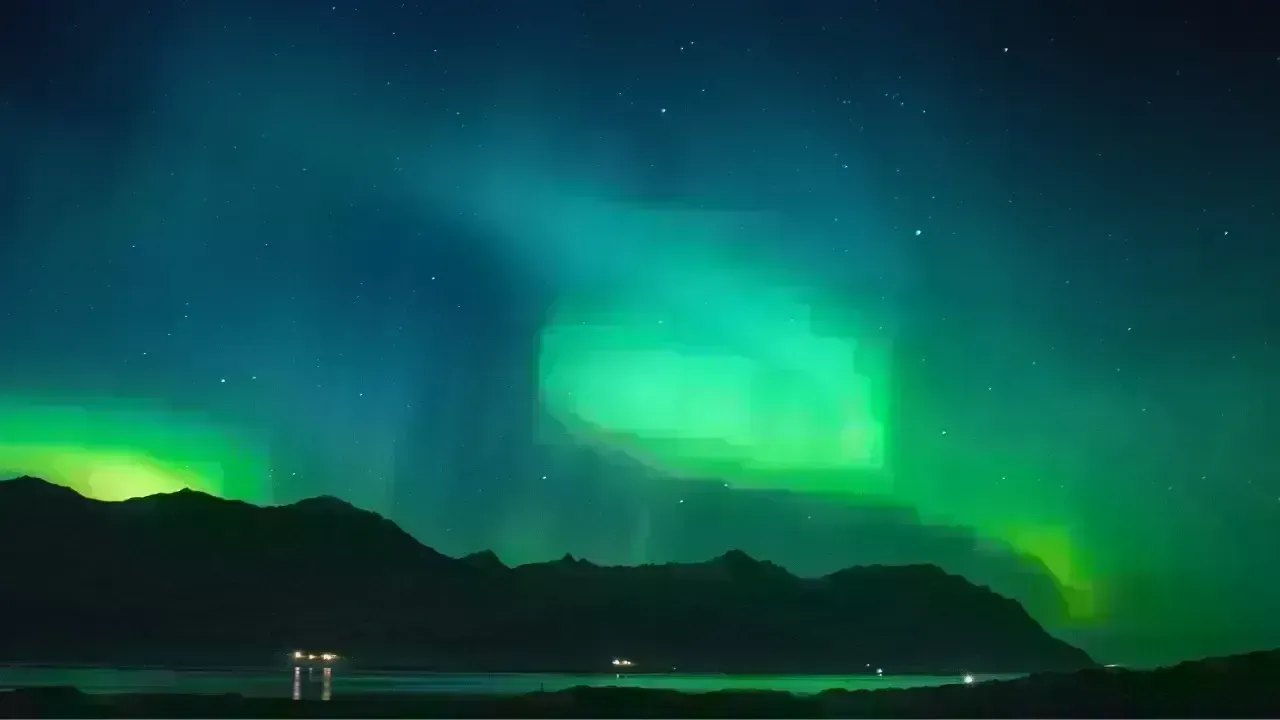
Auroras form when charged solar particles collide with gases in Earth’s upper atmosphere. These collisions release energy in the form of light.
Oxygen produces green and red auroras
Nitrogen produces blue and purple hues
The result is the shimmering curtains of light known as the aurora borealis in the north and aurora australis in the south.
Stronger geomagnetic storms allow charged particles to travel further from the poles, making auroras visible in regions that rarely experience them.
Space weather monitoring shows that solar flares and coronal mass ejections are becoming more frequent and energetic. This trend is consistent with predictions for the current solar cycle’s peak.
Agencies such as NASA and NOAA have already increased monitoring efforts due to the heightened risk of geomagnetic activity.
Geomagnetic storms can interfere with satellite electronics, degrade solar panels, and alter orbital paths. Navigation systems, including GPS, may experience temporary inaccuracies.
Strong storms can induce electric currents in power lines, potentially overloading transformers. Past events have caused large-scale blackouts, making grid protection a major concern in 2026.
Airlines operating near the poles may reroute flights during strong geomagnetic storms to avoid radiation exposure and communication blackouts.
High-frequency radio communications, used by aviation and maritime services, can be disrupted when the ionosphere becomes unstable during geomagnetic activity.
For people on Earth’s surface, geomagnetic storms pose little direct health risk thanks to atmospheric and magnetic protection.
Astronauts in space, especially those outside Earth’s magnetic shield, face higher radiation exposure during solar storms. Mission planning accounts for these risks.
While geomagnetic storms primarily impact the upper atmosphere, they can cause heating and expansion of atmospheric layers, which affects satellite drag.
There is ongoing research into whether long-term solar activity influences climate patterns, though consensus remains cautious.
Modern space weather forecasting uses satellites positioned between Earth and the Sun to detect incoming solar storms hours or days in advance.
This allows power companies, satellite operators, and aviation authorities to take preventive measures.
Advances in solar observation, data modelling, and artificial intelligence are improving prediction accuracy, making 2026 one of the most closely monitored space weather years on record.
As auroras appear in unexpected regions, public interest has surged. Social media platforms are filled with images of rare light displays from mid-latitude locations.
Auroras serve as a visible reminder that Earth exists within a dynamic solar system, where cosmic forces constantly interact with our planet.
The 1859 Carrington Event remains the most powerful recorded geomagnetic storm. If a similar event occurred today, it could cause widespread technological disruption.
This historical precedent underscores why scientists are closely watching solar activity in 2026.
Governments and utilities are investing in grid resilience, satellite shielding, and backup communication systems to reduce vulnerability.
Space weather is a global challenge. Data sharing between countries and agencies is essential for effective forecasting and response.
In a world dependent on satellites, digital networks, and electricity, geomagnetic storms test the resilience of modern civilisation.
Understanding these phenomena is no longer purely academic—it is a matter of technological preparedness.
2026 is poised to be a landmark year for space weather. As geomagnetic storms intensify and auroras light up unexpected skies, the Sun reminds humanity of its immense influence.
These events blend beauty with risk, wonder with responsibility. By studying and preparing for them, scientists aim not only to protect modern infrastructure but also to deepen our understanding of the powerful star that makes life on Earth possible.
This article is intended for informational and editorial purposes only. Space weather activity varies and forecasts may change based on real-time solar observations. Readers should rely on official advisories from space agencies and scientific institutions for alerts and safety guidance.








AI Companies Expected to Drive Most US Earnings Growth in Q3
AI companies are expected to drive US third-quarter earnings growth as investors assess tech profits

Money Market Funds See Record Inflows as Global Bond Selloff Intensifies
Global money market funds attract $153.81 billion as bond yields rise, inflation fears persist and i

Meta Bans TikTok Ads on Facebook and Instagram in Seven Countries
Meta has banned TikTok ads in seven countries, escalating competition over social media users, adver

ASML and Zeiss Target Next-Generation Chip Technology in 10 Years
ASML and Carl Zeiss are developing Hyper NA technology to print smaller chip circuits, with the next

Rabada Misses First Australia Test as South Africa Pick Two Spinners
Kagiso Rabada misses the opener as South Africa vs Australia begins, with Anrich Nortje returning an

Starc Compares Australia's Tough Year to McIlroy's Major Sweep
Mitchell Starc says Australia winning three away Test series and the World Cup would match Rory McIl