You have not yet added any article to your bookmarks!
Join 10k+ people to get notified about new posts, news and tips.
Do not worry we don't spam!
Post by : Meena Ariff
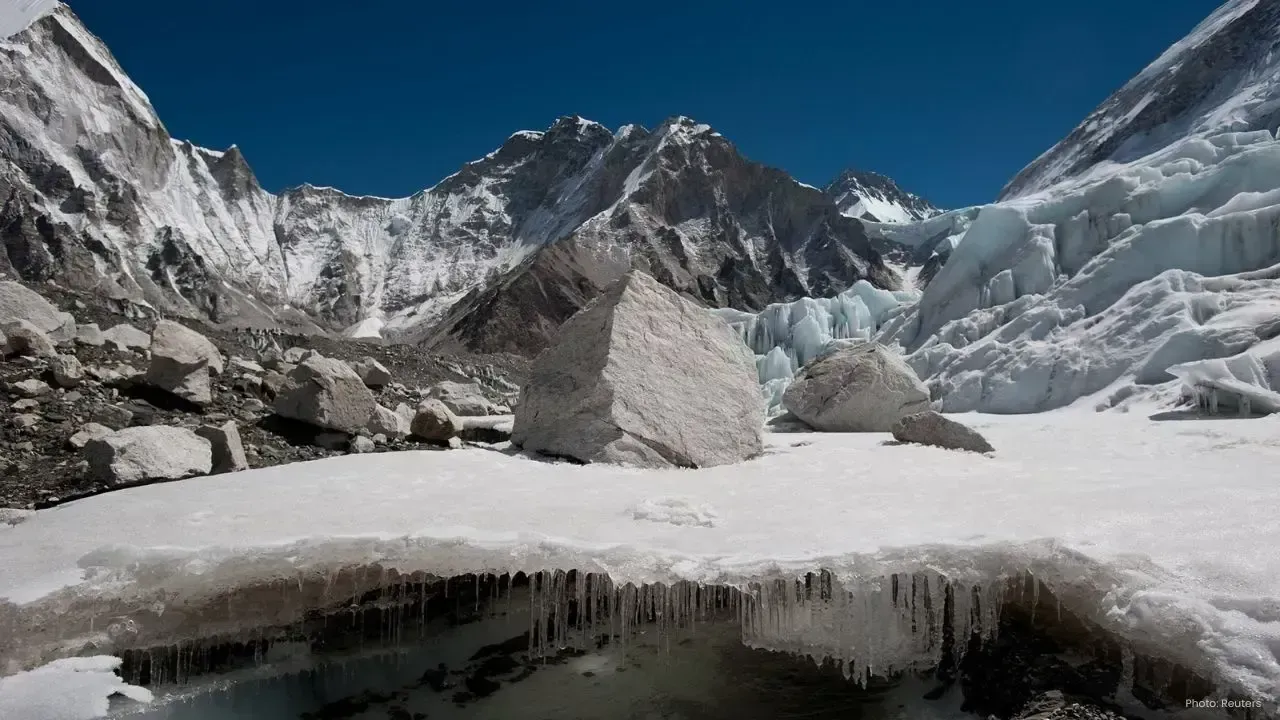
Much less winter snow is falling across the Himalayas, leaving many peaks bare and rocky during a season when they should be covered in snow, meteorologists say. Over the past five years, snowfall has consistently fallen below the long-term average recorded between 1980 and 2020.
Rising temperatures are causing the limited snow that does fall to melt quickly. Lower-elevation regions are also seeing more rain instead of snow, a change attributed partly to global warming. Scientists now describe this trend as a “snow drought” affecting large parts of the Himalayan region.
The accelerated melting of glaciers due to rising temperatures has long been a major concern for India’s Himalayan states and neighboring countries. Experts warn that the decline in winter snowfall is worsening this crisis. Reduced snow and ice not only change the appearance of the mountains but also impact millions of people and fragile ecosystems that rely on these water sources.
Winter snowpack gradually melts in spring, feeding rivers that provide drinking water, irrigation, and hydropower. A drop in snowfall threatens this supply. Reduced winter precipitation also increases the risk of forest fires due to drier conditions.
Glaciers and snow also act as natural stabilizers for the mountains. Their disappearance contributes to more frequent natural disasters, including rockfalls, landslides, glacial lake outbursts, and debris flows.
Meteorologists emphasize that this decline in snowfall is not a one-time occurrence. The Indian Meteorological Department reported almost no rainfall or snowfall across northern India in December. From January to March, many parts of northwest India—including Uttarakhand, Himachal Pradesh, Jammu, Kashmir, and Ladakh—are expected to receive up to 86% less precipitation than the long-period average (LPA).
LPA measures rainfall and snowfall over 30–50 years to classify current weather as normal, excess, or deficient. North India’s LPA between 1971 and 2020 was 184.3 millimeters.
“This decrease in winter precipitation is visible across multiple datasets,” said Kieran Hunt, principal research fellow in tropical meteorology at the University of Reading, UK. His 2025 study, covering 1980–2021, highlighted a decline in winter precipitation across the western and central Himalayas.
Using ERA-5 reanalysis datasets, Hemant Singh, a research fellow at the Indian Institute of Technology in Jammu, reported that snowfall in the northwestern Himalayas has fallen by 25% over the past five years compared to the 1980–2020 average.
Nepal, home to the central Himalayas, has also experienced significant declines. “There has been almost no rainfall since October, and this winter appears set to remain largely dry. This pattern has been consistent over the last five years,” said Binod Pokharel, associate professor at Tribhuvan University in Kathmandu.
While occasional winters have seen heavy snowfall in isolated areas, these are extreme events rather than the steady, evenly distributed snowfalls typical of previous decades, meteorologists added.







Toyota Recalls 105,794 US Land Cruiser Hybrids Over Fire Risk
Toyota recalls 105,794 Land Cruiser Hybrid vehicles in the US over a potential fuel leak and fire ri

Mohammed Shami Remains Determined to Return to India Team
Mohammed Shami remains hopeful of an India cricket team comeback after missing the New Zealand tour,

Ravi Shastri Urges India to Manage Jasprit Bumrah Ahead of 2027 World Cup
Ravi Shastri urges India to manage Jasprit Bumrah’s workload and prioritise Test cricket to keep the

Davidovich Fokina Wins Shanghai Masters for Third 2026 Title
Alejandro Davidovich Fokina beats Rafael Jodar to win the Shanghai Masters 2026, securing his third
Haze Keeps Air Quality Unhealthy Across Central, Southern Malaysia
Malaysia haze persists as Johan Setia records an API of 172, with several areas in Selangor, Negeri

Brandon Figueroa Stripped of WBA Featherweight Title After Missing Weight
Brandon Figueroa loses his WBA featherweight title after weighing 1.4 pounds over the limit before h