
You have not yet added any article to your bookmarks!
Join 10k+ people to get notified about new posts, news and tips.
Do not worry we don't spam!
Post by : Anis Farhan
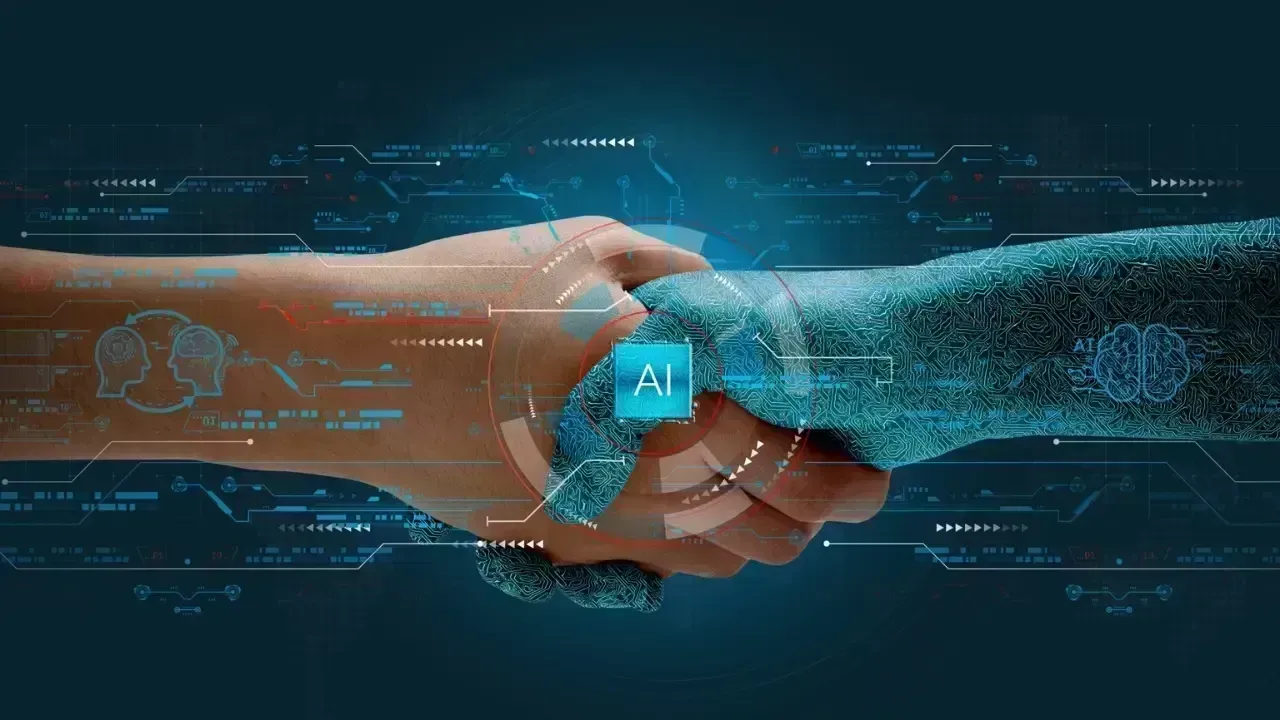
As artificial intelligence (AI) continues its rapid evolution, the nature of work itself is undergoing a fundamental shift. No longer relegated to performing discrete tasks or automating isolated functions, AI is increasingly becoming an integral partner in everyday work processes. Recent reports from global industry bodies such as Nasscom and Indeed reveal that by 2027, human-AI collaboration will not just influence work — it will define it. This impending transformation is already reshaping roles, workflows, hiring practices and skill expectations across sectors, compelling individuals and organizations to rethink how work is structured, measured and performed.
Historically, AI has been viewed primarily as a tool — something separate from human workflows that could assist with specific functions like data analysis, prediction, or automation. That paradigm is shifting. The latest industry research suggests that AI will become embedded in everyday workflows, with humans and machines working synergistically to achieve outcomes that neither could accomplish alone.
Instead of operating as stand-alone assistants, AI systems are evolving into collaborative partners, augmenting human decision-making and handling increasingly complex tasks. This collaborative model involves AI taking on routine, repetitive work while humans focus on higher-order thinking, creativity and strategic judgment.
According to recent findings by international research organisations and HR leaders, a striking 97 per cent of HR leaders believe that by 2027, humans will work alongside AI in a deeply integrated manner, not merely interacting intermittently with technology. This means that AI will be part of everyday workflows across industries — from software development to marketing, customer service to business operations.
In practical terms, this implies that job roles will not simply be “augmented” with AI; they will be redefined around AI-enabled processes. Rather than viewing AI as a replacement or threat, workplaces will increasingly see it as a partner that enhances productivity, creativity and decision-making.
Reports indicate that 20–40 per cent of work within technology organisations is already being performed with direct AI involvement across various functions. In sectors like software development, AI is taking on substantial portions of routine tasks, with up to 45 per cent of development work currently supported or executed by AI tools.
Tasks such as code generation, quality testing, data processing and intelligent automation are increasingly AI-assisted, freeing human workers to focus on design, strategy and oversight activities that require human judgment and creativity.
The nature of job performance is shifting from execution of tasks to delivery of outcomes. In a human-AI collaborative environment, employees are evaluated not just on the tasks they complete but on the value created through human oversight, innovation and strategic thinking. AI, in this context, handles data-intensive processing, pattern recognition and routine computation — activities where speed and precision are paramount.
Humans, on the other hand, leverage emotional intelligence, ethical reasoning, contextual understanding and creative problem-solving — the aspects of work that machines are not well-suited to replicate.
Although AI is increasingly capable, imperfect outputs and incomplete results still underscore the importance of human oversight. In fact, more than half of HR leaders point to the need for humans to validate, refine and guide AI outputs, ensuring quality, reliability and ethical standards in decisions that affect business outcomes.
This means that human roles will evolve rather than disappear. Jobs in scope definition, system architecture, data model design, creative problem solving and strategic leadership will grow in importance, as these domains require nuanced judgment and context-aware decision-making — capabilities that AI is far from mastering independently.
With AI embedded into workflows, the criteria for hiring are changing. Traditional credentials such as degrees or years of experience are giving way to skills-based evaluation, where proof of capability and demonstrable outcomes matter more than formal qualifications.
Around 85 per cent of hiring managers now emphasise skills and real-world competencies over credentials, and nearly all recognise the need for hybrid and multidisciplinary skill sets that combine technical proficiency with soft skills such as communication, creativity and adaptability.
Upskilling and reskilling are becoming workplace imperatives. As AI takes on routine functions, employees need to enhance competencies that AI cannot replicate. Organisations are investing in internal reskilling programs to prepare their workforce for hybrid roles where humans and AI collaborate fluidly. This includes developing capabilities in critical thinking, AI system oversight, data literacy, and decision science — competencies essential in the new work landscape.
The technology sector is at the forefront of AI integration. Already, AI tools assist with more than 40 per cent of coding tasks and development functions. This doesn’t just optimise efficiency; it shapes the skills that programmers and engineers must master. Instead of writing routine code, human developers are increasingly called upon to guide AI systems, evaluate results for quality, and architect complex systems that require deep expertise.
Higher-value activities such as system design, user experience strategy and complex problem decomposition are becoming core to human roles as machines handle pattern-based tasks.
Sectors like finance, consulting and legal services, where decision quality and ethical considerations are paramount, will synthesise AI insights with human judgment. For example, AI can analyse vast datasets to unearth trends, but professionals are needed to interpret those insights, contextualise them within ethical frameworks, and apply them in business strategy or client advisory settings.
Customer-centric roles — such as consulting, creative leadership and relationship management — will increasingly blend AI-generated insights with uniquely human skills like empathy, ethical reasoning and storytelling.
Even in more routine industries, such as supply chain operations, marketing strategy, HR and administrative functions, AI is being embedded into daily tasks. Predictive analytics, automation bots and intelligent workflows are reshaping responsibilities, reducing manual workload and enabling faster decision cycles. Quality control, customer interaction analysis, trend forecasting and data reporting — once time-intensive activities — are now candidates for AI augmentation.
The union of human creativity and AI efficiency can unlock unprecedented productivity gains. AI accelerates data processing and pattern recognition at scale, while humans bring contextual understanding and ethical judgment to the process. This synergy can lead to faster innovation cycles, more insightful decision-making and accelerated value creation across functions.
Rather than automating humans out of work entirely, AI can reframe how work is done. Repetitive, low-value tasks are handed to machines, giving employees more time to pursue creative and strategic responsibilities. This shift has the potential to enhance job satisfaction, engagement and professional growth — provided workers are equipped with the necessary skills and support.
Despite the promise of AI, organisations face significant hurdles. Skills gaps remain a primary concern, with many professionals reporting inadequate training or guidance on AI tools at work. A mismatch between AI adoption and employee readiness could slow the transition unless efforts to upskill are prioritised.
Ethical and governance issues — including data privacy, fairness and transparency — also surface when AI systems handle sensitive decision areas. Effective human-AI collaboration requires strong frameworks to ensure accountability and trust.
Workforces must embrace continuous learning. Employers, educators and individuals should prioritise learning pathways that build AI literacy, critical thinking, adaptability and ethical awareness. A culture of lifelong learning will be central to thriving in a human-AI collaborative environment.
Organisations need to rethink job structures, enabling AI to handle routine operations while humans lead strategy, oversight and creativity. Job redesign should intentionally blend machine efficiency with human value to ensure balanced roles that enhance productivity and well-being.
For true collaboration to flourish, employees must trust AI systems. Transparent governance, clear ethical guidelines and inclusive communication are essential. AI should be seen as a partner that assists rather than replaces humans, supported by policies that safeguard privacy, fairness and accountability.
By 2027, work will not simply be influenced by AI; it will be reshaped through deep human-AI collaboration. The future workplace will see technology embedded into daily workflows, redefining roles, expectations and how value is created. Humans will lead in areas requiring judgment, creativity and contextual understanding, while AI handles precision, scale and routine processing. Together, they will redefine productivity, innovation and the very nature of work itself, ushering in a new era of possibility and transformation.
Disclaimer:
This article synthesises available industry insights and research trends related to human-AI collaboration and the future of work. It is intended for informational purposes only and does not constitute professional advice. Developments in AI adoption, workplace practices and related technology may evolve rapidly and vary across industries.








Google Signs 3.6-GW Power Deal With Constellation Energy in US
Google signs a 3.6-GW power deal with Constellation Energy, including nuclear power upgrades to supp

Harmanpreet Kaur Steps Down as India Captain Across All Formats
Harmanpreet Kaur steps down as India captain across all formats after a remarkable leadership journe

Michael Bracewell Chooses Casual Contract, Targets BBL Opportunity
Michael Bracewell moves to a casual contract as he eyes a BBL opportunity while remaining available

Tuchel Says Alex Scott Can Challenge Declan Rice for England Midfield Spot
Thomas Tuchel says Alex Scott can challenge Declan Rice for an England midfield place after his impr

Air Quality Turns Unhealthy in Central and Western Singapore Amid Haze
Singapore haze pushes PSI above 100 in central and western areas as smoke from regional hotspots rai

PM Modi Pays Tribute to Mahatma Gandhi, Urges People to Support Khadi
PM Modi pays tribute to Mahatma Gandhi on Gandhi Jayanti and urges citizens to support Khadi and the

