You have not yet added any article to your bookmarks!
Join 10k+ people to get notified about new posts, news and tips.
Do not worry we don't spam!

Post by : Meena Ariff
A fresh earthquake measuring 4.0 on the Richter scale struck Myanmar on Wednesday, adding to concerns in a country that is still struggling to recover from a series of powerful earthquakes earlier this year. The tremor occurred at 11:56:28 IST and was recorded at a shallow depth of 10 kilometres, a factor that often leads to stronger ground shaking and increases the risk of aftershocks.
Seismic data placed the epicentre at latitude 25.05 degrees North and longitude 95.80 degrees East. While there were no immediate reports of casualties or major damage, the shallow nature of the earthquake has put residents and authorities on alert, particularly in regions that have already suffered structural damage in recent months.
Shallow earthquakes are considered more dangerous than deeper ones because seismic waves travel a shorter distance to the Earth’s surface, resulting in stronger vibrations. These vibrations can cause damage to buildings, roads, and essential infrastructure, especially in areas with older construction or weakened foundations. Even moderate earthquakes can have serious consequences when they strike regions already under stress.
The latest tremor comes just months after two powerful earthquakes measuring 7.7 and 6.4 struck central Myanmar on March 28. Those earthquakes caused widespread destruction, forcing tens of thousands of people from their homes and damaging hospitals, schools, and vital services. Many survivors are still living in temporary shelters, where conditions remain difficult.
Following the March earthquakes, global health agencies warned of rapidly rising health threats among displaced populations. Overcrowded shelters, poor sanitation, and limited access to clean water have increased the risk of tuberculosis, HIV, and vector- and water-borne diseases such as dengue, malaria, and diarrheal infections. Health systems in several affected areas continue to face pressure due to damaged facilities and shortages of medical supplies.
Myanmar also experienced another earthquake earlier this month on January 12, when a tremor measuring 5.0 struck the region at a depth of 130 kilometres. Although deeper earthquakes usually cause less surface damage, the repeated seismic activity highlights the country’s ongoing vulnerability to tectonic movement. That earlier quake was recorded at latitude 24.89 degrees North and longitude 95.07 degrees East.
The country lies in a highly active seismic zone and is positioned between four major tectonic plates — the Indian, Eurasian, Sunda, and Burma plates. The constant interaction between these plates creates significant geological stress, making earthquakes a frequent threat.
One of the most dangerous geological features in Myanmar is the Sagaing Fault, a 1,400-kilometre-long transform fault that runs through the country. It connects the Andaman Sea spreading centre in the south to a collision zone in the north and significantly increases earthquake risk across large parts of the country.
Major cities including Sagaing, Mandalay, Bago, and Yangon lie close to this fault system and together account for nearly 46 percent of Myanmar’s population. Although Yangon is located some distance from the fault line, experts warn that its dense population and urban landscape make it highly vulnerable. Historical records show that a powerful earthquake in Bago in 1903, measuring 7.0, caused severe shaking in Yangon despite the distance.
Seismologists continue to monitor the region closely, warning that earthquakes of this size can sometimes be followed by additional tremors. While a 4.0 magnitude earthquake is considered moderate, its timing and location are significant given the region’s recent seismic history. Authorities have urged residents to remain cautious and prepared as Myanmar continues to face both geological risks and humanitarian challenges.








George Russell Wins Dutch GP Sprint, Boosts Mercedes Morale
George Russell wins the Dutch GP Sprint from pole as Mercedes teammate Kimi Antonelli extends his F1

Australia 50/3 After Bangladesh Bowled Out for 64 in Second Test
Australia reached 50/3 after Bangladesh were bowled out for 64 in the second Test, with Mitchell Sta

Jordan Burroughs Returns to Wrestling with 2028 Olympic Dream
Jordan Burroughs returns to wrestling with Real American Freestyle as the Olympic champion eyes a po

Lamborghini Catches Fire on Singapore's ECP, Causing Heavy Traffic
A Lamborghini caught fire on Singapore's ECP, causing heavy traffic and bus delays. No injuries were

Bangkok Airport Duty-Free Area Flooded by Pipe Burst
A burst water pipe flooded the duty-free shopping area at Bangkok's Suvarnabhumi Airport on July 16,
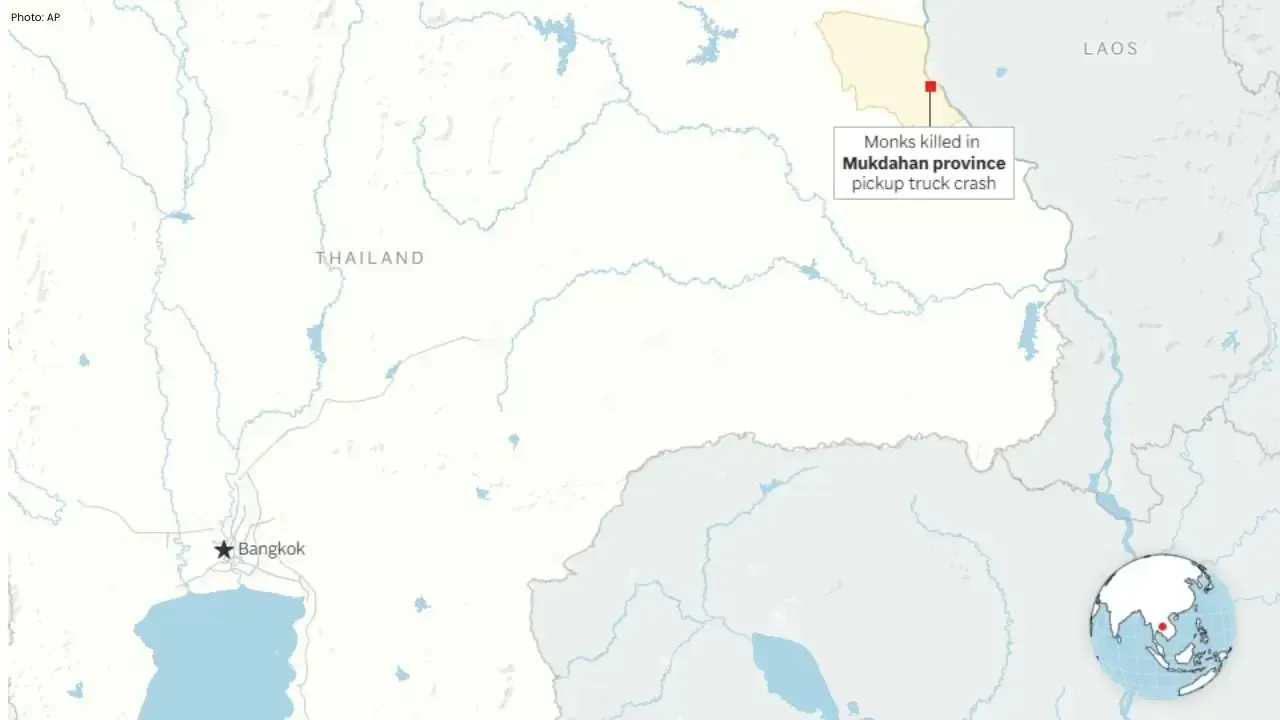
Nine Monks Killed in Thailand Pickup Truck Tragedy
An 11-year-old boy driving a pickup truck crashed into monks during a pilgrimage in northeastern Tha