You have not yet added any article to your bookmarks!
Join 10k+ people to get notified about new posts, news and tips.
Do not worry we don't spam!
Post by : Anis Farhan
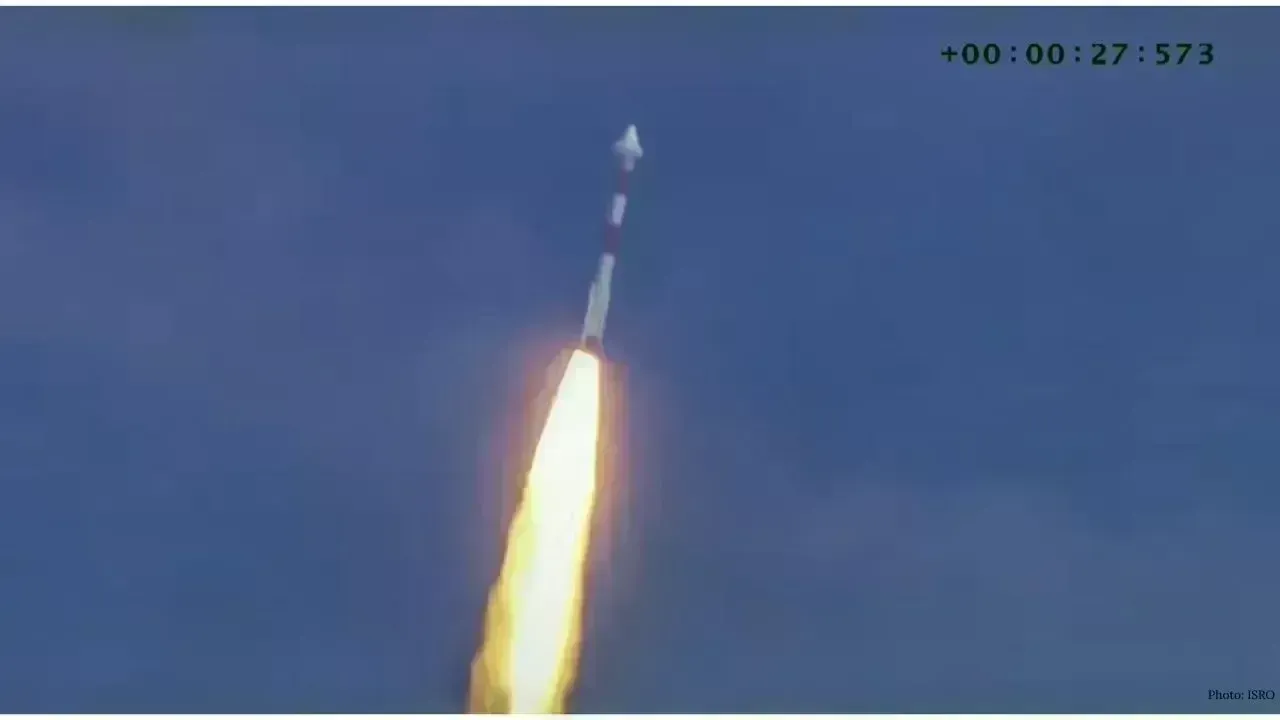
On January 12, 2026, the Indian Space Research Organisation (ISRO) experienced a major mission failure when the PSLV-C62 rocket failed to reach its intended orbit, resulting in the loss of the critical DRDO’s hyperspectral imaging satellite EOS-N1 (also known as Anvesha) along with 15 other satellites carrying disruptive technologies. Originally planned as India’s first orbital launch of the year, the mission instead ended abruptly after an anomaly disrupted the rocket’s flight path during its crucial third stage.
The fallout from this failure is multifaceted, touching on strategic national capabilities, the confidence of international customers, and the burgeoning Indian private space sector. In this detailed article, we break down what happened, why it matters, and what comes next for ISRO and its partners.
The PSLV-C62 mission lifted off from the Satish Dhawan Space Centre’s First Launch Pad in Sriharikota, Andhra Pradesh, carrying a total of 16 satellites onboard — including strategic payloads and commercial satellites from both Indian and international entities.
The primary payload was the EOS-N1 (Anvesha) Earth observation satellite developed in collaboration with the Defence Research and Development Organisation (DRDO). Designed as a hyperspectral imaging satellite, EOS-N1 was expected to provide advanced surveillance capabilities — a critical asset for both defence and civilian applications such as agriculture, environmental monitoring, and urban planning.
Alongside EOS-N1 were multiple co-passenger payloads from space startups and global partners, including satellites intended to showcase cutting-edge disruptive technologies in areas ranging from on-orbit refuelling to artificial intelligence and Earth imaging.
The vehicle used was the PSLV-DL variant, featuring a mix of solid and liquid stages, and two strap-on boosters. This configuration is a variant of India’s most reliable launch vehicle and was intended to deliver its payloads safely into a sun-synchronous orbit at approximately 505–512 kilometres altitude.
The rocket’s initial ascent appeared normal, with the first and second stages performing within expectations. However, trouble emerged during the third stage (PS3) burn, where telemetry data recorded an unexpected disturbance and drop in pressure, leading to a deviation from the planned flight path.
ISRO Chairman Dr. V. Narayanan confirmed that a significant anomaly occurred toward the end of the third stage, preventing the vehicle from achieving the necessary orbital velocity and insertion. As a result, none of the satellites onboard could be successfully deployed into the intended orbit.
This type of failure, particularly at the third stage, is especially challenging because it happens at a critical point when the rocket is accelerating toward orbital velocity. A deviation of even a few degrees can have dramatic consequences — as this mission demonstrated.
ISRO has launched a comprehensive analysis to determine the root cause of the anomaly. Ground-station telemetry, system logs, and component data from all rocket stages are being scrutinized by engineers and specialists. The goal is to identify whether the issue stemmed from manufacturing tolerances, stage integration anomalies, propulsion inconsistencies, or another underlying cause.
The agency has emphasized transparency in its investigation and has pledged to release detailed findings once the Failure Analysis Committee completes its review.
EOS-N1, also known as Anvesha, was designed to be a hyperspectral Earth-observation satellite with the ability to capture images across hundreds of wavelengths — far beyond traditional optical or infrared systems. Its applications would have included
Strategic defence surveillance
Border and maritime monitoring
Agricultural assessment and crop health analysis
Environmental and urban studies
The loss of this satellite represents a significant setback for India’s defence space architecture, as it was intended to further enhance situational awareness and intelligence capabilities.
Alongside EOS-N1, the mission carried 15 satellites developed by private and international partners. These included payloads from Indian startups such as Dhruva Space, TakeMe2Space, and Eon Space Labs — each advancing innovative technologies with commercial and scientific implications.
Some payloads aimed to demonstrate concepts such as
On-orbit refuelling experiments
Space-based AI processing
Multispectral Earth imaging
Educational and research missions involving universities
International collaborative projects with partners from France, Nepal, Brazil, and the UK
Loss of their satellites not only delays their technology roadmaps but also impacts investor confidence and future launch opportunities.
In recent years, India’s private space ecosystem has grown rapidly, with startups engaging in satellite manufacturing, launch services, and new space technologies. The PSLV-C62 mission represented one of the country’s most ambitious collaborations between ISRO and private entities.
The failure has prompted concerns among investors and partners about launch reliability, particularly for smaller organisations relying on rideshare opportunities. While individual companies have expressed resilience and readiness to rebuild, a reassessment of insurance frameworks, risk mitigation, and launch contracts is likely in the weeks ahead.
Beyond commercial implications, the mission failure has broader policy resonance. Space assets have become integral to national security, communication infrastructure, disaster response, and scientific research. Losing a strategic asset like EOS-N1 stresses the need for
Redundancy in critical space systems
Robust mission risk assessments
Strengthened quality control across all launch components
The Indian government and ISRO are expected to revisit risk management practices and may consider policy reforms to accelerate satellite recovery and replacement missions.
The Polar Satellite Launch Vehicle (PSLV) has long been a cornerstone of India’s space achievements. Since its debut in the 1990s, it has successfully delivered numerous satellites into orbit, supporting missions ranging from Earth observation to interplanetary exploration. Its successes include successful launches of Chandrayaan, Mars Orbiter Mission, and Aditya-L1 observatory.
However, recent back-to-back failures — including the preceding PSLV-C61 mission in 2025 — have raised questions about recurring third-stage anomalies and the reliability of critical propulsion subsystems. Engineers are analysing whether design refinements, manufacturing standards, or integration processes require urgent upgrades.
Despite setbacks, India’s space community and leadership maintain that failures are part of space exploration and that robust corrective action will strengthen future missions. The PSLV’s long history of achievements and lessons learned through decades of operations provide a strong foundation for recovery.
Clear communication about technical findings and corrective steps will be essential to restoring confidence among global partners and stakeholders heavily invested in India’s space ecosystem.
In the aftermath of this failure, ISRO has initiated
A detailed failure analysis led by senior engineers and external reviewers
Telemetry and component data assessment from all rocket stages
Independent verification of manufacturing and integration records
Strategic reviews of launch protocols and design margins
These steps aim to ensure not just a return to orbit but reinforcement of India’s reputation for precision and reliability in space missions.
Mission planners and stakeholders, including DRDO and private partners, are already considering replacement strategies for their lost satellites. This may involve
New satellite builds with updated specifications
Alternative launch opportunities
Enhanced risk models and backup payloads
Private companies are exploring insurance claims and revised business timelines, while international partners are closely monitoring developments before committing to future launches in India.
The PSLV-C62 mission failure marks a significant technical and strategic setback for India’s space ambitions, underscoring the complexity of orbital missions and the need for rigorous safeguards. The loss of DRDO’s advanced satellite and multiple disruptive payloads highlights both the risks and rewards of space exploration.
Yet, every setback in space history — from global superpowers to emerging space nations — has ultimately fueled innovation and resilience. India’s space programme, equipped with a legacy of scientific achievement and a growing private space sector, is poised to learn from this experience and chart a stronger course forward.
Disclaimer This article is based on information available from multiple news and official sources at the time of writing. Details of the mission, technical findings, and investigation outcomes may evolve as more data becomes available and official reports are published.






France’s Sesterce Plans $11 Billion AI Data Centre in Finland
Sesterce plans a $11 billion AI data centre in Finland, with major expansion, green energy plans and

Danaher to Launch AI-Powered Autonomous Research Lab in 2027
Danaher plans an AI research lab for 2027, combining robotics and automation to speed up drug discov

Musk Welcomes German Support for Tesla Driver Assistance Tech as EU Approval Push Continues
Elon Musk welcomes Germany's backing for Tesla FSD as the company seeks EU approval amid speed, safe

Microsoft and Nvidia CEOs to Unveil AI Laptop at San Francisco Event
Microsoft and Nvidia showcase a new AI laptop with RTX Spark chips as they push powerful local AI co
Man to face charges over perfume thefts at Changi Airport
A 47-year-old man faces charges over perfume theft at Changi Airport after six items worth nearly S$

Google Signs 3.6-GW Power Deal With Constellation Energy in US
Google signs a 3.6-GW power deal with Constellation Energy, including nuclear power upgrades to supp