You have not yet added any article to your bookmarks!
Join 10k+ people to get notified about new posts, news and tips.
Do not worry we don't spam!
Post by : Rohit Dhiman
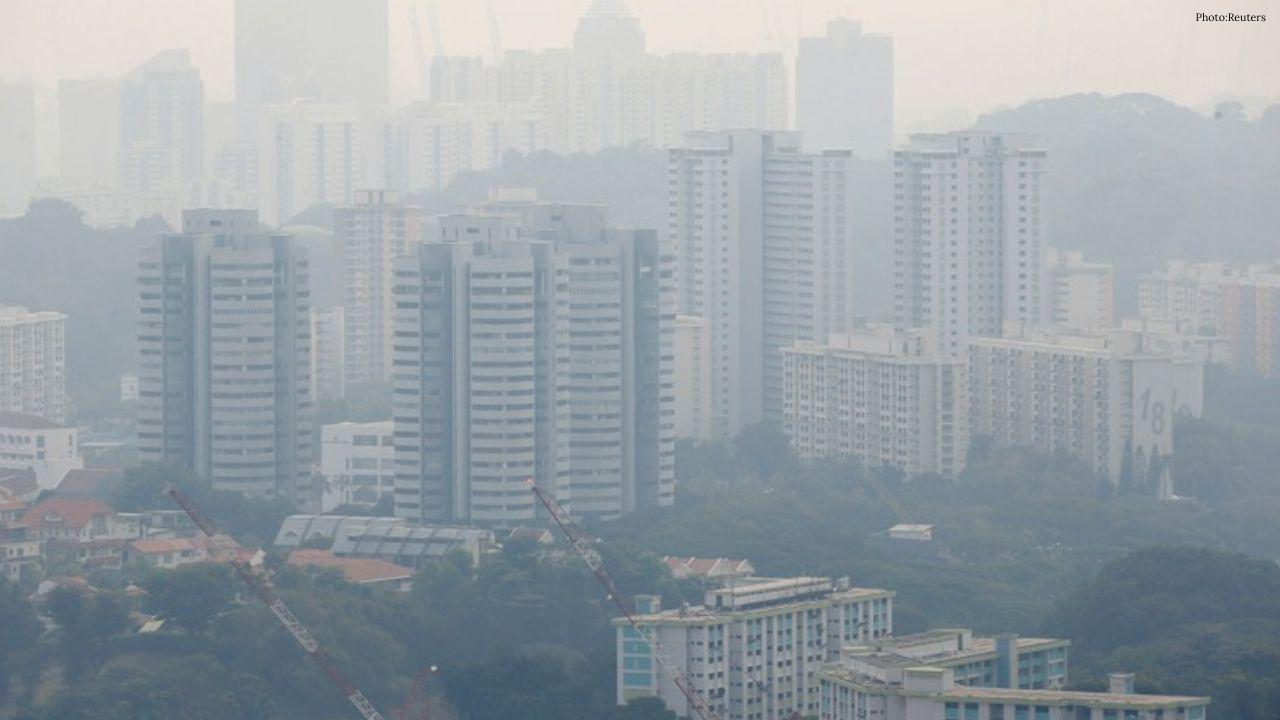
SINGAPORE: Air quality in central Singapore has once again moved into the unhealthy range as hazy conditions continue to affect the city-state. The deterioration came after smoke from fires in parts of Indonesia continued to drift towards Singapore, while dry weather in parts of the region increased the likelihood of haze remaining in the atmosphere. According to the National Environment Agency, the 24-hour air quality reading in the central region crossed the unhealthy threshold late on Wednesday night. The reading reached 102 at 11pm before rising further during Thursday morning. By 6am on Thursday, the reading had climbed to 104. It then fluctuated slightly through the day and stood at 103 at 7pm.
The latest episode has been linked to smoke plumes from fires in Indonesia. The National Environment Agency said moderate to dense smoke continued to be detected over southern Sumatra and Kalimantan. Some of the smoke from southern Sumatra was carried towards Singapore, contributing to the deterioration in conditions over the central region. The situation is also being influenced by weather conditions. Although some rainfall is expected over parts of central and northern Sumatra, relatively dry conditions are expected to continue over southern Sumatra and Kalimantan. If fires remain active in those areas, Singapore could continue to experience periods of reduced air quality. The development is particularly significant because the country had already experienced unhealthy readings earlier in September. The latest Singapore haze episode therefore represents a return of poor conditions after a temporary improvement.
Singapore uses the 24-hour Pollutant Standards Index, or PSI, as an indicator of daily air quality. The index also forms the basis for health-related advisories issued by the National Environment Agency. A reading between 101 and 200 is classified as unhealthy. The central region's reading of 103 therefore places it just inside the unhealthy category. The next category, from 201 to 300, is considered very unhealthy, while readings above 300 are classified as hazardous. The PSI takes several pollutants into account, including fine particulate matter, particulate matter, ozone, sulphur dioxide, nitrogen dioxide and carbon monoxide. Among these pollutants, fine particulate matter is particularly important during haze episodes because tiny particles can remain suspended in the air and enter the respiratory system.
Yes. A 24-hour PSI reading between 101 and 200 falls within the unhealthy range. With the central region recording 103, people in the affected area may need to take greater care, particularly if haze levels rise further. The impact can vary from person to person. People who are sensitive to air pollution may experience discomfort when exposed to hazy conditions, especially during prolonged outdoor activity. Residents can monitor official advisories and consider reducing unnecessary outdoor exposure when conditions deteriorate.
The haze affecting Singapore is linked to smoke from fires in Indonesia, particularly areas of Sumatra and Kalimantan. Wind patterns can carry smoke across national borders, making air quality in Singapore dependent partly on conditions in neighbouring areas. The National Environment Agency has forecast air quality ranging from the higher end of the moderate category to the lower end of the unhealthy range. This means conditions could fluctuate over the coming days depending on rainfall, wind direction and fire activity. Dry conditions in southern Sumatra and Kalimantan remain a concern because they can allow existing fires to continue and increase the amount of smoke entering the atmosphere.
The latest deterioration follows an earlier episode of poor air quality at the beginning of September. On Sep 4, the central region recorded a 24-hour PSI as high as 123, marking the first time since 2023 that the reading had entered the unhealthy range. The situation later improved, with air quality returning to the moderate category. However, the improvement was temporary as the central region once again crossed the unhealthy threshold on Wednesday night. The earlier deterioration prompted the National Environment Agency to begin issuing daily haze advisories. These updates provide residents with information about current conditions and expected air quality for the following period.
People can follow official air-quality updates before planning outdoor activities. Those who are particularly sensitive to polluted air may consider limiting prolonged or strenuous outdoor activity when conditions worsen. The public can also keep track of changes in the 24-hour PSI and related health guidance rather than relying only on how visible the haze appears. The Singapore air quality situation can change throughout the day because the PSI reflects conditions over a 24-hour period. A relatively clear-looking environment does not necessarily mean that pollutant levels have returned to normal. The air quality Singapore situation will therefore remain dependent on regional weather conditions and the persistence of fires in Indonesia.
Read Also: Thailand to increase tax on EV imports, official says
The continuing movement of smoke from Indonesia demonstrates the regional nature of the problem. Haze generated by fires can travel across borders when wind conditions are favourable for the movement of smoke. For Singapore, the risk is especially important during prolonged dry periods across neighbouring areas. The current Indonesia fires are therefore being closely watched because continued fire activity could lead to further smoke reaching Singapore. Weather conditions will also play an important role. Rainfall in affected areas could help reduce fire activity and improve air conditions, while continued dryness could prolong the problem.
The near-term outlook remains uncertain because air quality depends on several factors developing at the same time. These include the intensity of fires in Indonesia, wind direction, rainfall and the movement of smoke plumes. The haze Singapore situation could therefore improve if rainfall increases or winds shift, but conditions could deteriorate again if fires continue and smoke is transported towards the island.






Singapore Haze Returns as Central Region Air Quality Turns Unhealthy
Singapore haze returns as central air quality worsens, with Singapore air quality entering the unhea

Thailand to increase tax on EV imports, official says
Thailand will raise EV import tax to encourage local EV production, with different rates based on ve

Samsung Prepares for Apple’s Foldable iPhone Challenge in Global Market
Samsung faces Apple’s $1,999 foldable iPhone as the foldable phone market heats up, with Samsung Gal

Kimi Raikkonen's Son Robin Joins Red Bull Driver Development Programme
Kimi Raikkonen's son Robin joins the Red Bull Junior Team, marking a major step in his karting caree

Lionel Messi Agrees Deal to Buy Spanish Second-Tier Club Eldense
Lionel Messi agrees to buy Spanish club Eldense as he expands his football ownership portfolio with

Santner rejects BBL deal to focus on New Zealand schedule
Mitchell Santner rejects a lucrative BBL deal to focus on New Zealand cricket, captaincy and upcomin