You have not yet added any article to your bookmarks!
Join 10k+ people to get notified about new posts, news and tips.
Do not worry we don't spam!
Post by : Samjeet Ariff
When reminiscing about the 1950s, most envision a less complicated time, far from the grasp of smartphones and instant messaging. Yet, this era was remarkably advanced, teeming with pioneering communication tools and rapid innovations that subsequently influenced our modern digital lifestyle. Early computers, long-distance phone services, and data transmission systems of the 1950s set the groundwork for today's connected society.
Even without the luxury of mobile technology, rapid long-distance communication was a reality.
The global phone infrastructure grew substantially. Calls that used to take hours were now almost instantaneous with the advent of automated switching systems, making the process faster and more private as electromechanical switches took over from human operators.
Innovative networks of coaxial cables and microwave relay towers allowed entire urban areas and nations to connect seamlessly, enabling multiple conversations to occur simultaneously, thereby improving both speed and reliability in personal and business communication.
By the mid-1950s, television had risen to prominence as the principal source of information and entertainment in various countries.
TV outpaced newspapers in delivering news and made live broadcasts a reality, enabling millions to engage with shared national events as they unfolded. Cutting-edge transmission towers and early satellite-like systems positioned television as one of the decade's premier communication technologies.
Before the days of Wi-Fi and mobile data, radio played a crucial role in providing immediate global communication.
Shortwave radio facilitated global conversations, delivering weather reports, maritime communication, and emergency announcements in real time. Amateur radio enthusiasts forged international connections long before the internet came into play, laying the groundwork for wireless mass communication.
Though often associated with the 1990s, the technology behind fax machines has its roots in the 1950s.
Documents were converted into electronic signals and transmitted via telephone lines, where they were reconstructed instantly by the receiving machine. Businesses relied on fax machines for various urgent communications, marking a significant advancement before today's digital methods.
Despite their size and cost, computers were developing at a remarkable pace.
They processed data beyond human capability, automating telecommunication networks and finding uses in weather forecasting and military communications. The UNIVAC computer captured attention by accurately predicting the outcome of the 1952 U.S. election, showcasing the power of data-driven communication.
Telex emerged as a vital communication tool, resembling today's digital messaging systems.
Messages typed on a keyboard were transmitted through teleprinter networks and printed instantly at the recipient's end. This technology enabled real-time exchanges of essential information among businesses and government entities across borders.
Before email entered the scene, air mail was a speedy method for message delivery.
Dedicated aircraft designed for mail transport and streamline routing systems ensured quick delivery. International letters often reached major cities in just 24 to 48 hours, a remarkable feat prior to digital communication.
The latter part of the 1950s witnessed the launch of Sputnik, marking the dawn of artificial satellite communication.
This event opened doors to global wireless transmission, laying the foundation for technologies such as satellite phones and GPS. The groundwork laid in the '50s was crucial for future advancements in global connectivity.
Various high-tech systems from the 1950s originated from military research.
Radar systems for navigation, secure communication channels, and early networking models were all developed during this time. Many of today’s communication technologies emerged from these military advancements.
Even everyday communication tools in homes were more advanced than one might expect.
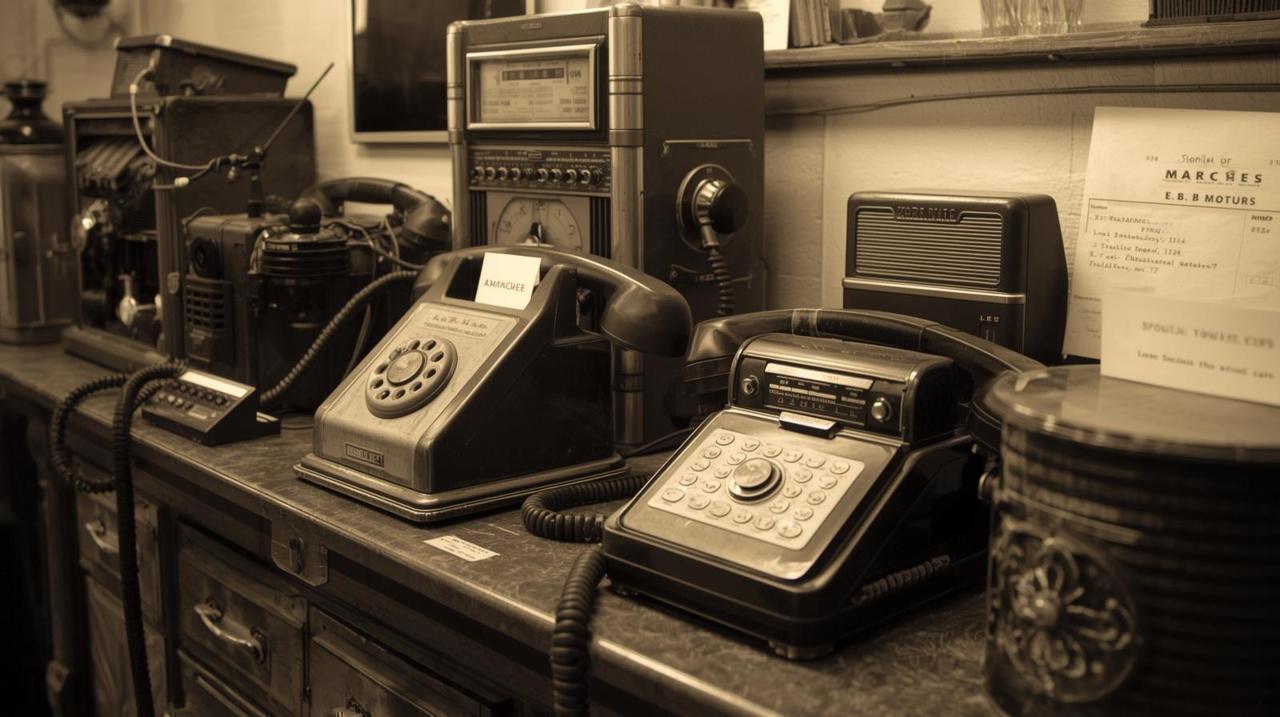
Testing of push-button telephones took place, automatic long-distance dialing became common, and home radios included multiple frequency options. While these devices seem quaint now, they were significant innovations in the 1950s.
The 1950s era was far from a simple, technologically stunted time. It marked the inception of high-speed communication, advanced broadcasting, and early computing, laying the groundwork for modern innovations, including smartphones and social media. Recognizing this period helps us appreciate how technological progress is incremental, with many of today's conveniences stemming from decades of pioneering efforts.
This article serves informational purposes and delves into the historical communication technologies of the 1950s. It should not be considered professional or technical advice. Though the information is based on established historical facts, readers are encouraged to independently verify details when utilizing this content for research or academic endeavors.










Jacob Bethell Returns as England Name Squads for Australia Tour
England name ODI and T20 squads for the Australia tour, with Jacob Bethell returning from injury and

Beauden Barrett Opens Up About Mental Struggles During All Blacks Exile
Beauden Barrett discusses his confidence struggles after missing six tests, his return against Austr

IMF Says AI Investment Supports Global Growth Despite Energy Shock
IMF says AI investment is supporting global growth near 3%, with Asian economies benefiting from ris

Will O'Rourke Ruled Out of New Zealand's India Series
New Zealand fast bowler Will O'Rourke will miss the India series with hamstring and calf injuries as

AI Companies Expected to Drive Most US Earnings Growth in Q3
AI companies are expected to drive US third-quarter earnings growth as investors assess tech profits

Money Market Funds See Record Inflows as Global Bond Selloff Intensifies
Global money market funds attract $153.81 billion as bond yields rise, inflation fears persist and i