You have not yet added any article to your bookmarks!
Join 10k+ people to get notified about new posts, news and tips.
Do not worry we don't spam!
Post by : Rohit Dhiman
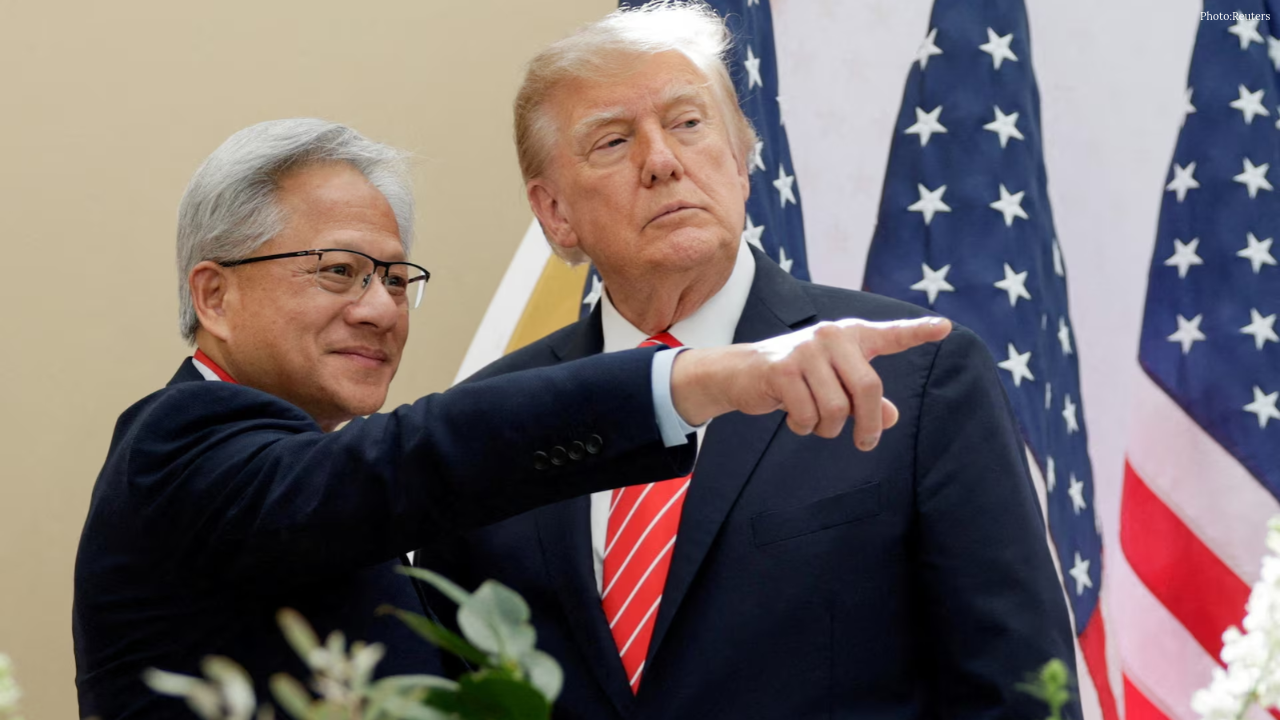
Washington: President Donald Trump has demonstrated that his influence over American politics and corporate decision-making remains significant, even after Republicans suffered a major setback in the midterm elections and Democrats prepared to take control of Congress. His intervention in the leadership dispute at technology giant Nvidia has highlighted his willingness to directly involve himself in decisions involving some of America's most powerful companies. Trump's latest move centred on the reinstatement of Jensen Huang as the chief executive officer of Nvidia. The decision came after the company's board had reportedly ruled against restoring Huang to the position following damaging allegations surrounding his personal associations and concerns about possible connections to Chinese intelligence. The development has attracted attention across Washington, Wall Street and the global technology industry. It has also raised questions about the extent to which a US president can influence the internal decisions of a major private corporation, particularly one that plays a critical role in the global artificial intelligence race.
The controversy surrounding Nvidia's leadership had become increasingly complicated following revelations about Huang's alleged relationships with a woman suspected of having links to Chinese intelligence, along with reports concerning other women. These allegations placed the company's leadership under intense scrutiny and raised concerns about whether the situation could create potential risks for American national security. According to the reports, Nvidia's board had initially decided against bringing Huang back into the CEO position. However, Trump stepped into the controversy and publicly supported his return. During a press conference on Friday, the US president made a strong case for Huang's reinstatement. Rather than allowing the controversy to remain an internal corporate matter, Trump turned the issue into a broader discussion involving national security, American technological leadership and the future of the country's semiconductor industry. The president also sent senior members of his administration to engage with the company's board over the weekend. Their efforts reportedly focused on addressing concerns surrounding Huang's position and convincing board members to reconsider their earlier decision. Shortly before the US stock market opened on Monday, Nvidia announced the leadership reversal. The announcement represented a significant turnaround in a dispute that had appeared to be moving in the opposite direction just days earlier.
Following the announcement, Trump publicly celebrated the outcome and took credit for the decision during an interview with CNBC. In an interview that lasted nearly an hour, the president described Huang as a national treasure and suggested that his administration had played an important role in resolving the concerns that had prevented the CEO's return. Trump said the company's board had wanted clarity on whether Huang's situation presented a national security problem. According to the president, the administration examined the issue and concluded that there was no such problem. He also expressed confidence in Huang's position, indicating that the administration believed the executive was in a strong position to continue leading the company. Trump's remarks were significant because they suggested that the White House had gone beyond offering political support and had actively participated in influencing the outcome of a major corporate leadership dispute. The president's involvement also demonstrated his preference for direct intervention when he believes a company's decisions could affect broader American economic or strategic interests.
Trump's intervention did not end with the announcement of Huang's return. The president also used social media to highlight the outcome through an unusual image referencing the 2024 assassination attempt against him at a political rally in Pennsylvania. The original photograph showed Trump raising his fist after surviving the attack. In the altered version shared by the president, Huang was placed in Trump's position. The image also included a red bra in Huang's hand, apparently referring to the personal controversy that had surrounded the Nvidia executive. The post attracted attention because it combined political symbolism, humour and a reference to the allegations that had threatened Huang's position. The episode illustrated Trump's unconventional approach to public communication. Instead of limiting his response to an official statement, he used a widely recognised political image to portray the reinstatement as a personal and political victory. Presidential historian Thomas Alan Schwartz of Vanderbilt University described the intervention as highly unconventional, particularly because it involved a president directly influencing the leadership of one of America's most important technology companies.
Although Huang's return has resolved the immediate leadership question, concerns about national security have not disappeared. The controversy is particularly sensitive because Nvidia occupies a central position in the global semiconductor and artificial intelligence industries. The company's advanced processors are essential for developing and operating sophisticated artificial intelligence systems. These technologies have applications in commercial computing, scientific research, military operations and other strategically important areas. The possibility that sensitive American technology could reach China through inappropriate channels has therefore become a major concern for US policymakers. Some lawmakers believe that Huang's alleged associations require further examination before the issue can be considered fully resolved. The debate is also connected to the wider rivalry between Washington and Beijing over access to advanced semiconductor technology. The United States has introduced export restrictions and other measures to limit China's access to certain high-performance chips, arguing that unrestricted access could create significant strategic and security risks. Senate Majority Leader John Thune expressed concern about allowing China to obtain America's most advanced semiconductor technology. He warned that such access could create a serious vulnerability for American national security and indicated that stronger export-control measures would be necessary. Former US House Speaker Newt Gingrich, a close political ally of Trump, also questioned the decision to reinstate Huang. In a post on X, Gingrich said there was something seriously wrong with the situation and called on Congress to investigate the matter as a major national security issue.
Trump's intervention could create further political challenges when Democrats assume control of Congress in January. Democratic lawmakers have indicated that they intend to investigate the circumstances surrounding Huang's return and the administration's role in the process. Their concerns extend beyond the company's internal leadership arrangements. Lawmakers are expected to examine whether the administration followed appropriate procedures, how national security assessments were conducted and whether sufficient safeguards were maintained during discussions with Nvidia. Huang is also scheduled to appear for an initial round of testimony at a congressional hearing next week, according to the report. The hearing could become an important opportunity for lawmakers to seek explanations about the allegations, the company's decision-making process and the potential implications for American technology policy. The investigation may also examine how the administration evaluates possible foreign intelligence risks involving executives who lead strategically important American companies. For Democrats, the issue provides an opportunity to scrutinise Trump's expanding involvement in corporate America.
Read Also: Virginia and Oregon Sue SpaceX Over Grok AI Sexual Images
The Nvidia episode is not an isolated example of Trump's involvement in corporate America. Since returning to the White House, Trump has repeatedly taken an active interest in major business decisions, particularly when companies are connected to manufacturing, critical technology, employment or national security. His administration has used a combination of political pressure, negotiations and government agreements to influence the direction of several major American businesses. These interventions have increasingly blurred the traditional boundaries between government policy and private-sector decision-making.
One prominent example involved the proposed acquisition of US Steel by Japan's Nippon Steel. The US$14.9 billion transaction faced significant political resistance after Trump and members of his administration publicly opposed the proposed arrangement. Following negotiations, the Japanese company agreed to an unusual structure that provided the US government with considerable influence over certain future decisions involving the steelmaker. Under the arrangement, the administration gained the authority to appoint a board member and obtain a final say on important matters, including the idling of production facilities, production cuts and the relocation of jobs overseas. The agreement demonstrated how the Trump administration could use national economic interests as leverage in negotiations involving major international companies.
Another important example involved semiconductor manufacturer Intel. Last year, the Trump administration negotiated a 10 per cent stake in the struggling chipmaker through an arrangement that converted government grants into an equity holding. The agreement came after Trump had publicly called for Intel CEO Lip-Bu Tan to resign over concerns about his connections to China. The subsequent arrangement made the US government Intel's largest shareholder. The move was particularly significant because it represented a direct financial relationship between the federal government and one of America's most important semiconductor manufacturers. It also reflected Trump's broader approach of seeking greater government influence over industries considered essential to the country's technological and economic future.
Nvidia has also been involved in another important policy decision concerning China's access to American semiconductor technology. The Trump administration reached an agreement allowing the company to sell its H20 artificial intelligence chips to China in exchange for the US government receiving 15 per cent of those sales. The arrangement highlighted the complicated balance between American commercial interests and national security concerns. On one hand, allowing certain chip sales provides American technology companies with access to an important international market. On the other, the government must consider whether advanced semiconductor products could contribute to China's technological and military capabilities. The agreement demonstrated that Trump's administration was prepared to negotiate directly with major technology companies over how their products could be sold internationally.
Pentagon's Growing Role in the Rare Earth Industry
The administration has also moved to strengthen America's position in the supply of rare earth materials, which are essential for several advanced manufacturing industries. Under another agreement, the Pentagon became the largest shareholder in MP Materials, a company involved in rare earth mining. The objective was to increase the production of rare earth magnets and strengthen domestic supply chains. These materials are important for defence equipment, electric vehicles, electronics and other advanced technologies. Reducing dependence on foreign suppliers, particularly China, has become an important part of Washington's broader economic and national security strategy.
The significance of Trump's intervention becomes clearer when considering Nvidia's position in the global technology market. Nvidia is one of the most influential companies in the semiconductor industry. Its graphics processing units and specialised computing platforms are widely used in artificial intelligence development, large-scale data centres, scientific research and advanced computing. As demand for artificial intelligence continues to increase, access to powerful processors has become a major source of international economic competition. The United States wants to maintain its leadership in this sector, while China is investing heavily in developing its own semiconductor manufacturing capabilities. This competition has made companies such as Nvidia strategically important beyond their commercial value. Decisions involving the company's leadership, technology exports and international partnerships can have consequences for American economic policy and relations with other countries. That is why Huang's reinstatement has become more than a corporate management story. It has developed into a wider debate about the relationship between political authority, private businesses and national security.
The political timing of the Nvidia decision is also important. The Republican Party's midterm election setback has raised questions about Trump's ability to influence Washington during the remaining period before Democrats take control of Congress. Traditionally, a president entering the final phase of political power with a hostile Congress is often described as a lame-duck president. Such a situation can reduce the administration's ability to pass legislation and advance its political agenda. However, the Nvidia episode suggests that Trump's influence may extend beyond the legislative process. A president can still use executive authority, government agencies, public pressure, negotiations and relationships with business leaders to influence major developments. Trump's intervention also demonstrates that political power in Washington is not limited to the number of seats a party controls in Congress. His ability to place corporate decisions at the centre of national discussions gives him another avenue through which to influence economic and strategic policy. However, this approach also carries risks. Direct government involvement in private-sector decisions can lead to questions about transparency, corporate independence, accountability and the proper limits of presidential authority.
The return of Jensen Huang to Nvidia's leadership has brought together several major issues shaping the current international landscape: American politics, artificial intelligence, semiconductor competition, US-China relations and national security. For Trump, the outcome represents an opportunity to demonstrate that he remains capable of influencing important decisions even after his party's electoral setback. For Nvidia, the decision places the company back at the centre of discussions about technological leadership and international security. For lawmakers, the matter raises questions about how the government should respond when the leadership of a private company becomes connected to possible intelligence risks. The bigger question is whether Trump's increasingly direct involvement in major corporate decisions will become a lasting feature of American economic policy. As Democrats prepare to investigate the Nvidia episode and US-China technology tensions continue, the consequences of this intervention could extend well beyond the company's boardroom.






Shubman Gill Wants Bowler-Friendly Pitch for 2nd Test
Shubman Gill wants a bowler-friendly Christchurch pitch as India prepare to bounce back after a draw

Cadillac Targets F1 Progress After Difficult Debut Season
Cadillac F1 retains Valtteri Bottas for 2027 as Dan Towriss focuses on team stability, performance a

GTA 6 Launches Worldwide After 13 Years With a New Vice City Story
GTA 6 arrives after 13 years with Jason and Lucia, a new Vice City world, immersive gameplay, major

Arda Guler Signs Six-Year Real Madrid Contract Extension Until 2032
Arda Guler signs a new six-year Real Madrid deal, extending his stay until 2032 after an impressive
APEC Members Emphasise Safe and Responsible Use of Artificial Intelligence
APEC members discuss responsible AI use, digital innovation and data governance as China and the US
Union of European Clubs Challenge UEFA and EFC Over EU Competition Rules
UEC files an EU competition complaint against UEFA and EFC, challenging club representation, governa