You have not yet added any article to your bookmarks!
Join 10k+ people to get notified about new posts, news and tips.
Do not worry we don't spam!
Post by : Rameen Ariff
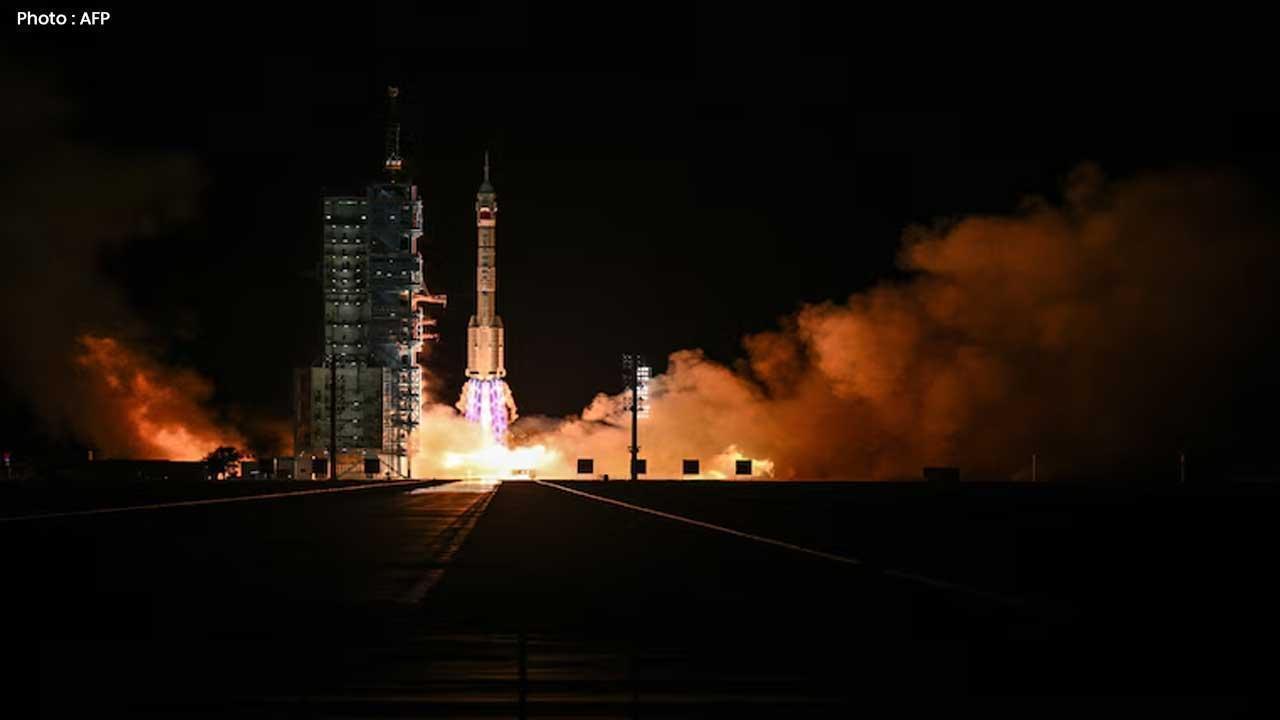
China took another leap in its ambitious space journey as the Shenzhou-21 mission lifted off late Friday night, carrying three astronauts — including the country’s youngest space traveler — and four lab mice to the Tiangong space station.
The Long March-2F rocket ignited at 11:44 p.m. local time (1544 GMT) from the Jiuquan Satellite Launch Center in northwest China, marking yet another milestone in Beijing’s rapidly growing space program.
The new crew includes mission commander Zhang Lu, a seasoned space pilot; Wu Fei, a 32-year-old flight engineer who has become China’s youngest astronaut to fly into space; and Zhang Hongzhang, a 39-year-old payload specialist.
As they waved goodbye to their families and colleagues at the remote desert launch site, a military band played a patriotic song — a scene that reflected both pride and progress in China’s pursuit of its “space dream.”
Wu Fei, on his first mission, expressed his excitement before the launch, saying he felt “incomparably lucky” to represent his country in space. Commander Zhang Lu added that the team would “report back to our motherland and its people with complete success.”
The mission also includes a first for China’s space program — four lab mice, two male and two female, sent for the country’s inaugural in-orbit biological experiment involving rodents. Scientists hope the research will provide deeper insights into how microgravity affects living organisms.
The Shenzhou-21 spacecraft is expected to dock with Tiangong approximately three and a half hours after takeoff. Once aboard, the crew will conduct a variety of scientific experiments, spacewalks, and maintenance tasks, including installing anti-debris shields on the station’s exterior.
Under President Xi Jinping’s leadership, China has accelerated its efforts to realize its long-term “space dream.” The nation became the third in history to send humans into orbit after the United States and the former Soviet Union. It has since achieved remarkable milestones, including landing the Chang’e-4 probe on the far side of the Moon in 2019 and a robotic rover on Mars in 2021.
The China Manned Space Agency (CMSA) announced that the crew will also participate in educational outreach activities, encouraging youth to pursue science and space exploration.
Looking ahead, China plans to send a crewed mission to the Moon by 2030 and build a permanent lunar base, cementing its position as a major space power.
Excluded from the International Space Station (ISS) since 2011 due to U.S. restrictions on collaboration with NASA, China has worked to expand international partnerships in space. Earlier this year, it signed an agreement with Pakistan to train and recruit the first foreign “taikonauts.”
As the Shenzhou-21 mission embarks on its journey, it not only strengthens China’s scientific capabilities but also symbolizes a new era of exploration — one that brings the nation closer to its dream of reaching the Moon and beyond.







Rabada Misses First Australia Test as South Africa Pick Two Spinners
Kagiso Rabada misses the opener as South Africa vs Australia begins, with Anrich Nortje returning an

Starc Compares Australia's Tough Year to McIlroy's Major Sweep
Mitchell Starc says Australia winning three away Test series and the World Cup would match Rory McIl

France’s Sesterce Plans $11 Billion AI Data Centre in Finland
Sesterce plans a $11 billion AI data centre in Finland, with major expansion, green energy plans and

Danaher to Launch AI-Powered Autonomous Research Lab in 2027
Danaher plans an AI research lab for 2027, combining robotics and automation to speed up drug discov

Musk Welcomes German Support for Tesla Driver Assistance Tech as EU Approval Push Continues
Elon Musk welcomes Germany's backing for Tesla FSD as the company seeks EU approval amid speed, safe
Microsoft and Nvidia CEOs to Unveil AI Laptop at San Francisco Event
Microsoft and Nvidia showcase a new AI laptop with RTX Spark chips as they push powerful local AI co