You have not yet added any article to your bookmarks!
Join 10k+ people to get notified about new posts, news and tips.
Do not worry we don't spam!
Post by : Saif Rahman
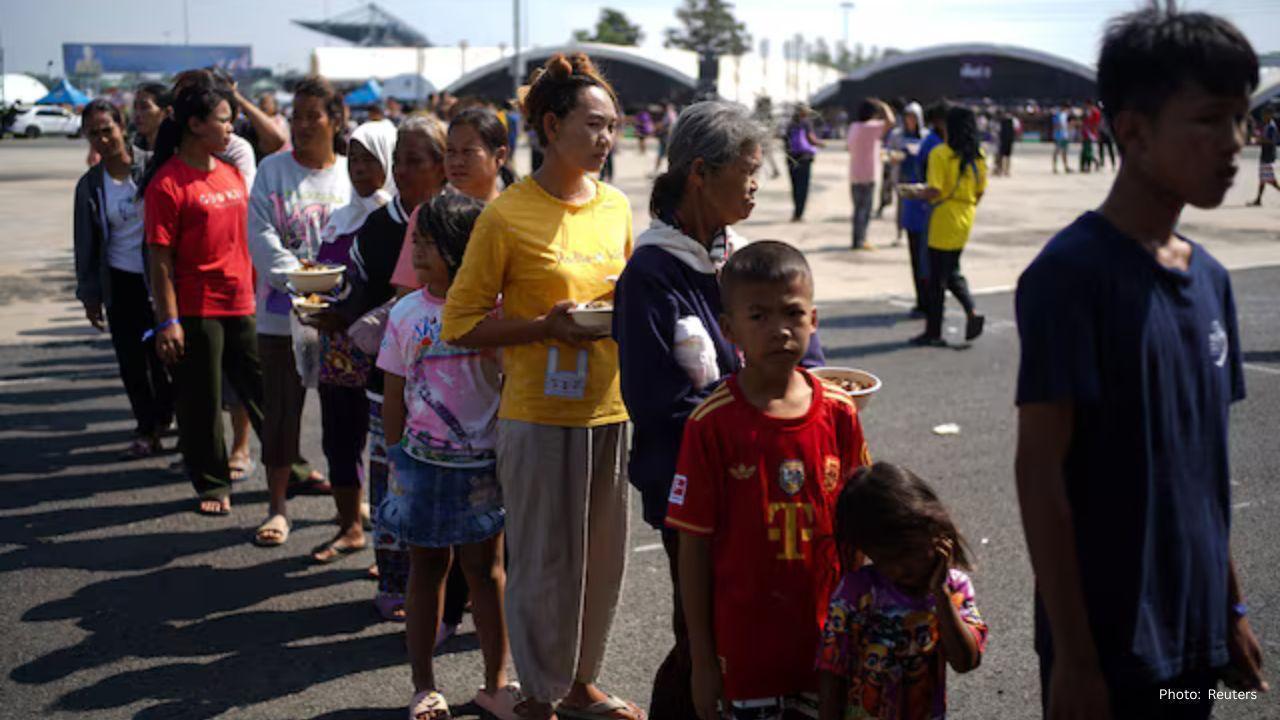
Recent skirmishes between Thailand and Cambodia have plunged countless families into chaos and despair. Residents near the contentious border were caught off guard as gunfire erupted, leading many to flee with minimal possessions. Currently, they are enduring harsh conditions in packed shelters with severe food and clean water shortages.
Chay Rey, a 54-year-old casino worker, recalled the harrowing moment of fleeing her home as gunfire rang overhead. Now, she finds herself sharing a temple in Srei Snam town with around 500 others who escaped the turmoil. While fear has turned into a new challenge of hunger and thirst, she laments, “There is no rice, no money, and no safe drinking water.” Children are left asking for food, while many parents can only respond with empty hands.
The unfolding crisis has forced over 130,000 people across six Cambodian provinces into more than 100 evacuation centers. Aid organizations report a critical gap in support, as new arrivals surge faster than assistance can be mobilized. This situation is reportedly graver than the previous flare-up in July, which impacted only two provinces. Now, over 800,000 Cambodian workers have returned from Thailand due to the unrest, straining local resources even further.
According to Janes Imanuel Ginting, national director of World Vision in Cambodia, the most urgent issues include access to food, clean drinking water, adequate shelter, and sanitation. Families are subsisting on limited supplies such as instant noodles and small rations of rice provided by local initiatives and donations. Humanitarian efforts have commenced, but the escalating demand far exceeds what can be offered at this time. If fighting persists, the situation is likely to deteriorate further.
A poignant reflection comes from 53-year-old Linh Thoem, who left his children behind to seek asylum with relatives. He fears for their safety but is equally torn about the fate of their cattle, which serve as their primary means of income. If the violence escalates further, he may have no option but to return to get them, risking everything.
His current shelter is equipped with running water, food, and medical personnel, yet he is deeply concerned that resources could dwindle if more displaced individuals continue to arrive or if violence persists. Even small provisions he managed to bring will run out quickly if the conflict continues.
The historic tensions between these two nations often erupt into violence, but the current level of displacement and suffering is unprecedented. The extreme urgency of the evacuations and the sheer number of new arrivals have created a humanitarian crisis that demands immediate action. Most of those displaced originated from humble villages, and now find themselves enduring life in makeshift shelters with virtually nothing.
Children, elderly individuals, and women are among the most vulnerable, often having to walk long distances in oppressive heat while carrying their meager belongings. Many reached the shelters sick and fatigued. Aid workers highlight the looming threat of diseases due to inadequate sanitation and access to clean water, worried about the impact on family health.
As gunfire echoes in distant areas, tension mounts within the shelters. Many cling to radio updates or await news from family members, holding on to hope. Others are seen praying for peace at local temples. Currently, there is little indication of when the conflict will cease.
This crisis starkly illustrates how border disputes unrelentingly affect ordinary citizens. While political leaders engage in blame games, it is the villagers who endure displacement, loss of livelihood, and insecurity. Humanitarian aid is urgently needed for families not only to survive but to rebuild their lives when tranquility eventually returns.
The burden of addressing this dire situation now falls to international organizations and neighboring countries, prompting an increase in assistance as the humanitarian crisis deepens. Urgent supplies of food, water, medical aid, and temporary accommodations are paramount to alleviate the suffering of the displaced.
The Cambodian populace did not invite this crisis; they seek safety, dignity, and the opportunity to return home. Until calm is restored to the border, their plight will persist, highlighting the global responsibility to respond to this urgent humanitarian need.






Josh Kerr and Jakob Ingebrigtsen Set for 1,500m Rivalry Rematch
Josh Kerr and Jakob Ingebrigtsen will renew their 1,500m rivalry at the Ultimate Championship in Bud

PSG Coach Luis Enrique Urges Players to Step Outside Comfort Zone
PSG coach Luis Enrique says players must leave their comfort zone and keep improving as the club tar

China’s Tiangong Sets New 400m Record at Robot Olympics
China’s Tiangong robot sets a new 400m record at the Robot Olympics, beating a South African robot i

George Russell Wins Dutch GP Sprint, Boosts Mercedes Morale
George Russell wins the Dutch GP Sprint from pole as Mercedes teammate Kimi Antonelli extends his F1

Australia 50/3 After Bangladesh Bowled Out for 64 in Second Test
Australia reached 50/3 after Bangladesh were bowled out for 64 in the second Test, with Mitchell Sta

Jordan Burroughs Returns to Wrestling with 2028 Olympic Dream
Jordan Burroughs returns to wrestling with Real American Freestyle as the Olympic champion eyes a po