
You have not yet added any article to your bookmarks!
Join 10k+ people to get notified about new posts, news and tips.
Do not worry we don't spam!
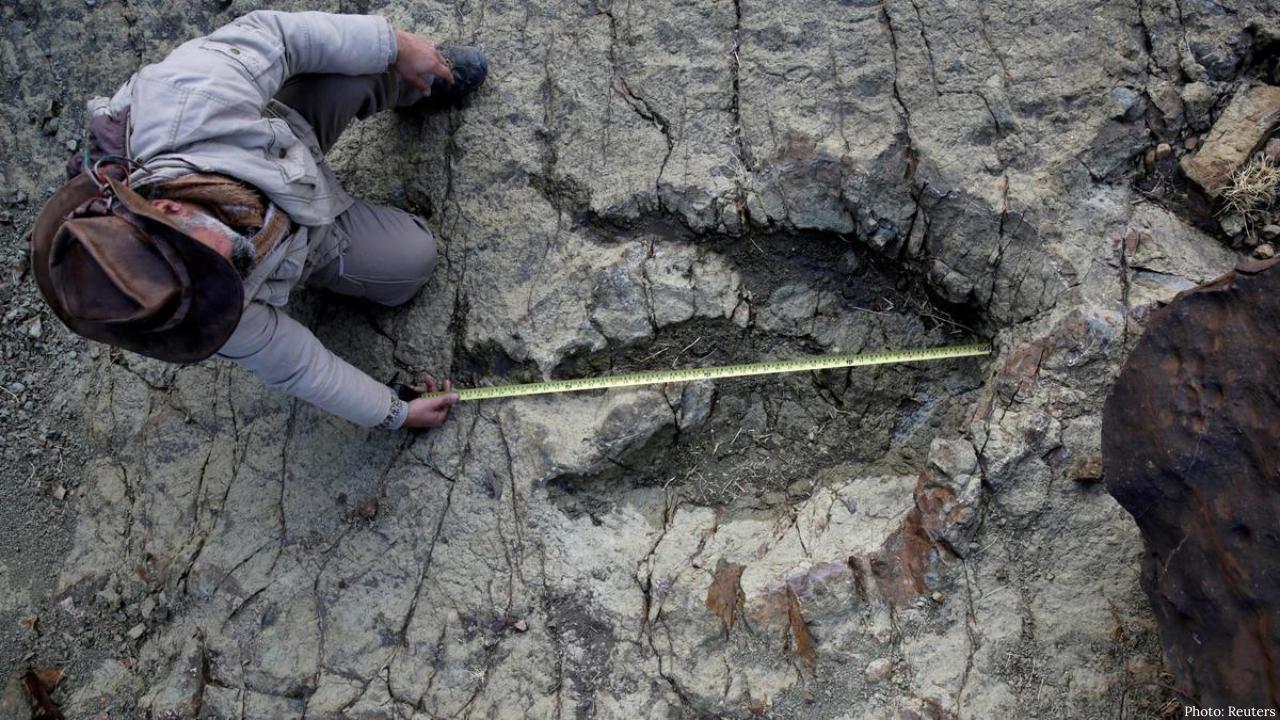
Post by : Anis Farhan
For more than a century, dinosaur footprints have fascinated scientists and the public alike. Some trackways stretch across ancient rock beds like frozen moments in time, capturing the movement of animals that vanished tens of millions of years ago. Yet despite their value, fossil footprints have long carried a frustrating limitation: it is often extremely difficult to know exactly which dinosaur species made them.
Now, researchers say a new artificial intelligence method is helping bridge that gap. By using advanced pattern recognition and statistical analysis, the system can compare fossil footprints with known skeletal and anatomical data, improving the ability of palaeontologists to identify the likely trackmaker. The breakthrough is being described as a major step for ichnology — the branch of science that studies fossil tracks and traces — and could unlock fresh understanding of dinosaur behaviour, ecosystems and evolution.
The development is especially important because footprints are far more common than bones in many fossil sites. In some locations, dinosaur tracks are abundant while skeletal remains are rare or completely absent. That imbalance has forced scientists to rely on educated guesses, indirect comparisons and broad classifications for decades. Artificial intelligence, researchers argue, may finally provide a more consistent and evidence-based way to match the right dinosaur to the right footprint.
Fossil footprints are not just “cool imprints.” They are among the most direct evidence of how dinosaurs lived.
Unlike bones, which show anatomy, footprints show movement and interaction with the environment. A footprint can reveal:
How fast a dinosaur was moving
Whether it walked alone or in groups
How its weight was distributed
Whether it limped or had an injury
The shape and size of its feet
The kind of ground it walked on
A long sequence of footprints, called a trackway, can even suggest social behaviour. Parallel trackways, for example, may hint at herding, while sudden changes in direction can suggest pursuit, avoidance, or feeding patterns.
In short, footprints are like a prehistoric surveillance record. But until now, scientists often struggled to identify the “person” in the footage.
One of the biggest puzzles in palaeontology is the mismatch between footprints and skeletons.
A fossil footprint is technically called an ichnofossil, meaning it is a trace of life rather than a body part. It is evidence that an animal existed and moved in a certain way, but it does not always tell researchers which exact species made it.
This is because many dinosaurs had broadly similar feet. In particular:
Many theropods (meat-eating dinosaurs) had three-toed feet with claws
Many ornithopods (plant-eaters like Iguanodon relatives) also left three-toed prints
Footprints change shape depending on mud, sand, or rock hardness
Erosion can distort prints over millions of years
Footprints can vary depending on speed, turning, or slipping
As a result, footprints are often classified into ichnospecies — categories based on footprint shape rather than the dinosaur’s actual biological species. This system is useful but limited because it separates track science from bone science.
Researchers have wanted a more direct link between tracks and trackmakers for decades.
The new method uses artificial intelligence to analyse footprints in a way that goes beyond human visual judgement.
Instead of relying mainly on expert interpretation, the AI system processes measurable features of the footprint, such as:
Toe length and width
Toe angles and spacing
Heel shape and size
Claw impression placement
Overall footprint proportions
Depth and pressure distribution patterns
Once the footprint is converted into data, the system compares it with known patterns from dinosaur foot anatomy and fossil evidence.
The AI does not simply “guess.” It calculates which dinosaur group is statistically most likely to match the footprint, based on how closely the footprint features align with known skeletal structures.
This is similar to how modern AI tools can recognise faces or fingerprints, but adapted for ancient fossil traces.
Traditional footprint identification relies heavily on expert experience. Skilled ichnologists can often distinguish broad categories, such as whether a footprint belongs to a theropod or an ornithopod.
However, narrowing it down to specific species is far harder.
AI can help because it:
Detects subtle differences humans may overlook
Processes thousands of measurements consistently
Avoids fatigue or bias
Handles complex multidimensional comparisons
Improves accuracy as more data is added
In many sciences, AI is already being used for pattern recognition tasks, from detecting cancer in scans to identifying galaxies in space images. Dinosaur footprints, researchers say, are another perfect match for this approach because they contain complex shape information.
AI does not work automatically. It must be trained.
To train an AI system for footprints, researchers typically need:
High-quality images or 3D scans of footprints
A large dataset of different footprint types
Measurements linked to known dinosaur anatomy
Labels and classifications verified by experts
3D scanning is especially important because footprint depth matters. A shallow print on hard ground may look different from a deep print in soft mud, even if made by the same animal.
By scanning footprints in three dimensions, researchers can capture pressure patterns, toe depth differences, and subtle ridges that are invisible in photographs.
Once the system has enough data, it can begin recognising recurring footprint “signatures” and matching them to known dinosaur groups.
The biggest scientific leap in this method is the attempt to reconnect footprint evidence with actual dinosaur identity.
If AI can reliably link a footprint to a dinosaur species or family, it could solve a problem that has limited palaeontology for generations.
This matters because fossil sites often contain:
Many trackways
Few or no bones
Unclear environmental context
In such cases, footprints may be the only evidence of what dinosaurs lived in the area. If those tracks can be identified more precisely, researchers can reconstruct ancient ecosystems with much greater confidence.
If widely adopted, the AI approach could reshape several major areas of dinosaur science.
Knowing which dinosaurs lived together helps scientists understand food chains.
For example:
Which predators hunted which prey
Whether certain herbivores lived in herds
How many species coexisted in one region
Whether dinosaurs migrated seasonally
Footprints can show which animals were present at a specific moment in geological time, sometimes even on the same day, based on track overlap.
Footprints reveal gait, stride length and speed.
If AI can identify the trackmaker, researchers can compare behaviour between species and track how locomotion evolved across different dinosaur groups.
Bones are often found in limited areas, but footprints can appear across wide regions.
This means AI-based footprint identification could expand maps of where certain dinosaurs lived, potentially changing what scientists believe about migration and habitat range.
Footprints can reveal how foot structure changed over time.
If AI can match footprints to groups with known evolutionary relationships, it could provide additional evidence for how dinosaurs adapted to different environments.
While the new method is promising, researchers stress that footprints are not simple objects.
A footprint is influenced by:
The dinosaur’s foot anatomy
The weight of the animal
The speed of movement
The angle of entry into the ground
The moisture content of the sediment
The grain size of sand or mud
Later erosion and compression
This means a footprint is not always a perfect “stamp” of the foot. It is a footprint plus geology.
That is why AI models must be carefully trained and tested, using datasets that include different sediment conditions and preservation styles.
The same AI approach could potentially be applied to other fossil trace evidence.
For example:
Mammal footprints from the Ice Age
Early human footprints in ancient sediments
Reptile and amphibian trackways
Marine trace fossils
The broader scientific value is that AI can help extract more information from trace fossils — which are often underused compared to bones.
Despite the excitement, experts caution that AI is not a magic solution.
Some key limitations remain:
Some dinosaurs are known from only a handful of bones. If their footprints have never been confidently identified, AI has less training data to work with.
A distorted footprint can produce misleading measurements. AI models must learn to separate true anatomy signals from sediment effects.
AI systems can sometimes output confident answers even when uncertainty is high. Scientists must treat results as probability-based, not absolute proof.
Even the best AI models require human palaeontologists to interpret results in geological and biological context.
Researchers emphasise that AI should support experts, not replace them.
Ichnology has often been treated as a separate field from mainstream dinosaur palaeontology. Track specialists use different classification systems, and footprints are sometimes seen as secondary evidence compared to skeletons.
This AI breakthrough could help change that.
By building stronger connections between track evidence and dinosaur identity, footprints may gain new importance as primary scientific data. This could lead to:
More funding for footprint sites
Expanded 3D scanning projects
Better protection of track-bearing rock surfaces
Increased collaboration between track experts and skeletal fossil researchers
In many regions, footprint sites are threatened by erosion, construction and tourism damage. Stronger scientific value could encourage better preservation policies.
The development comes at a time when AI is rapidly spreading across scientific disciplines.
In recent years, AI has been used in palaeontology for:
Reconstructing dinosaur skeletons
Predicting missing bone shapes
Analysing fossil images
Identifying species from partial remains
Mapping fossil site patterns
Footprint identification is one of the most challenging tasks in the field because it involves both biology and geology. Success here suggests AI may be able to handle even more complex fossil problems in the future.
Researchers say the next stage will be expanding datasets and testing the method across different fossil sites worldwide.
The most important future steps include:
Creating global footprint databases
Standardising 3D scanning methods
Comparing AI results with known bone evidence
Publishing open datasets for peer review
Improving models for distorted or incomplete tracks
As more museums, universities and field teams digitise their footprint collections, the AI method is expected to become more accurate and more widely usable.
Dinosaur footprints have always been one of the most dramatic and accessible fossils. They are physical traces of animals that once walked across mudflats, riverbanks and coastal plains. Yet for decades, the identity of the trackmakers behind many footprints remained uncertain.
The new AI method aims to change that by bringing precision, consistency and deeper pattern recognition into footprint analysis. By transforming footprints into measurable data and matching them with known anatomical patterns, the approach could allow scientists to identify trackmakers with greater confidence than ever before.
If the method continues to improve, it may help rewrite parts of dinosaur history — revealing which species lived where, how they moved, and how prehistoric ecosystems functioned when bones are missing.
In a field built on fragments and traces, AI is now helping scientists read the ground beneath the dinosaurs’ feet.
Disclaimer:
This article is intended for informational and educational purposes only. It summarises reported scientific developments and does not represent an official statement from any single research institution. Findings and interpretations may evolve as further peer-reviewed research becomes available.










PM Modi Pays Tribute to Mahatma Gandhi, Urges People to Support Khadi
PM Modi pays tribute to Mahatma Gandhi on Gandhi Jayanti and urges citizens to support Khadi and the

Amazon Seeks to Offload $8 Billion in Nvidia Chips to Investors
Amazon plans to move $8 billion in Nvidia chips to investors, using a new financing model to strengt

Samsung Raises Galaxy S26 Prices as Memory Chip Costs Rise
Samsung raises Galaxy S26 prices in South Korea as rising memory chip costs put pressure on smartpho

Lewis Hamilton Calls Singapore Grand Prix One of F1's Toughest Races
Lewis Hamilton discusses the demanding Singapore Grand Prix and brings Plus44 and Almave to Singapor

Denmark's Pandora Opens World's Largest Jewellery Factory in Vietnam
Pandora opens its largest jewellery factory in Vietnam, expanding global production, strengthening s

Gautam Gambhir Questions Batting-Friendly Pitches After India's Record ODI Chase
Gautam Gambhir questions batting-friendly ODI pitches after India’s record chase, calling for a bett

